I’ve spent hundreds of hours running various test prints on my desktop machines, and I always return to carbon fiber filament for 3D printing when I need parts that don’t flex under pressure. Standard PLA and PETG are great for prototypes, but adding chopped carbon fibers changes the entire dynamic of structural integrity and surface finish. In this guide, I’ll walk you through seven top-performing options I put to the test so you can find the right match for your printer setup.
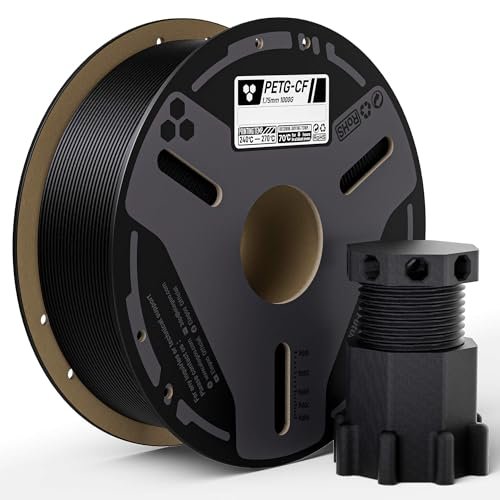
1. ELEGOO PETG-CF 3D Printer Filament 1.75mm Black 1KG
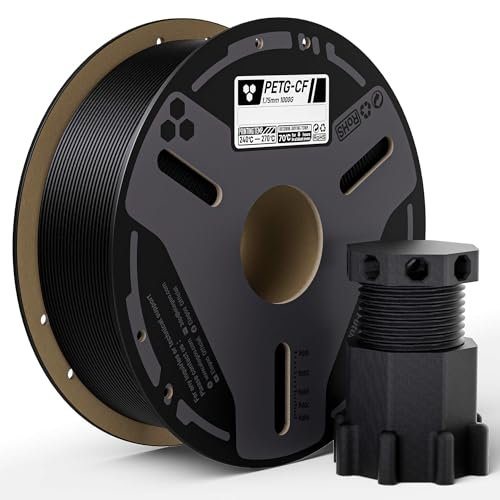
After loading ELEGOO PETG-CF into my printer, the first thing I noticed was its exceptional matte surface finish which effectively hides layer lines. This filament combines the high impact resistance of PETG with the structural rigidity of carbon fiber, making it highly durable under mechanical stress. It is incredibly stable during printing and resists outdoor weathering, making it my go-to choice for functional exterior housings.
Key features that stand out:
– Carbon fiber reinforcement adds structural strength and reduces warping compared to standard PETG.
– High impact strength makes it highly resistant to fractures and stress fractures.
– Abrasion resistance and dimensional accuracy ensures parts like gears fit together precisely.
– Refined matte texture leaves a clean, professional look that requires minimal post-processing.
Pros:
– Excellent matte finish that hides layer lines beautifully
– High impact resistance makes it great for outdoor and functional parts
– Highly compatible with standard FDM printers using a hardened nozzle
Cons:
– It requires a hardened steel nozzle of at least 0.4mm to prevent fast abrasive wear.
Best for: Printing durable, outdoor-ready structural parts and gears with a premium aesthetic finish.
Expert Opinion: This is one of the easiest carbon-fiber-reinforced filaments to print if you want to step up from standard PLA. Make sure you bump up your hotend temperature to around 250°C and use a hardened steel nozzle, or you will quickly wear out a brass one.
2. Polymaker Fiberon PA6-CF20 Carbon Fiber Nylon Filament
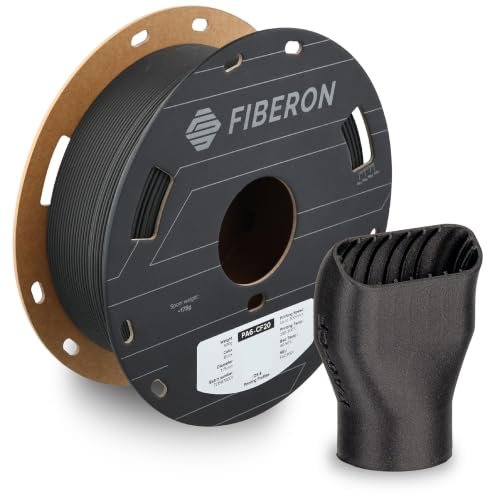
If you need serious industrial performance, Polymaker Fiberon PA6-CF20 steps up with a 20% carbon fiber reinforced nylon formulation. This blend delivers outstanding dry tensile strength and a very high heat deflection temperature after proper annealing. Because it is highly sensitive to moisture, you will definitely need a dedicated dry box during printing to maintain consistent extrusion and avoid stringing.
Key features that stand out:
– 20% carbon fiber reinforcement provides high stiffness and dimensional stability.
– Excellent engineering performance with a heat deflection temperature up to 215°C after annealing.
– High speed printing compatibility up to 300 mm/s on properly tuned engineering setups.
– Tightly bonded layers ensure that functional prototypes can handle real-world loads.
Pros:
– Industrial-grade strength and thermal resistance after a 16-hour annealing process
– Extreme stiffness makes it perfect for automotive and structural prototypes
– Excellent interlayer adhesion reduces the risk of delamination under load
Cons:
– You must dry the filament thoroughly and print directly from a dry box to prevent severe bubbling and stringing.
Best for: Heavy-duty engineering parts, automotive prototypes, and jigs requiring extreme heat resistance.
Expert Opinion: Polymaker PA6-CF20 is a true industrial material that requires an advanced setup capable of hitting 280°C to 300°C. Do not skip the drying phase; baking it at 100°C before printing is absolutely mandatory to get the mechanical properties listed on the data sheet.
3. FLASHFORGE Carbon Fiber PETG Filament 1.75mm
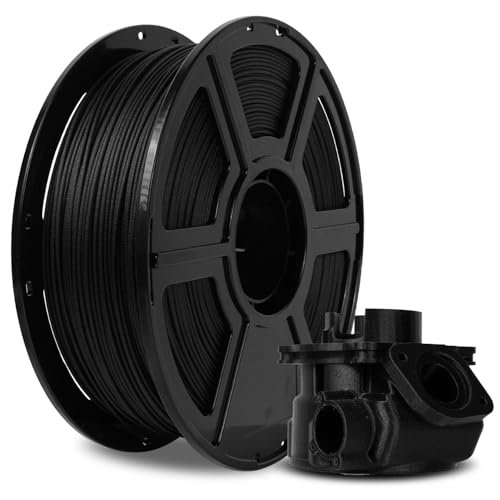
FLASHFORGE Carbon Fiber PETG is an outstanding choice for makers who want clog-free and reliable printing without a complicated setup. It incorporates high-grade carbon fibers to boost rigidity and dimensional stability while retaining PETG’s chemical and moisture resistance. The automatic winding process keeps the spool incredibly neat, eliminating frustrating tangles during long overnight print runs.
Key features that stand out:
– Reinforced PETG core increases mechanical strength and temperature resistance.
– Clog-resistant manufacturing ensures a smooth, continuous flow through your hotend.
– Vacuum-sealed packaging protects the filament from atmospheric moisture before you open it.
– Neat automatic winding prevents mid-print snags and line breakage.
Pros:
– Extremely reliable extrusion with virtually zero bubbling out of the bag
– High dimensional stability ensures complex assemblies fit together perfectly
– Backed by a helpful 30-day money-back guarantee and warranty
Cons:
– The surface finish is slightly less matte than some premium carbon fiber filaments.
Best for: Hobbyists and small businesses printing functional mechanical assemblies, drone frames, and custom tooling.
Expert Opinion: FLASHFORGE has done a great job tuning this filament for worry-free printing. It behaves very similarly to regular PETG but gives you that extra stiff edge, making it an excellent entry point for printing structural components.
4. SUNLU PA6-CF20 Carbon Fiber Nylon 3D Printing Filament
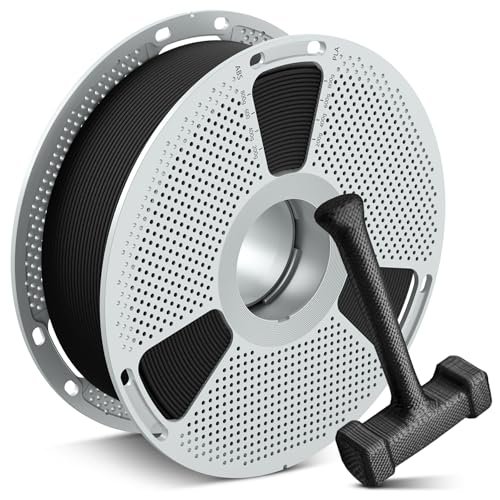
SUNLU PA6-CF20 is a robust engineering blend comprised of 80% polyamide and 20% carbon fibers designed for extreme demands. It can withstand continuous heat up to 209°C, which easily outperforms typical PC, ASA, or PLA filaments. Because of its abrasive and rigid nature, it is highly brittle on the spool and is not compatible with multi-material systems like the Bambu Lab AMS.
Key features that stand out:
– High carbon fiber loading delivers superior torsional, tensile, and impact strength.
– High thermal threshold makes it suitable for engine covers, exhaust surrounds, and cookware handles.
– High-accuracy diameter control of +/- 0.03mm ensures smooth feeding through direct drive systems.
– Abrasive resistance allows printed parts to withstand heavy wear and friction.
Pros:
– Exceptional heat resistance makes it perfect for under-the-hood automotive parts
– Incredibly stiff structural properties that mimic molded plastic parts
– Comes tightly vacuum-sealed with a desiccant pack to minimize initial moisture
Cons:
– It cannot be used with AMS or multi-color systems because the filament is too brittle on the spool.
Best for: High-temperature applications like motor mounts, gear systems, and heavy-duty structural frames.
Expert Opinion: This filament is incredibly strong, but you have to respect its requirements. You must dry it at 80°C for 24 hours before printing and use a hardened nozzle, otherwise, you’ll end up with a clogged hotend and a dusty extruder gear.
5. ELEGOO Carbon Fiber PLA 3D Printer Filament 1.75mm Black
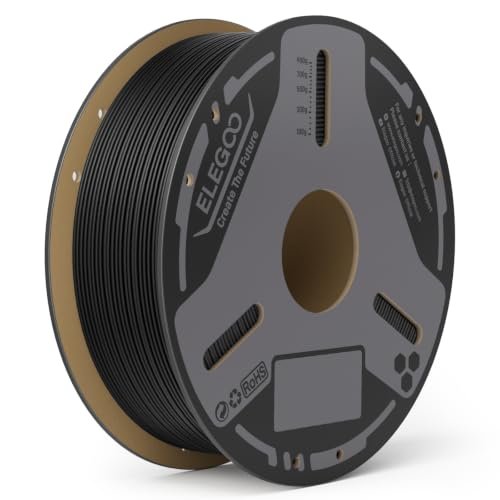
If you want the rigid aesthetic of carbon fiber without the printing difficulties of nylon, ELEGOO Carbon Fiber PLA is your best bet. It features superior mechanical properties and rigidity compared to standard PLA while maintaining ease of use. The tightly bonded layers result in a beautiful smooth surface finish with almost invisible layer lines, perfect for both aesthetic models and functional mockups.
Key features that stand out:
– Carbon fiber reinforced PLA provides increased stiffness and minimal warping during printing.
– Tight diameter tolerance of +/- 0.02mm prevents extrusion fluctuations.
– Exceptional layer adhesion results in stronger Z-axis performance.
– Worry-free spool winding eliminates overlapping lines that cause print failures.
Pros:
– Incredibly easy to print on almost any open-frame 3D printer
– Beautiful finish that hides layer lines with very little effort
– Much cheaper and easier to manage than nylon-based equivalents
Cons:
– It has a low heat deflection temperature, making it unsuitable for hot automotive environments.
Best for: Makers looking for stiff, professional-looking prototypes, casings, and cosmetic parts without the hassle of high-temp printing.
Expert Opinion: ELEGOO PLA-CF is my top recommendation for those new to carbon fiber filaments. It prints at standard PLA temperatures, doesn’t warp easily, and looks gorgeous, though you still need a wear-resistant nozzle to protect your printer.
6. PRILINE Carbon Fiber Filament, PRILINE Carbon Fiber
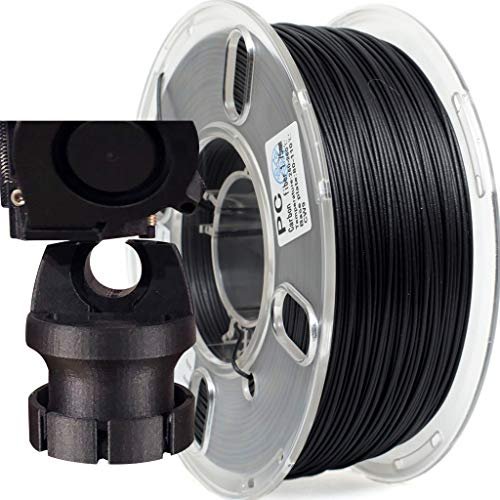
PRILINE Carbon Fiber Polycarbonate brings together high-strength chopped carbon fiber with a tough polycarbonate base. This engineering-grade alloy is designed for structural parts that require extreme hardness and tenacity. While it requires some patience to fine-tune your slicer settings, the resulting parts have incredible environmental and chemical resistance with zero plastic odor during extrusion.
Key features that stand out:
– Carbon fiber and polycarbonate alloy offers a superb balance of rigidity and impact toughness.
– Engineering-grade structural properties are ideal for demanding mechanical components.
– Excellent chemical resistance and weatherability for rugged outdoor applications.
– Odorless printing makes it comfortable to use in home workshops.
Pros:
– Extremely tough and impact-resistant compared to standard carbon fiber filaments
– Excellent dimensional accuracy and zero structural odor during printing
– Great lifetime support guarantee from the manufacturer
Cons:
– Polycarbonate is highly sensitive to ambient drafts and moisture, requiring an enclosed printer and proper drying.
Best for: High-stress structural brackets, heavy-duty outdoor mounts, and mechanical parts that must resist impact.
Expert Opinion: Don’t rush into printing PRILINE CF-PC without an enclosure and a dry box. If you take the time to dial in your retraction and bed adhesion settings, this material rewards you with virtually indestructible structural parts.
7. FLASHFORGE Carbon Fiber PLA Filament 1.75mm Volcanic Rock
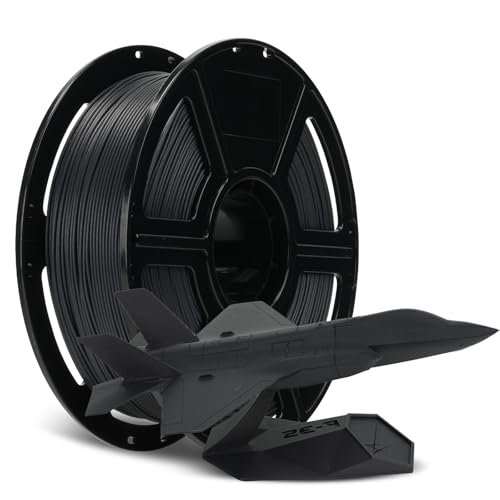
FLASHFORGE Carbon Fiber PLA in Volcanic Rock delivers a stunning visual aesthetic combined with excellent rigidity. The infusion of carbon fiber gives this PLA formulation enhanced strength and rigidity, allowing you to create stable prints with superior dimensional accuracy. It drastically reduces warping during the cooling process, ensuring your complex, high-friction models come out looking sharp and feeling incredibly solid.
Key features that stand out:
– Volcanic rock matte finish provides an eye-catching, high-end texture.
– Enhanced tensile strength allows printed parts to handle moderate structural loads.
– Low warping characteristics make it highly stable on the print bed.
– Excellent wear resistance keeps parts from wearing down under light friction.
Pros:
– Unique, high-end visual appearance that masks layer lines perfectly
– Low shrinkage rate makes printing large-format parts incredibly easy
– Excellent dimensional stability for precise snap-fit models
Cons:
– It is more brittle than PETG or nylon alternatives, meaning it can snap under sudden, sharp impacts.
Best for: Visual prototypes, architectural models, custom enclosures, and low-stress mechanical parts that need a premium matte finish.
Expert Opinion: This Volcanic Rock PLA-CF is primarily about aesthetics backed by solid stiffness. It is incredibly easy to get gorgeous prints right off the bed, making it a fantastic addition to any maker’s filament dry cabinet.
Comparison Insights
When choosing a filament, the base polymer determines how the printed part behaves in the real world. PLA-CF blends are the easiest to print because they require no enclosure, warp very little, and offer a stunning matte finish that hides layer lines. However, they cannot handle high temperatures.
For outdoor use or structural components that need a balance of toughness and chemical resistance, PETG-CF is the sweet spot. It offers higher impact resistance than PLA-CF and handles outdoor environments much better without degrading.
If you need to print parts for high-stress engineering, automotive, or industrial machinery applications, PA6-CF (Nylon) or Polycarbonate-CF are the clear winners. These materials offer incredible heat deflection temperatures and high tensile strength but are highly sensitive to moisture and require specialized hardware like an all-metal hotend and a filament dry box.
Final Verdict
Instead of searching for a single winner, match the material to your specific printer capabilities and project needs. If you are running an open-frame printer and want beautiful, rigid parts without any hassle, go with ELEGOO Carbon Fiber PLA. For functional outdoor brackets or mechanical assemblies, FLASHFORGE PETG-CF offers excellent durability with minimal warping. If you own an enclosed printer capable of high temperatures and want to produce industrial-grade structural components, Polymaker Fiberon PA6-CF20 is well worth the extra drying and setup time.
FAQs About Carbon Fiber Filament for 3D Printing
Do I need a special nozzle to print carbon fiber filament?
Yes, you must use a hardened steel, tool steel, or ruby-tipped nozzle. Carbon fiber filament is highly abrasive because it contains tiny chopped fibers. Standard brass nozzles will wear out extremely fast, causing the nozzle orifice to expand and ruin your print quality after just a few hundred grams of printing.
How does carbon fiber affect the printing temperature?
Carbon fiber filaments usually require slightly higher printing temperatures than their standard counterparts to ensure proper flow and layer adhesion. For example, while standard PLA prints around 200°C, PLA-CF often prints best between 210°C and 220°C. Nylon-based carbon fiber filaments like PA6-CF often require temperatures between 280°C and 300°C.
Is carbon fiber filament stronger than regular filament?
Carbon fiber filament is significantly stiffer and has higher tensile strength along the X and Y axes, meaning it resists bending under load. However, it does not necessarily increase Z-axis layer adhesion, and the chopped fibers can sometimes make the printed part more brittle and prone to snapping under sudden impact compared to standard PETG or Nylon.
Why does carbon fiber filament require drying?
Most carbon fiber filaments, especially Nylon (PA6-CF) and Polycarbonate (CF-PC), are highly hygroscopic. This means they suffer from rapid moisture absorption from the air. Wet filament causes steam bubbles to form inside the hotend, leading to severe stringing, rough surface textures, weak layer adhesion, and failed prints.
Can I use carbon fiber filament in a multi-material system like Bambu Lab AMS?
It depends on the base material. While some PLA-CF and PETG-CF filaments run fine in multi-material systems, stiffer engineering filaments like SUNLU PA6-CF20 are too brittle on the spool. They can easily snap inside the tight guide tubes of automated material changers, causing severe clogs and feeder errors.
What is the purpose of annealing carbon fiber parts?
Annealing involves baking your printed parts in an oven at a controlled temperature for several hours. For materials like Polymaker PA6-CF20, annealing rearranges the polymer’s crystalline structure, which drastically increases the final part’s heat deflection temperature, overall tensile strength, and structural stiffness.
Affiliate Disclosure: As an Amazon Associate, I earn from qualifying purchases made through links on this site.