
When I first started operating on the 2-meter band, I realized fast that the cheap, flimsy coaxial cable I was using was absolutely killing my signal. High frequencies like VHF (30–300 MHz) and UHF (300–3000 MHz) are extremely sensitive to cable quality, especially over long runs. Finding the best coax cable for vhf/uhf isn’t just about finding the right connectors; it’s about minimizing signal loss (attenuation) so your transceiver’s power actually reaches the antenna. This guide reviews five top-performing cables I’ve either used or thoroughly analyzed for reliable performance in amateur radio, marine, and scanning applications.
Contents
- YOTENKO RG58 Coaxial Cable 49.2ft, CB Coax Cable, UHF PL259 Male to Male Coaxial 50 Ohm Coax Low Loss for HF VHF CB Radio, Ham Radio, SWR Meter, Scanner, Antenna Analyzer
- MOOKEERF 15ft UHF Coax Cable, PL259 Male to Male, Low Loss for HAM, VHF Radios & SWR Meter
- Superbat PL-259 UHF CB Coax Cable 10ft CB Antenna Cable RG8X Coaxial Cable PL259 to SO239 Jumper for Marine VHF Ham Radio Antenna Shack Duplexer Tuner Dummy Load SWR Meter etc.
- MOOKEERF PL-259 UHF CB Coax Cable – 10FT, RG58 PL-259 UHF Male to Female Low Loss Antenna Extension Jumper for HAM Radio, Antenna Analyzer, Dummy Load, SWR Meter
- MOOKEERF 50ft KMR400 PL259 Male to Male Coaxial Cable – Low Loss UHF Cable for HAM Radio, VHF Radio, SWR Meter, Antenna Analyzer
- Practical Comparison Short Insights
- Final Verdict: Selecting Your Best Coax Cable
- Frequently Asked Questions About Best Coax Cable for VHF/UHF
- Why does cable quality matter so much more for UHF than for HF?
- What is the difference between RG58, RG8X, and LMR-400 equivalent cables?
- What is the maximum recommended cable length for a VHF radio?
- Should I worry about the inner conductor material (Copper vs. Copper Clad Aluminum)?
- Are PL259 connectors suitable for UHF frequencies?
- How important is weather sealing for outdoor coax connections?
YOTENKO RG58 Coaxial Cable 49.2ft, CB Coax Cable, UHF PL259 Male to Male Coaxial 50 Ohm Coax Low Loss for HF VHF CB Radio, Ham Radio, SWR Meter, Scanner, Antenna Analyzer
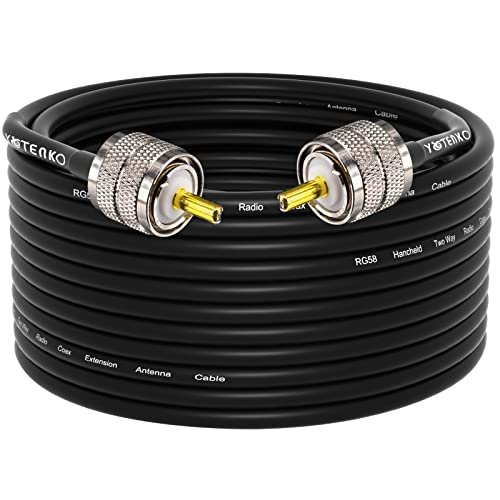
The YOTENKO RG58 offers a ready-made 49.2-foot run terminated with standard PL259 connectors. While RG58 is known for its flexibility and ease of use, it typically exhibits higher attenuation on UHF frequencies, making it best suited for shorter runs or applications primarily focused on HF and low-band VHF signals. The manufacturer has focused on making the connections robust, featuring an upgraded, lengthened heat shrink tube to protect the crucial cable-connector junction.
Key features that stand out:
– Cable Type: RG58 Coax (Flexible and widely compatible).
– Connector Protection: Lengthened 6 cm heat shrink tube for durability.
– Inner Conductor: Bare copper, ensuring stable 50 Ohm impedance.
Pros:
– Very flexible cable, easy to route through small spaces.
– Connectors are solidly integrated with extra-long heat shrink.
– Excellent price point for a nearly 50-foot run.
Cons:
– RG58 has significant attenuation loss at higher UHF frequencies, especially at this length.
Best for: Budget-conscious users, CB radio enthusiasts, or VHF operations where the total cable run is kept under 30 feet.
Expert Opinion: For HF or low-end VHF (like the 6-meter band), this cable offers great value. However, if you plan to operate seriously on 70cm (UHF), the signal loss inherent in RG58 over 50 feet will severely degrade your performance, making it less than the ideal best coax cable for vhf/uhf in long-run applications.
MOOKEERF 15ft UHF Coax Cable, PL259 Male to Male, Low Loss for HAM, VHF Radios & SWR Meter
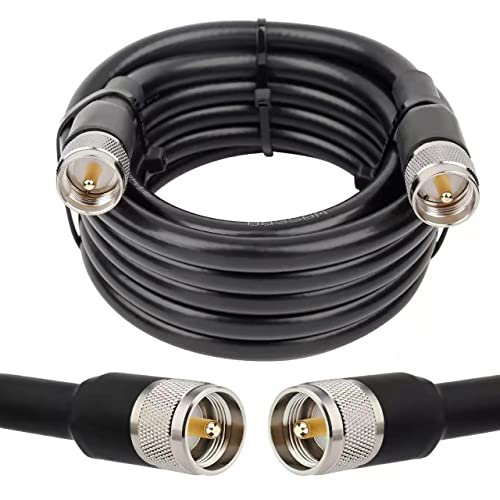
When you need ultra-low loss over a short distance—perhaps to connect your radio to an SWR meter or tuner inside the shack—the MOOKEERF 15ft KMR400-equivalent cable is an exceptional choice. KMR400 (similar to LMR-400) is a thick, highly shielded cable designed specifically to minimize attenuation at high frequencies. At 15 feet, the signal loss is impressively low, ensuring nearly all your transmitted power is preserved.
Key features that stand out:
– Cable Type: KMR400 equivalent (Extremely low loss).
– Performance: Loss is less than 0.59dB at 450MHz (UHF).
– Structure: Inner conductor is copper clad aluminum, protected by tinned copper braid and foil.
Pros:
– Minimal signal loss, making it ideal for VHF/UHF applications.
– Robust, durable, and waterproof jacket for potential outdoor connections.
– Connectors use clamp design and adhesive-lined heat shrink for moisture resistance.
Cons:
– Its thickness makes it less flexible than RG58 cables.
Best for: Short jumper applications in the shack, connecting high-powered VHF/UHF amplifiers, or short runs to roof-mounted antennas where every fraction of a dB matters.
Expert Opinion: If you are building a serious VHF/UHF station, having a short, low-loss jumper like this is non-negotiable. This cable maximizes efficiency where components are closely linked and is a strong contender for the title of best coax cable for vhf/uhf in short-run scenarios.
Superbat PL-259 UHF CB Coax Cable 10ft CB Antenna Cable RG8X Coaxial Cable PL259 to SO239 Jumper for Marine VHF Ham Radio Antenna Shack Duplexer Tuner Dummy Load SWR Meter etc.
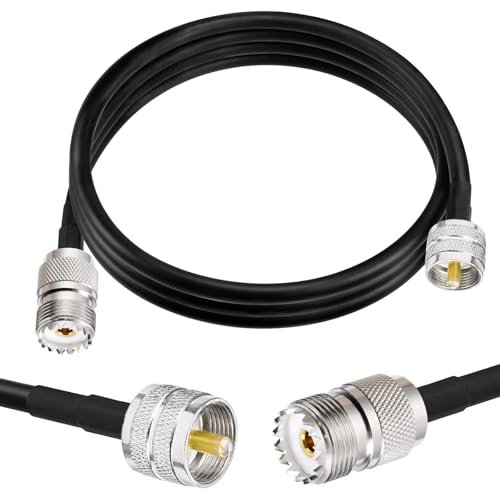
The Superbat RG8X cable offers a middle ground between the super-thick LMR400 types and the thin RG58. RG8X provides significantly less loss than RG58 while maintaining much greater flexibility than KMR400. This specific 10-foot jumper is unique because it features a PL259 Male connector on one end and an SO239 Female connector on the other, making it perfect for connecting components that require this specific gender reversal, like some duplexers or antenna switches.
Key features that stand out:
– Cable Type: RG8X Coaxial Cable (Good balance of low loss and flexibility).
– Unique Connectors: PL259 Male to SO239 Female connection.
– Impedance: Standard 50 Ohm, suitable for high-power applications.
Pros:
– RG8X minimizes loss better than RG58 over short distances.
– Highly useful PL259 to SO239 configuration saves on adapters.
– Comparatively thick but still manageable for shack routing.
Cons:
– The SO239 connector limits its universal application as a standard patch cable.
Best for: Interconnecting equipment within a radio shack, feeding a specialized antenna switch or duplexer, or temporary field installations where flexibility is key.
Expert Opinion: For general shack connectivity involving VHF and UHF equipment, RG8X is often the sweet spot. It handles high power well and has far lower attenuation than its smaller counterparts, making it a reliable solution for anyone seeking the best coax cable for vhf/uhf versatility.
MOOKEERF PL-259 UHF CB Coax Cable – 10FT, RG58 PL-259 UHF Male to Female Low Loss Antenna Extension Jumper for HAM Radio, Antenna Analyzer, Dummy Load, SWR Meter
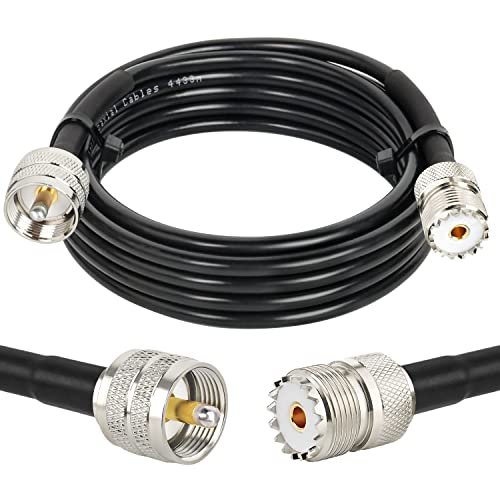
This MOOKEERF cable fills the niche for a high-quality, short-run RG58 extension. At 10 feet, the inherent loss of the RG58 type is minimal enough to be ignored in most low-power amateur and CB radio uses. The key benefit here is the Male-to-Female configuration, allowing you to quickly and reliably extend an existing antenna lead or relocate an SWR meter temporarily. It features a solid copper conductor and UV-proof jacket for durability.
Key features that stand out:
– Cable Configuration: PL-259 UHF Male to Female (Extension capability).
– Shielding: High-density tinned copper braid for 100% shield coverage.
– Build Quality: Flexible UV proof rf-PVC jacket designed for outdoor exposure.
Pros:
– Excellent flexibility for tight setups.
– Male-to-Female configuration reduces the need for barrel connectors/adapters.
– Durable construction resistant to oxidation and corrosion.
Cons:
– Higher signal loss than RG8X or KMR400 cables.
Best for: Extending an existing run by a small distance, temporary setups like field day operations, or connecting an antenna analyzer close to the feed point.
Expert Opinion: While RG58 isn’t the lowest loss option, sometimes flexibility and configuration trump sheer performance. This cable is the perfect short extension lead, built with quality connectors that prevent the common RG58 failure point—connector pull-out.
MOOKEERF 50ft KMR400 PL259 Male to Male Coaxial Cable – Low Loss UHF Cable for HAM Radio, VHF Radio, SWR Meter, Antenna Analyzer

This is the serious cable for serious distances. If you need a 50-foot run up to a tower or mast and plan to transmit on the sensitive UHF 70cm band, using high-loss cable types will render your setup useless. The MOOKEERF 50ft KMR400 provides the necessary protection against attenuation. The manufacturer specifies less than 2.8dB of loss at 450MHz over the entire 50 feet, which is an impressive figure compared to the potentially massive loss experienced with a 50ft RG58 cable.
Key features that stand out:
– Cable Type: KMR400 Low Loss (Equivalent to LMR-400).
– Long Distance Performance: Less than 2.8dB loss at 450MHZ over 50 feet.
– Durability: Waterproof PVC jacket and corrosion-resistant nickel-plated connectors.
Pros:
– Essential for maximizing power transmission over long VHF/UHF runs.
– Highly durable and built for permanent outdoor installations.
– Connectors are sealed with a long, adhesive-lined heat shrink tube for moisture protection.
Cons:
– It is thick and stiff, making installation more difficult than flexible cables.
Best for: Permanent installations on towers or masts, long runs from the shack to the antenna, or any setup where maximizing effective radiated power on UHF is the primary goal.
Expert Opinion: When running 50 feet or more, this type of low-loss dielectric cable is mandatory for effective VHF/UHF operation. It handles the high frequencies beautifully, securing its spot as one of the best coax cable for vhf/uhf systems requiring long runs.
Practical Comparison Short Insights
Choosing the best coax cable for vhf/uhf truly depends on your length requirements, as attenuation is directly proportional to both frequency and length.
For high-frequency applications like 440MHz (UHF), the KMR400/LMR400-equivalent cables (like the MOOKEERF 50ft option) offer vastly superior signal retention compared to RG58 or RG8X. While more expensive and much stiffer, the minimal loss is critical for effective communication over distance.
On the other hand, RG58 is significantly more flexible than thick KMR400. If you are only connecting a radio to an SWR meter 10 feet away, the slight loss of the RG58 is negligible, and the ease of routing is a major benefit. Use RG58 for jumper cables only.
RG8X sits in the middle; it’s a great compromise for runs between 15 and 25 feet where you need better performance than RG58 but require more flexibility than LMR-style cables. RG8X is often the ideal choice for temporary or portable VHF setups.
For any permanent run longer than 25 feet, prioritizing a low-loss type like KMR400 is essential when dealing with sensitive VHF/UHF signals.
Final Verdict: Selecting Your Best Coax Cable
Deciding on the best coax cable for vhf/uhf requires balancing performance against cost and flexibility.
The Long-Run Champion (Performance Priority): The MOOKEERF 50ft KMR400 PL259 Male to Male Coaxial Cable is the undisputed winner for permanent outdoor installations requiring runs of 30 feet or more. Its low attenuation characteristics ensure that your signal reaches the antenna with minimum power wasted.
The Shack Jumper (Flexibility & Efficiency): For connecting internal shack components, the MOOKEERF 15ft UHF Coax Cable, PL259 Male to Male, Low Loss is fantastic. Its short length combined with KMR400 quality means virtually zero power loss between your radio and amplifier or tuner.
The Versatile Setup Option: If you are looking for a cable that performs decently on VHF and is flexible enough for frequent deployment, the Superbat PL-259 UHF CB Coax Cable 10ft CB Antenna Cable RG8X offers the best practical blend of manageable size and acceptable low-loss performance.
Frequently Asked Questions About Best Coax Cable for VHF/UHF
Why does cable quality matter so much more for UHF than for HF?
Signal loss, also known as attenuation, increases dramatically as frequency increases. At HF frequencies (like 7 MHz), even long runs of thin RG58 cable may only have a few decibels of loss. However, at UHF frequencies (like 440 MHz), that same length of RG58 could easily incur 10dB or more of loss, effectively cutting your transmitted power by 90%. Therefore, using high-quality, low-loss coaxial cable attenuation is crucial for VHF/UHF operation.
What is the difference between RG58, RG8X, and LMR-400 equivalent cables?
The difference lies primarily in their construction, diameter, and attenuation figures.
* RG58 (Thin): High loss at high frequencies, very flexible. Best for short jumpers (under 15 ft).
* RG8X (Medium): Better performance than RG58, good compromise between loss and flexibility. Good for medium runs (15–30 ft).
* KMR400/LMR400 (Thick): Highest performance, lowest loss due to thicker center conductor and superior shielding. Essential for long runs, but very stiff.
What is the maximum recommended cable length for a VHF radio?
There is no fixed maximum, but the limit is determined by your acceptable VHF radio cable length attenuation. For common 2-meter VHF operation, most experts recommend ensuring your total feedline loss is under 3 dB. Depending on the cable type:
* RG58 is limited to about 20–25 feet before 3dB loss is reached.
* LMR-400 equivalents can typically handle 75–100 feet while maintaining under 3dB loss.
Should I worry about the inner conductor material (Copper vs. Copper Clad Aluminum)?
Yes, especially for high power and high frequency. While Copper Clad Aluminum (CCA) is lighter and cheaper, a solid or stranded bare copper conductor generally offers lower resistance and better performance, especially at UHF frequencies where the signal primarily travels along the outer surface (skin effect). For the best coax cable for vhf/uhf performance, solid copper is preferred, though quality CCA, when used in a low-loss design (like KMR400), can perform well over short distances.
Are PL259 connectors suitable for UHF frequencies?
PL259 connectors (often mistakenly called “UHF connectors”) were originally designed for frequencies below 300 MHz. While they are adequate and widely used for amateur VHF operation (144-148 MHz) and even tolerable for 70cm UHF (440 MHz), they are not technically considered “low-loss” at very high UHF/microwave frequencies. For the absolute highest frequency performance, N-type connectors are superior, but PL259 is the standard for most consumer and amateur radio VHF/UHF antenna connections.
How important is weather sealing for outdoor coax connections?
Extremely important. Moisture ingress into the coaxial cable, particularly at the connection points, drastically increases attenuation and SWR over time. Using quality adhesive-lined heat shrink over all outdoor connectors (as seen in the MOOKEERF products) is essential for long-term reliability and maintaining the integrity of the signal path.
Affiliate Disclosure: As an Amazon Associate, I earn from qualifying purchases made through links on this site.