Over the past few months, I’ve spent hundreds of hours calibrating extruders, running test prints, and swapping spools to see what modern desktop hardware can really achieve. Finding reliable gear among the top ten best 3d printers and their vital printing materials can be tricky with all the inflated marketing specs out there. In this guide, I share my practical bench notes so you can choose equipment that runs cleanly, avoids constant jams, and delivers dependable results from the first layer onward.
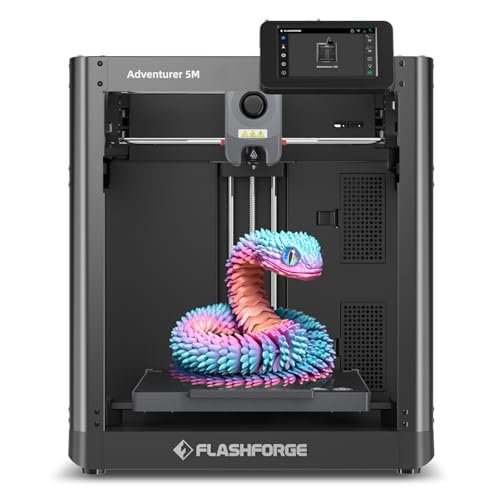
FLASHFORGE Adventurer 5M 3D Printer
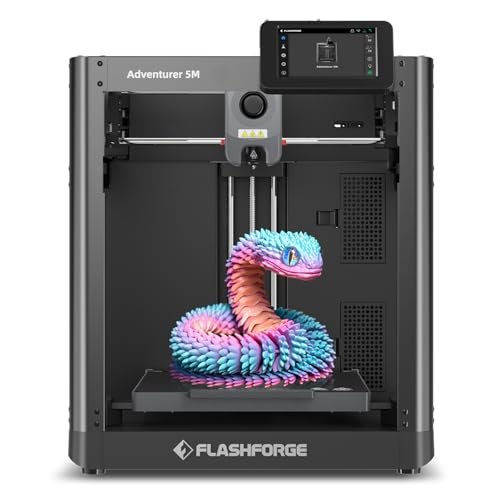
The FLASHFORGE Adventurer 5M makes fast prototyping remarkably approachable right out of the box. Its CoreXY motion system handles acceleration up to 20,000mm/s² while maintaining crisp dimensional corners. I particularly appreciated the one-click automatic leveling, which produced a flat, well-adhered first layer without needing manual paper shims. Swapping the hotend takes mere seconds thanks to the quick-swap nozzle assembly, saving substantial downtime during routine maintenance.
Key features that stand out:
– CoreXY structure capable of up to 600mm/s travel speed and 20,000mm/s² acceleration
– Full auto-bed leveling system for hands-off first-layer calibration
– Direct drive extruder reaching up to 280°C with dual cooling fans
– Rapid 35-second heat-up time to 200°C with quick-release nozzles
– Built-in vibration compensation and remote Wi-Fi control via Flash Studio
Pros:
– Very fast print speeds without noticeable ghosting artifacts
– Quick-change nozzle mechanism simplifies unclogging and diameter swaps
– Dual-sided textured PEI sheet releases finished prints cleanly once cooled
Cons:
– The open frame design means you need to buy or print an enclosure for advanced temperature-sensitive filaments.
– Cooling fans can get quite loud during high-speed runs.
Best for: Hobbyists and small workshops needing rapid turnaround on functional prototypes.
Expert Opinion: The Adventurer 5M strikes an exceptional balance between high-speed performance and low maintenance, making it a reliable workhorse for everyday functional prints.
Entina Tina2C 3D Printer for Beginners & Kids
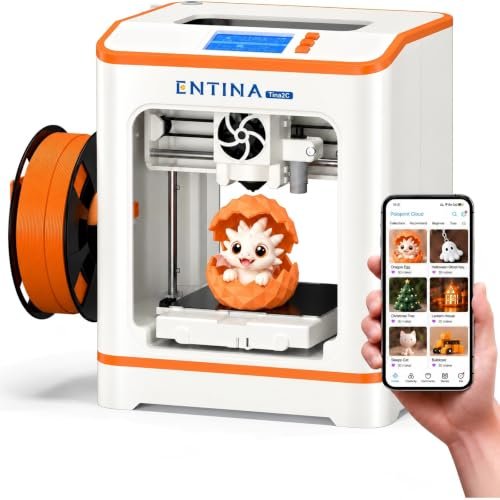
The Entina Tina2C is a compact mini machine built specifically to take the intimidation out of desktop fabrication. It comes fully assembled from the factory, letting you unpack, power up, and start your first model within minutes. Navigating prints via the Poloprint mobile app gives newcomers access to ready-made designs without requiring complicated slicer adjustments. Its flexible magnetic bed flexes effortlessly, meaning you will not need scrapers or sharp tools to remove delicate finished models.
Key features that stand out:
– Out-of-the-box readiness with zero assembly required
– Automatic bed leveling system pre-calibrated from the factory
– Poloprint Cloud app integration with Wi-Fi control and AI model tools
– Flexible magnetic build surface with a 3.9 x 3.9 x 3.9-inch build area
– Power-loss recovery to preserve prints during unexpected shutoffs
Pros:
– Small desktop footprint that fits neatly on study desks or craft tables
– Very quiet stepper motors during active printing
– Safe and straightforward removal of finished parts using the flexible bed
Cons:
– The compact print volume limits your projects to small toys, miniatures, and minor household brackets.
– Lacks a heated print bed, which restricts your material choice primarily to standard PLA.
Best for: Younger learners, classrooms, and absolute beginners wanting an easy first step into 3D printing.
Expert Opinion: If you want a zero-stress printer for small desk toys or STEM experiments that will not overwhelm your living space, the Tina2C is an easy recommendation.
AOSEED AI 3D Printer for Kids
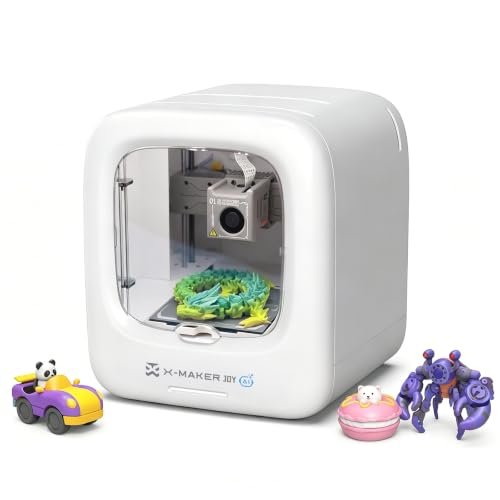
Designed as an all-in-one home toy factory, the AOSEED AI machine turns creative ideas into tangible items with minimal supervision. It incorporates a fully enclosed safety cabinet that keeps curious fingers away from hot components during operation. Kids can use AI-assisted design modules within the companion app to turn simple sketches or voice commands into printable files. With speeds up to 400mm/s peak movement, small projects finish quickly enough to hold a child’s attention span.
Key features that stand out:
– Fully enclosed body with pinch-resistant doors and quiet fans
– AI Doodle and MiniMe software tools for text and image-based 3D modeling
– Speeds up to 400mm/s with 0.05mm layer precision capability
– Built-in monitoring camera that automatically creates shareable time-lapse clips
– Safe single-tap printing paired with filament runout sensors
Pros:
– Fully shielded interior provides peace of mind for parents
– Onboard camera makes monitoring prints from your smartphone simple
– Fast layer deposition means small toys finish in under half an hour
Cons:
– It only supports single-color printing per run, requiring multi-part assemblies for multicolored items.
– Advanced slicer settings are hidden, which limits deeper tinkering for experienced makers.
Best for: Families seeking an engaging, educational tool that combines creative artificial intelligence with safe home fabrication.
Expert Opinion: AOSEED has solved the safety and software hurdles that usually frustrate kids, turning 3D printing into an inviting family activity rather than a technical chore.
Dynta 10 Colors 250g PLA 3D Printer Filament
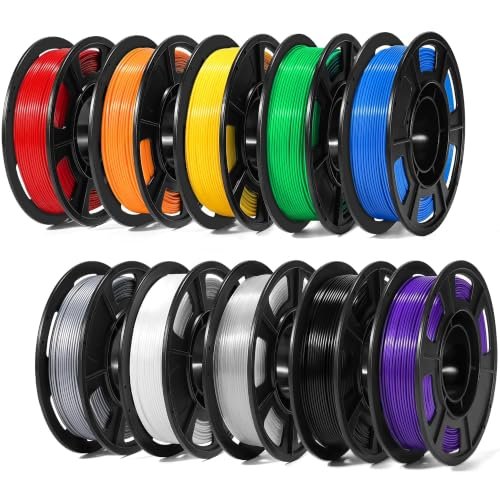
Having the right media is half the battle in 3D printing, and this Dynta multi-pack provides welcome versatility without the clutter of giant spools. The set includes ten distinct 250g mini spools, giving you a rainbow of colors for multi-part models without forcing you to buy 10 kilograms of plastic. Its tight dimensional tolerance of +/-0.02mm prevents extruder slipping and inconsistent line widths. Each roll arrives individually vacuum-sealed with desiccant, ensuring smooth extrusion without popping or bubble-induced defects.
Key features that stand out:
– 10 vibrant color varieties on convenient 250-gram spools
– Consistent 1.75mm diameter with tight +/-0.02mm tolerance
– Neat machine winding to minimize crossing and feed snags
– Standard 53mm center hub hole compatible with desktop spool holders
– Individually packed with moisture-absorbing desiccant packs
Pros:
– Excellent color selection for detail work and small multi-part assemblies
– Low tendency to string across standard 190°C to 210°C nozzle temperatures
– Compact spools take up very little shelf space
Cons:
– Small spools run out quickly on medium-to-large prints.
– Spool hub size can require a printed adapter on certain third-party auto-feeders.
Best for: Hobbyists who want a wide palette for tabletop figures, prototypes, and decorative accents.
Expert Opinion: This bundle is ideal for creators who switch colors often; it avoids having expensive, half-used 1kg spools absorbing humidity on your workshop shelves.
SUNLU PLA Plus 3D Printer Filament (10-Color Bundle)
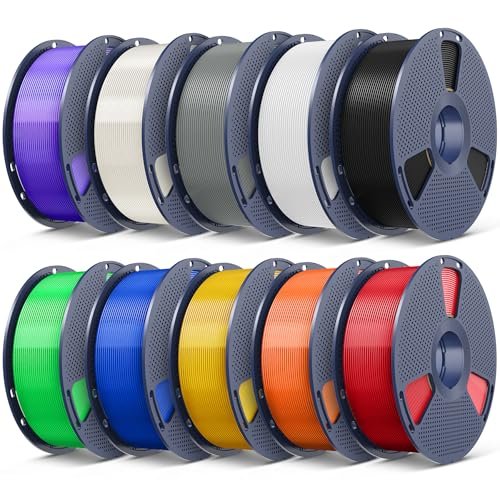
When standard PLA feels too brittle for functional brackets, SUNLU PLA Plus provides a significant bump in mechanical strength. This bulk pack includes ten full 1kg spools featuring both solid and translucent colors. The modified formula delivers three times the impact resistance of standard PLA, making it less susceptible to cracking under moderate mechanical loads. Thanks to precision automated spooling, the filament feeds evenly through Bowden tubes and direct-drive setups without snagging midway through an overnight run.
Key features that stand out:
– Upgraded PLA+ formulation offering higher layer toughness and impact strength
– 10 full 1-kilogram spools with rich solid and translucent tint options
– Neat machine winding designed to eliminate knots and feeding tension
– Broad extrusion temperature range between 210°C and 235°C
– Universal 1.75mm diameter fits practically all desktop FDM machines
Pros:
– Superior layer adhesion results in sturdier functional components
– High optical clarity on the translucent colors in the pack
– Consistent spooling reduces failed prints caused by snags
Cons:
– Requires slightly higher hotend temperatures than standard baseline PLA.
– Storing ten full-sized spools demands dedicated dry storage bins.
Best for: Makers running continuous print jobs who need durable functional prints and rich color variety.
Expert Opinion: SUNLU PLA+ has become an industry benchmark for a reason; its predictable extrusion behavior and enhanced toughness make it an easy choice for production batches.
ANYCUBIC PLA+ 3D Printer Filament (10KG Bundle)
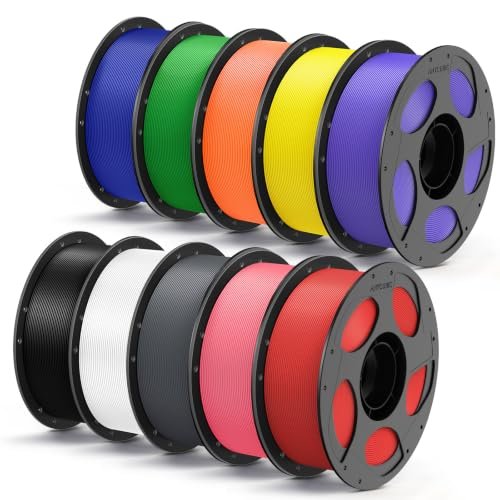
ANYCUBIC formulated this PLA+ bundle to resist brittle fractures while maintaining clean surface quality on detailed models. During evaluation, the plastic showed minimal shrinkage during cooling, which stopped corner lifting on wide-base parts. The spooling is managed to maintain a strict +/-0.02mm wire diameter, keeping extrusion rates smooth and predictable. It melts evenly without strange odors or bubbling, producing clean horizontal layer lines across various layer heights.
Key features that stand out:
– High-toughness modified PLA blend resistant to moderate impacts
– Controlled diameter tolerance of +/-0.02mm to stop flow inconsistencies
– Clean winding layout designed to minimize mid-spool snagging
– Moisture-shielded vacuum packaging around every individual roll
– Compatible with desktop 3D printers and high-temp 3D pens
Pros:
– Strong layer bonding produces functional parts that do not snap along print planes
– Excellent bed adhesion on both textured PEI and smooth glass plates
– Uniform color saturation across the entire spool length
Cons:
– The spool rims can occasionally show small burrs that catch on unbearing-supported roller racks.
– You will need to dial in retraction carefully to avoid minor wisps on travel moves.
Best for: Prototyping workshops and cosplayers producing sturdy armor components and mechanical mockups.
Expert Opinion: If you are tired of brittle PLA parts shattering when dropped on a concrete floor, this ANYCUBIC formulation delivers the exact structural resilience you need.
OVERTURE High Speed PLA Filament (10KG Bundle)
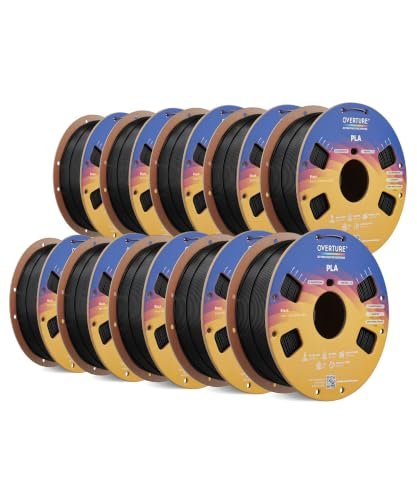
With modern printers running at speeds past 300mm/s, standard plastics can struggle to melt fast enough, but OVERTURE High Speed PLA handles the pace effortlessly. Each batch is inspected using a real-time closed-loop CCD camera to ensure exact diameter uniformity. The material features an anti-clog melt formulation that flows freely through high-flow hotends without developing partial nozzle obstructions. The spools feature an enlarged inner hub diameter, reducing tight coil bending as you near the end of the roll.
Key features that stand out:
– Formulated specifically to maintain flow stability at high print velocities
– CCD camera monitored manufacturing for guaranteed +/-0.02mm diameter precision
– 24-hour factory drying process before immediate vacuum sealing
– Anti-clog additives for reliable, jam-free extrusion
– Large interior spool core prevents harsh filament coiling near the finish
Pros:
– Flows smoothly through high-speed CoreXY machines without under-extrusion
– Minimal stringing even across long open-air travel moves
– Consistent matte-satin surface finish masks layer seams nicely
Cons:
– Costs slightly more per spool than bargain-bin generic filaments.
– Higher flow rate requires careful slicer tuning if used on older, slow-moving printers.
Best for: Owners of modern fast-motion 3D printers looking to minimize print times without sacrificing clean surfaces.
Expert Opinion: OVERTURE’s high-speed formulation eliminates the under-extrusion issues common when pushing modern machines past 250mm/s, making it a reliable staple for quick turnarounds.
15 Bright Colors 3D Pen & Printer PLA Refill Pack
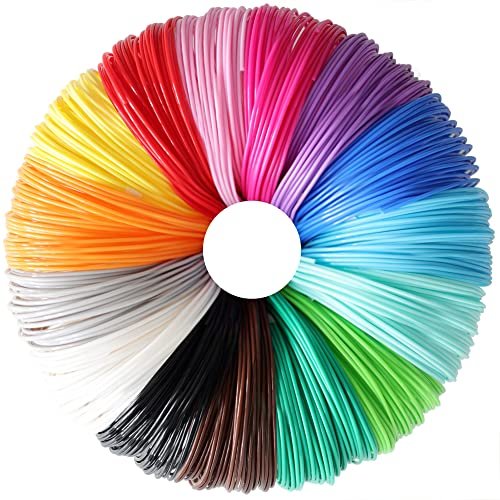
If you need small quantities of varied colors for accent details, test swatches, or 3D pen touch-ups, this 15-color refill bundle fits the bill. The kit provides 15 individually wrapped 10-foot color coils, totaling 150 feet of pure virgin PLA material. It melts cleanly without producing acrid fumes, making it safe and non-toxic for indoor use with children. The consistent 1.75mm diameter standard allows it to feed through regular 3D printer extruders just as well as handheld creative pens.
Key features that stand out:
– 15 distinct solid colors including bright neon and primary shades
– 10 feet per color coil, providing 150 feet of total printing length
– Made from 100% pure virgin PLA raw material
– Uniform 1.75mm diameter compatible with mainstream pens and extruders
– Vacuum sealed together with moisture protection
Pros:
– Inexpensive way to get a wide variety of colors for detailing and repairs
– Melts smoothly at low 190°C temperatures without bubbling
– Great for welding multi-part 3D prints together using a handheld pen
Cons:
– Coils are not wound onto rigid spools, making them prone to tangling if fed directly into standard printer feeds.
– The 10-foot length per color limits you strictly to tiny projects or accents.
Best for: Detailed finishing touches, 3D printing pen art, and color calibration swatches.
Expert Opinion: While not meant for continuous large-scale printing, these sample lengths are unbeatable for fixing seams, filling minor surface blemishes, or letting kids draw freehand 3D sculptures.
SUNLU PETG Filament 1.75mm (10kg Solid Set)
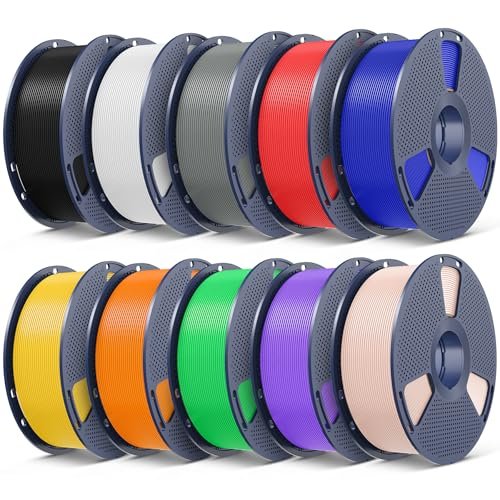
SUNLU PETG bridges the gap between easy-printing PLA and temperature-resistant ABS, offering great durability for demanding functional parts. This bulk ten-pack delivers superior mechanical toughness and thermal resistance, resisting deformation inside hot vehicles or sunny windows. The filament maintains an accurate +/-0.02mm tolerance, ensuring your printer maintains consistent wall thicknesses across tall builds. Because PETG naturally exhibits high water and chemical resistance, prints made from this material hold up outdoors much longer than standard plastics.
Key features that stand out:
– Combines the printing ease of PLA with the structural strength of ABS
– Heat resistance up to roughly 75°C to 80°C before softening occurs
– High chemical and weather resistance for functional outdoor gear
– Tightly monitored 1.75mm wire diameter to prevent over-extrusion jams
– Generous 10-kilogram bulk set designed for high-volume functional shops
Pros:
– Incredible inter-layer adhesion makes parts virtually shatterproof
– Excellent moisture and UV resistance compared to standard PLA
– Low odor during extrusion at recommended 240°C-250°C temperatures
Cons:
– Prone to fine stringing if your retraction settings and travel speeds are not dialled in.
– Can adhere too aggressively to bare glass beds, requiring a glue stick or release agent.
Best for: Functional brackets, outdoor mounts, and mechanical enclosures subjected to moderate heat and physical stress.
Expert Opinion: SUNLU’s standard PETG is my go-to choice for functional parts that need to live in hot environments; once you tune your retraction to curb wisps, it prints reliably every single time.
SUNLU PETG Filament 1.75mm (10-Pack Multi-Color)
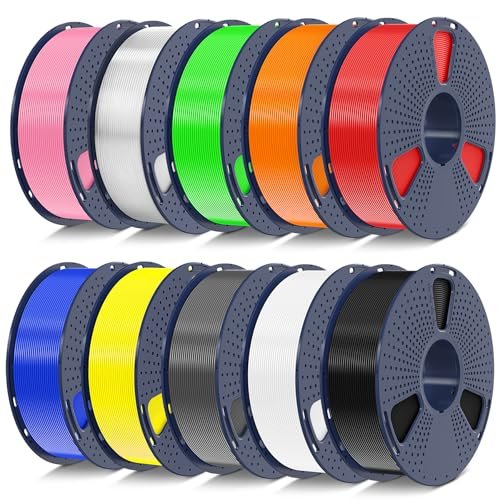
For makers who want the durability of copolyester along with creative visual variety, this SUNLU multi-color PETG bundle hits the sweet spot. It delivers the same high impact strength and weather resistance as standard monochrome PETG while providing varied hues for distinct projects. The plastic feeds smoothly across print speeds from 50 to 200mm/s, letting you run it on both standard bedslingers and modern high-speed CoreXY platforms. Its neat spool winding pattern protects your long prints from failure caused by crossed filament strands.
Key features that stand out:
– Multi-color 10-spool pack combining structural resilience with aesthetic versatility
– Robust impact and fatigue resistance suited for working assemblies
– Stable dimensional accuracy within +/-0.02mm
– Broad speed tolerance operating smoothly up to 200mm/s
– Standardized spool dimensions that fit most enclosed filament dry boxes
Pros:
– Allows color-coded functional prototyping for multi-part mechanical assemblies
– Superior layer welding that resists splitting along the Z-axis
– Vacuum packed to protect against the ambient moisture that PETG loves to absorb
Cons:
– PETG absorbs airborne moisture faster than PLA, meaning spools must be stored sealed after opening.
– Requires bed temperatures between 65°C and 75°C, demanding a capable heated build plate.
Best for: Engineering students and makers needing durable, color-coded functional components.
Expert Opinion: Having ten varied colors of robust PETG on hand lets you build durable mechanical assemblies that look as good as they hold up under stress.
Helpful Comparison Insights
Choosing between modern printing platforms and their associated materials comes down to your primary use case.
If your goal is pure speed and functional modeling, CoreXY motion architectures like the Flashforge Adventurer 5M run circles around traditional bedslingers, cutting production times by more than half without sacrificing layer alignment.
When introducing children or students to fabrication, enclosed safety frames and pre-leveled beds—found on systems like the AOSEED AI and Entina Tina2C—are vastly more important than blistering print speeds. An enclosed build chamber protects curious hands from hotends reaching over 200°C.
On the filament front, PLA+ formulations offer an ideal middle ground for general use, providing significantly better impact resistance than base PLA while retaining easy bed adhesion.
If your models will spend time outdoors or in warm environments like a closed car, switch to PETG filament bundles, as PLA will soften and warp once ambient temperatures pass 50°C.
Final Verdict
| Evaluation Category | Top Selection | Key Advantage |
| :— | :— | :— |
| High-Speed Prototyping | FLASHFORGE Adventurer 5M | 600mm/s motion with hands-off auto-leveling |
| Beginner & Educational | Entina Tina2C | Plug-and-play setup ready in five minutes |
| Family & Child Safety | AOSEED AI 3D Printer | Enclosed build chamber with AI design tools |
| Bulk Everyday Printing | SUNLU PLA Plus (10-Color) | 3x toughness over base PLA with neat winding |
| Functional & Outdoor Use| SUNLU PETG 10kg Multi-Pack | High thermal resistance and layer bonding |
If I had to outfit a workshop from scratch, my primary workhorse would be the FLASHFORGE Adventurer 5M paired with OVERTURE High Speed PLA. This pairing lets you take full advantage of high-velocity printing without suffering from flow starvation or under-extruded layers.
For parents or teachers, picking the AOSEED AI printer alongside a multi-color PLA pack avoids technical troubleshooting and lets young makers focus entirely on creative modeling.
Frequently Asked Questions About the Top Ten Best 3D Printers
What should I look for when choosing among the top ten best 3d printers?
Look closely at bed leveling capabilities, motion style (CoreXY vs. Bedslinger), hotend maximum temperature, and whether the machine is open-frame or enclosed. Automated bed leveling saves substantial setup time, while a direct-drive extruder handling up to 260°C or higher ensures compatibility with multiple filament types.
What is the practical difference between PLA and PLA Plus filament?
Standard PLA is easy to print and stiff, but it tends to be brittle and snaps under sudden shock. PLA Plus (PLA+) incorporates impact modifiers and flow enhancers, giving finished parts roughly two to three times the toughness of standard PLA with superior layer adhesion.
Can high-speed 3D printers use standard filament spools?
Yes, but you may need to increase hotend temperatures by 5°C to 15°C to melt the plastic fast enough. Alternatively, high-speed filaments are formulated with a higher melt flow index (MFI), allowing them to pass smoothly through the nozzle at rapid feed rates without causing extruder skipping.
Why is automatic bed leveling so important on modern machines?
The first layer determines whether a 3D print succeeds or detaches halfway through the run. Auto bed leveling uses inductive probes or load cells to map micro-variations across your print plate, dynamically adjusting the Z-axis height during printing to ensure uniform adhesion across the entire bed surface.
When should I choose PETG instead of PLA?
Choose PETG when your printed object needs to withstand higher mechanical stress, moisture, outdoor UV exposure, or heat above 55°C. PETG remains dimensionally stable up to roughly 75°C to 80°C, making it far superior for car accessories, outdoor brackets, and garden tools.
How should I store my 3D printer filament to keep it fresh?
Both PLA and PETG absorb ambient moisture from the surrounding air over time. Store open spools in airtight plastic containers or vacuum-seal bags with silica desiccant packs to prevent popping, stringing, and brittle extrusion during your print jobs.
Do mini 3D printers for kids require computer-aided design (CAD) skills?
Not anymore. Modern beginner printers incorporate mobile apps featuring pre-tested model catalogs, simple block builders, and AI-assisted prompt generators that let children design models using photos, sketches, or voice commands without learning complex CAD software.
Affiliate Disclosure: As an Amazon Associate, I earn from qualifying purchases made through links on this site.