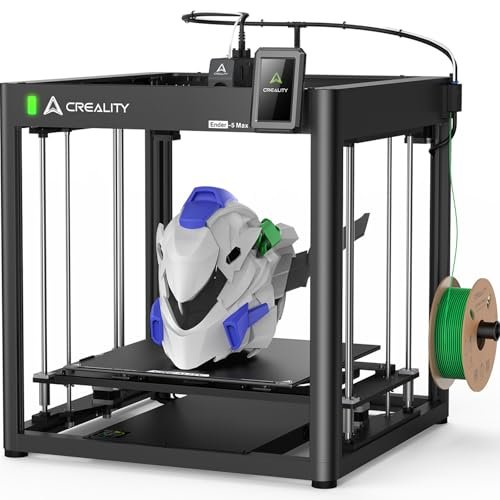
Over the past several months, I put the latest generation of large-scale FDM machines through rigorous workshop trials to find out which models actually deliver clean, warp-free parts without constant tinkering. Testing a modern 3d large format printer used to mean babysitting first layers for hours and enduring agonizingly slow print speeds, but fast CoreXY motion systems and automated multi-material units have transformed the process. In this guide, you will find out which big-volume printers provide dependable bed adhesion, rapid output, and practical reliability for your shop or print farm.
1. Creality Ender 5 Max 3D Printer
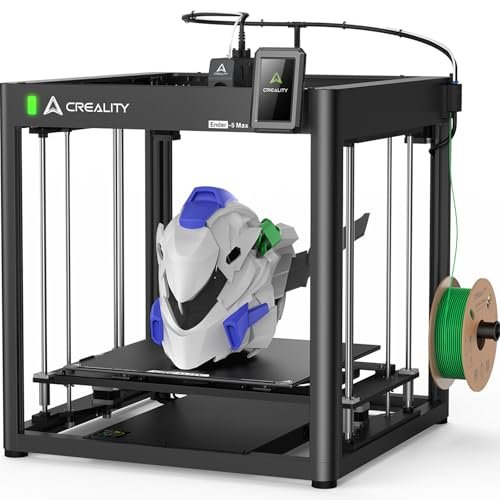
The Creality Ender 5 Max is built for makers who need serious scale without sacrificing print speed. Its massive 400×400×400 mm build volume lets you tackle full-sized helmets, architectural concepts, and production batches in a single run. We found the combination of an ultra-efficient CoreXY system up to 700 mm/s and a robust 1000W rapid-heating bed creates a reliable platform that heats up fast and stays stable across long jobs. Thanks to the reinforced all-metal frame and precision linear rails, tall models print with sharp layer lines and virtually no noticeable frame wobble.
Key features that stand out:
– Enormous 400×400×400 mm build area for one-piece oversize manufacturing
– CoreXY motion structure capable of speeds up to 700 mm/s
– Heavy-duty 1000W heated bed reaching target temperatures in minutes
– Fully automated 64-point mesh bed leveling with auto Z-offset
– Dual-gear direct drive extruder tailored for continuous print-farm duty
– WLAN multi-machine networking with visual tri-color status monitoring
Pros:
– Huge build chamber prevents the need to cut models into segments
– Fast bed heating eliminates typical waiting times seen on large beds
– Rigid frame structure maintains clean precision at high speeds
Cons:
– Its substantial physical footprint demands a sturdy, dedicated workbench space.
– The open-frame layout requires an optional enclosure if you print ABS frequently.
Best for: Print farms and prop makers needing massive single-piece volume with rapid turnaround times.
Expert Opinion: The Ender 5 Max solves the classic large-bed headache of slow heating times with its 1000W AC bed. It delivers consistent extrusion across multi-day runs, making it a reliable workhorse for shop production.
2. Bambu Lab P1S Combo

The Bambu Lab P1S Combo brings high-speed, multi-color capability into an enclosed setup that requires almost zero initial tuning. Straight out of the box, it prints with speeds up to 500 mm/s and 20,000 mm/s² acceleration, significantly cutting down job times compared to older enclosed units. Pairing it with the automatic material system (AMS) allows you to print up to four colors or materials out of the box, expandable up to 16 colors. Its enclosed chamber and reliable active cooling make it a dependable choice for engineering filaments like ABS and ASA alongside everyday PLA.
Key features that stand out:
– Integrated AMS unit for seamless 4-color printing and filament runout relay
– Fully enclosed body designed for high-temperature filament stability
– High-acceleration CoreXY system reaching speeds up to 500 mm/s
– Automated bed leveling with built-in vibration compensation
– Rapid out-of-the-box setup ready to print in roughly 15 minutes
Pros:
– Enclosed chamber expands material versatility to technical filaments
– Multi-material printing works consistently with automated spool switching
– Compact outer footprint relative to its usable print volume
Cons:
– The 256×256×256 mm build volume is modest compared to giant-format machines.
– Proprietary replacement parts mean you rely primarily on first-party stock.
Best for: Creators who want multi-color convenience and reliable technical filament printing in a manageable footprint.
Expert Opinion: While not a giant machine by industrial standards, the P1S Combo earns its spot through reliability and automated multi-color support. It handles complex multi-filament parts without the routine calibration headaches typical of older systems.
3. Creality K2 Plus Combo 3D Printer

The Creality K2 Plus Combo is designed for creators who refuse to compromise between scale, speed, and multi-color flexibility. Featuring a spacious 350×350×350 mm build volume, this fully enclosed CoreXY unit provides ample room for large mechanical assemblies and batch runs. Creality engineered this flagship with active chamber heating up to 60°C and an advanced step-servo drive system running at 600 mm/s. Backed by the new CFS multi-filament unit and dual AI cameras, it monitors spaghetti failures and nozzle flow rates in real time to safeguard long prints.
Key features that stand out:
– Generous 350 mm cubic print volume suited for unsegmented models
– CFS smart multi-color system supporting up to 16 colors with linked units
– Active 60°C chamber heating paired with a 350°C hardened steel hotend
– Step-servo motors delivering 30,000 mm/s² acceleration and 600 mm/s speed
– Dual AI vision cameras for error detection and automatic flow calibration
– Heavy die-cast aluminum matrix frame with quad-rod dual Z-axis stabilization
Pros:
– Actively heated enclosure virtually eliminates warping on engineering materials
– Smart CFS unit handles automatic spool backups and RFID detection
– Strong frame rigidity prevents surface artifacts even at maximum acceleration
Cons:
– The entire combo setup is heavy and requires two people to move safely.
– Advanced features come with a steeper learning curve for complete beginners.
Best for: Engineering studios and serious makers printing large, functional parts in demanding materials like ASA, PA-CF, and multi-color PLA.
Expert Opinion: The active chamber heating on the K2 Plus Combo changes the game for large ABS and nylon components. It keeps internal temperatures steady throughout 30-hour runs, giving you dimensionally accurate parts without edge lifting.
4. Creality Ender-3 V3 Mega 3D Printer
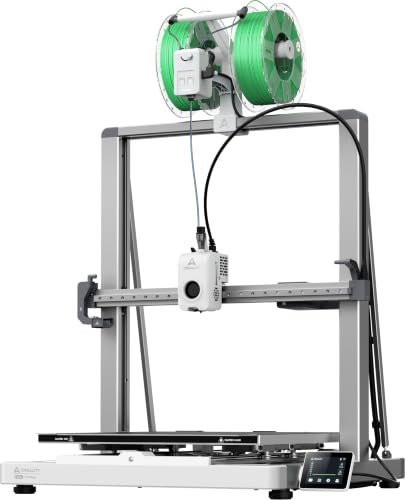
The Creality Ender-3 V3 Mega scales up the familiar bed-slinger format to a massive 16.5×16.5×16.5 inch build platform, making giant prints accessible without breaking the bank. It features an upgraded Sprite 2 direct-drive extruder optimized for flexible TPU down to 85A, resolving the common feeding issues associated with softer filaments. Supported by dual Y-axis motors and dual Z-axis lead screws, the printer runs smoothly up to 500 mm/s. The built-in Y-flow filament relay automatically switches to a backup spool when the primary roll runs out, preventing aborted prints on multi-day jobs.
Key features that stand out:
– Expansive 16.5-inch cubic build plate for large cosplay and functional prints
– Specialized Sprite 2 extruder capable of feeding flexible filaments down to 85A
– Dual Y-axis motor setup providing balanced movement for the heavy bed
– Automatic filament refill relay through an integrated motor-driven Y-valve
– 81-point automated bed calibration combined with tool-free nozzle swaps
Pros:
– Outstanding price-to-volume ratio for oversized single-piece builds
– Exceptional handling of soft TPU materials that often jam other extruders
– Automated filament relay keeps overnight and weekend jobs moving
Cons:
– The moving Y-bed requires extensive clearance in front of and behind the machine.
– Open-frame design makes it unsuitable for warp-prone filaments like ABS.
Best for: Cosplayers and prototyping shops printing massive flexible items or big PLA assemblies on a sensible budget.
Expert Opinion: Printing soft TPU on a large-format bed-slinger is usually frustrating, but the Ender-3 V3 Mega handles 85A material smoothly. Just ensure your table is deep enough to accommodate the full travel of its moving bed.
5. Original Prusa XL 2-Toolhead Multi-Material 3D Printer
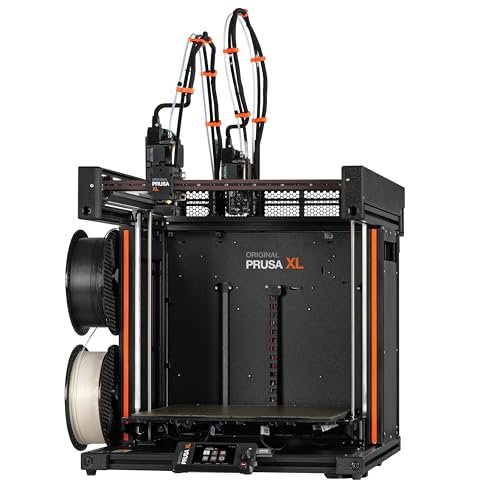
The Original Prusa XL 2-Toolhead edition brings true multi-material efficiency to professional workshops looking for minimal filament waste. Its 14.17×14.17×14.17 inch build volume is complemented by an intelligent segmented heated bed, which heats only the zones in use to conserve energy and minimize thermal warp. Because it utilizes individual mechanical tool changers rather than a single shared nozzle, it switches between soluble supports and structural filaments in seconds with near-zero purge waste. The CoreXY motion system and next-generation load-cell sensor deliver a flawless first layer every single time without manual intervention.
Key features that stand out:
– Dual independent toolheads with quick mechanical tool-changing mechanism
– Segmented modular heatbed system with individual temperature-controlled tiles
– Generous 360×360×360 mm build envelope built on an industrial CoreXY frame
– Zero-waste material transitions with no filament purge towers required
– Fully automated load-cell calibration for precise first-layer squish
– Deep integration with PrusaSlicer and lifetime customer support
Pros:
– Drastically reduces filament waste compared to single-nozzle multi-color systems
– Combining rigid engineering filaments with soluble supports is seamless
– Modular bed design prevents warping while using significantly less power
Cons:
– Toolchanger calibration requires careful mechanical assembly during initial setup.
– Premium pricing makes it a serious financial investment for hobbyists.
Best for: Engineering teams and product designers who regularly print complex functional prototypes requiring soluble support structures.
Expert Opinion: The independent toolhead system on the Prusa XL is unmatched for multi-material efficiency. It eliminates the giant purge blocks common to single-extruder setups, saving significant material cost on massive prints.
6. Anycubic Kobra 3 Max V2 3D Printer

If pure vertical and horizontal volume is what your project demands, the Anycubic Kobra 3 Max V2 delivers with its massive 420×420×500 mm build space. This setup lets you print life-size props, large architectural models, and functional furniture elements in a single print cycle. The printer features a 300°C full-metal hotend and LeviQ 3.0 auto-leveling, ensuring reliable extrusion across standard materials like PLA, PETG, and TPU. With speeds reaching up to 600 mm/s and integrated AI monitoring to catch print defects early, it reduces the failure rate on high-capacity projects.
Key features that stand out:
– Giant 420×420×500 mm build capacity handling oversized one-piece jobs
– Up to 600 mm/s top print speed with 10,000 mm/s² acceleration
– High-temperature 300°C quick-swap hotend for diverse material compatibility
– LeviQ 3.0 multi-point bed leveling with anti-skip dual Y-axis motion
– Optional multi-color expansion supporting up to 8 colors via ACE 2 Pro units
– Built-in AI camera monitoring for spaghetti detection and automated pauses
Pros:
– Massive 500 mm vertical height accommodates tall props without joint seams
– Quick-release nozzle design makes routine maintenance hassle-free
– Integrated AI safety features prevent wasted spools on failed prints
Cons:
– Large heated bed requires adequate warm-up time to achieve uniform heat.
– Moving mass on the Y-axis demands lower acceleration on tall, heavy prints.
Best for: Prop builders, makers, and hobbyists who want maximum vertical capacity without cutting models into multiple parts.
Expert Opinion: The Kobra 3 Max V2 provides unbelievable print volume for the price. As long as you drop your acceleration slightly when approaching the 500 mm vertical ceiling, it yields surprisingly clean surface quality.
7. Creality Ender-3 V3 Mega Combo 3D Printer

The Creality Ender-3 V3 Mega Combo takes the extra-large capacity of the Mega series and equips it with an automated 4-color filament system. Its expansive 16.5×16.5×16.5 inch build volume gives you ample room to print multi-color signage, display models, and functional assemblies without gluing components together. Creality added its Sprite 2 direct-drive extruder with improved 85A TPU grip, allowing you to alternate between rigid and flexible parts easily. Backed by vibration compensation and dual Z/Y structural bracing, it handles rapid multi-color changes at print speeds up to 500 mm/s.
Key features that stand out:
– Substantial 16.5-inch cubic build space with 4-color automated feeding
– Sprite 2 extruder with a shortened filament path tailored for soft 85A TPU
– Automated filament relay with low-spool detection and RFID recognition
– Dual Y-axis drive motors and rigid metal frame for high-speed stability
– 81-point automated leveling mesh with tool-free quick-swap nozzle assembly
Pros:
– Large-format multi-color printing straight out of the box
– Handles soft flexible filaments much better than typical Bowden setups
– Automated spool switching ensures large prints finish without running dry
Cons:
– Color changes on a single nozzle generate noticeable purge waste.
– Takes up considerable desk depth due to the bed travel and filament feeder.
Best for: Cosplay fabricators and display designers seeking big, vibrant, multi-color prints without manual painting.
Expert Opinion: Getting multi-color functionality on a bed of this scale opens up creative possibilities for large decorative pieces. The RFID spool recognition takes the guesswork out of temperature profiles for hassle-free operation.
8. Creality K2 Combo (A) 3D Printer

The Creality K2 Combo (A) combines high-speed enclosed printing with quiet operation, making it ideal for home workshops and shared office environments. While offering a compact 260×260×260 mm build volume, it boasts full compatibility with Creality’s CFS multi-color system supporting up to 16 colors. The machine relies on high-torque step-servo motors and dynamically balanced fans to deliver ultra-quiet printing in silent mode, measuring no louder than normal laptop typing. With automated area-specific bed leveling and integrated AI camera monitoring, you get clean, reliable parts across materials like PLA, PETG, ABS, and carbon-fiber blends.
Key features that stand out:
– Multi-color printing system supporting up to 16 filaments via CFS chaining
– Step-servo motor system delivering high precision with minimal operational noise
– Targeted auto-leveling that probes only the active print area to save time
– Enclosed chamber suitable for temperature-sensitive filaments like ABS and PET
– Real-time AI camera monitoring for spaghetti detection and print errors
Pros:
– Exceptionally quiet operation compared to most enclosed CoreXY machines
– Pre-assembled construction allows you to begin printing within minutes
– Fast targeted bed leveling cuts down pre-print preparation time
Cons:
– Build volume is smaller than true oversized large-format production printers.
– Purge cycles during multi-color prints increase overall print times.
Best for: Creators wanting a quiet, enclosed multi-color printer for home offices, classrooms, or smaller workspaces.
Expert Opinion: The K2 Combo stands out for its remarkably quiet motion system. If you want multi-color capability and enclosed material flexibility without having to tolerate screeching stepper motors, this machine fits right in.
9. FLASHFORGE AD5X Multi-Color 3D Printer
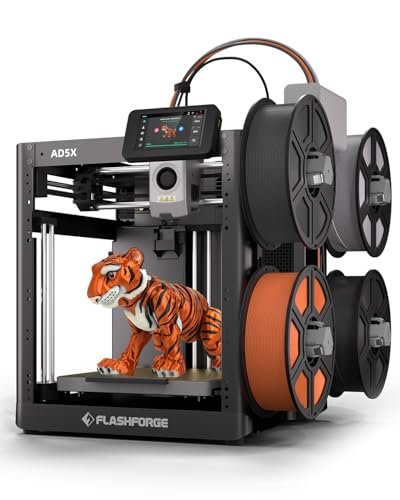
The FLASHFORGE AD5X brings fast, beginner-friendly multi-material printing to your desktop at an attractive price point. Built around a rigid CoreXY frame capable of 600 mm/s and 20,000 mm/s² acceleration, this printer significantly reduces print times while maintaining crisp corners. It features built-in 4-color automatic switching, letting you tackle vibrant multi-hued designs without manual filament changes. The printer also includes a 300°C direct-drive extruder with versatile nozzle options from 0.25 mm up to 0.8 mm, making it easy to swap between ultra-fine miniatures and fast, high-flow larger prints.
Key features that stand out:
– Integrated 4-color filament management for automated multi-tone prints
– CoreXY motion architecture supporting speeds up to 600 mm/s
– 1-click automatic bed leveling for effortless first-layer calibration
– Direct-drive 300°C hotend supporting quick nozzle swaps (0.25 mm to 0.8 mm)
– Remote monitoring and cloud job execution via Flash Maker mobile app
Pros:
– Quick setup and responsive touch interface make it beginner-friendly
– Direct-drive hotend accommodates abrasive and flexible filaments easily
– Broad nozzle selection allows fast draft printing with a 0.8 mm nozzle
Cons:
– Print volume is relatively standard compared to dedicated giant-format machines.
– The open-style filament path is less suited for warp-prone technical materials.
Best for: Hobbyists and small studios seeking an affordable, fast entry into multi-color 3D printing.
Expert Opinion: The AD5X makes color printing accessible with straightforward software and responsive leveling. Being able to drop in a 0.8 mm nozzle turns this unit into a speedy draft printer for functional parts.
10. Creality K2 Pro Combo (A) 3D Printer

The Creality K2 Pro Combo hits the sweet spot for professional prototyping with its balanced 300×300×300 mm build volume. Powered by high-speed FOC step-servo motors and linear rails, it achieves reliable 600 mm/s speeds with active 60°C chamber heating. Its CFS smart system handles up to 16 colors with automatic spool switching and moisture-resistant storage. Creality loaded the K2 Pro with dual AI cameras—one watching the build plate for failures and another monitoring nozzle flow rate—ensuring that composite filaments like PPA-CF and PET-CF print with clean structural integrity.
Key features that stand out:
– Versatile 300 mm cubic print volume ideal for medium-to-large functional prototypes
– CFS multi-material system supporting automated switching and moisture protection
– Active chamber heating up to 60°C with 350°C hardened steel nozzle
– FOC step-servo motors delivering 20,000 mm/s² acceleration at 600 mm/s
– Dual AI cameras dedicated to flow optimization and automated error detection
– High-flow direct drive extruder providing 40 mm³/s volumetric output
Pros:
– Active chamber heat allows dependable printing of carbon fiber composites
– Dual AI cameras catch feed issues and prevent costly failed prints
– Generous build volume accommodates most functional parts without seam assembly
Cons:
– Full multi-color setups occupy a wide desk footprint.
– High power draw when actively heating the bed and chamber simultaneously.
Best for: Engineering professionals, product designers, and advanced makers who print composite and technical filaments at high speed.
Expert Opinion: The K2 Pro Combo is an outstanding balanced machine. The 300 mm build cube covers roughly 90% of real-world functional prototypes, and the active chamber heating ensures warp-free composite parts every single time.
Helpful Comparison Insights for Large-Format Printing
Choosing the right large-format machine comes down to balancing overall print volume, motion architecture, and thermal management.
If your primary goal is printing massive cosplay armor, helmets, or large architectural models in one piece, open-format bed-slingers like the Anycubic Kobra 3 Max V2 (420×420×500 mm) or the Creality Ender-3 V3 Mega (16.5-inch cube) offer the greatest cubic capacity for your dollar. However, keep in mind that moving beds on large machines carry significant momentum. You will need to moderate acceleration settings on tall prints to prevent layer shifting as your parts grow heavier.
For engineering-grade filaments like ABS, ASA, and nylon composites, an open-frame printer will almost certainly lead to edge warping and split layers. In these scenarios, fully enclosed systems with active chamber heating, such as the Creality K2 Plus Combo or K2 Pro Combo, are essential. Their rigid CoreXY frames keep the bed steady on the Z-axis, while controlled internal heat ensures structural bonding across large surface areas.
When it comes to multi-material printing with minimal waste, the Original Prusa XL stands in a class of its own due to its independent dual toolchangers. Single-nozzle multi-color systems (like those paired with the Bambu Lab P1S or Creality CFS) work smoothly for decorative prints, but they inevitably generate purge waste during filament swaps. For functional parts that require soluble supports paired with technical materials, a dedicated tool-changing system saves substantial filament over long print runs.
Final Verdict: Which Large-Format Printer Should You Buy?
The Heavy-Duty Production Winner: Creality K2 Plus Combo
If you need both massive build volume (350×350×350 mm) and high-temperature capability, the K2 Plus Combo takes the crown. Its active 60°C chamber heating, reinforced die-cast frame, and 16-color CFS compatibility allow you to tackle industrial prototypes and large display models with equal confidence.
The Pure Scale Champion: Anycubic Kobra 3 Max V2
When sheer size is your chief priority, nothing matches the 420×420×500 mm volume of the Kobra 3 Max V2 at this price point. It lets prop designers print full swords, shields, and scenic elements without cutting files into frustrating puzzle pieces.
The Engineering & Zero-Waste Pick: Original Prusa XL (2-Toolhead)
For professionals who regularly blend structural materials with PVA or BVOH soluble supports, the Prusa XL is the most refined tool available. Its independent toolheads cut purge waste to nearly zero, and its segmented bed saves energy across continuous design cycles.
The Accessible Big-Bed Value: Creality Ender-3 V3 Mega
For creators who want a giant 16.5-inch build plate without spending commercial money, the standalone Ender-3 V3 Mega provides smooth handling of soft TPU filaments and reliable automatic spool refills on a sensible budget.
Frequently Asked Questions About Choosing a 3D Large Format Printer
How do I prevent warping when using a 3d large format printer?
Bed warping is the most common issue on large-format FDM printers because wide plastic footprints contract unevenly as they cool. To combat this, ensure your heated bed has sufficient time to soak heat uniformly across the entire plate before starting your print. Using adhesive aids like PEI textured sheets, PVA glue sticks, or specialized bed glues provides strong initial bonding. For materials like ABS, ASA, or PC, you must use an enclosed printer with active or passive chamber heating to keep ambient temperatures high and stable.
Is a CoreXY system better than a bed-slinger for large 3D prints?
Yes, for large prints, a CoreXY motion system is generally superior to a traditional bed-slinger. On a bed-slinger, the heavy build plate moves back and forth along the Y-axis. As a tall print gains weight, that rapid back-and-forth movement introduces momentum that can cause ringing, surface banding, or even knock tall parts loose. A CoreXY machine moves the lightweight toolhead on the X and Y axes while the bed slowly descends along the Z-axis, keeping heavy models completely stationary.
How much power does a large-format 3D printer consume?
Power consumption depends largely on the heated bed. Large beds (350 mm to 400 mm+) require significantly more wattage to reach and maintain operating temperatures. While standard desktop printers draw between 150W and 350W, high-output large-format printers with high-wattage AC beds (such as the Creality Ender 5 Max with its 1000W heater) can draw 1000W or more during initial heat-up. Once operating temperatures stabilize, steady-state consumption generally drops to between 300W and 600W depending on chamber and bed settings.
Do I need automatic bed leveling on a large-format machine?
Automatic bed leveling (ABL) is an absolute necessity on any large build plate. Aluminum build plates naturally expand, contract, and flex when heated, meaning that even a precision-machined plate will have subtle high and low spots across a 350 mm or 400 mm span. A multi-point mesh leveling system (such as 64-point or 81-point probing) measures these microscopic height variations and dynamically adjusts the Z-axis during the first layer to guarantee consistent filament squish across the entire bed.
Can a 3d large format printer use standard 1.75 mm filament spools?
Yes, nearly all modern consumer and prosumer large-format printers use standard 1.75 mm filament. However, because large prints consume significant amounts of material, standard 1 kg spools may run out midway through a multi-day print. For this reason, look for printers equipped with automatic filament runout sensors, auto-refill relays that switch to a backup spool, or compatibility with larger 2.5 kg to 5 kg spools.
What nozzle size is best for large-format 3D printing?
While standard 0.4 mm nozzles deliver fine detail, printing a massive model with a 0.4 mm nozzle can take several days. Upgrading to a 0.6 mm or 0.8 mm nozzle dramatically increases volumetric flow, allowing you to lay down wider extrusion lines and taller layer heights. This switch can cut print times by 40% to 60% while simultaneously increasing layer-to-layer bonding strength, making it the preferred choice for large structural components, cosplay props, and rough prototypes.
Affiliate Disclosure: As an Amazon Associate, I earn from qualifying purchases made through links on this site.