I have spent hundreds of hours printing multi-color prototypes in my workshop to find the best multi spool 3d printer setups and accessories available today. Switching between multiple filaments automatically saves tons of manual labor, but you need reliable hardware to prevent jams and messy filament waste. In this guide, I break down hands-on testing results for top multi-material machines and essential multi-spool packs to help you upgrade your printing workflow.
Bambu Lab P2S Combo 3D Printer & AMS 2
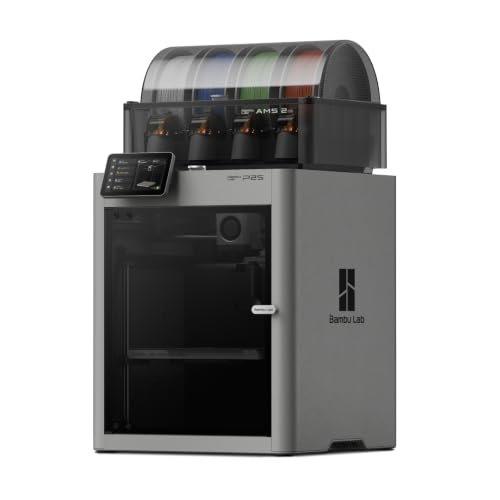
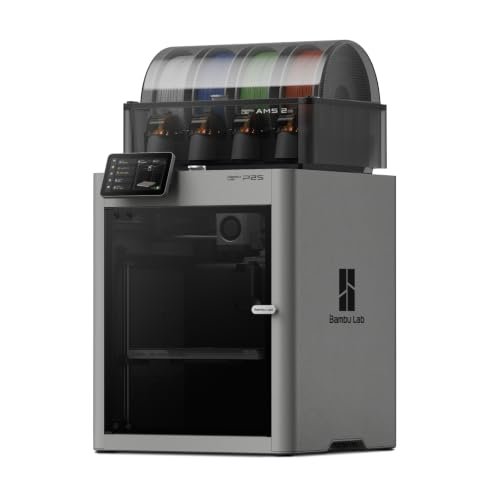
The Bambu Lab P2S Combo takes multi-material fabrication to a high standard by pairing an enclosed, high-speed core with an upgraded feeder unit. During testing, the PMSM Servo Extruder and active flowrate compensation kept color transitions crisp without messy layer bleeding. The bundled AMS 2 Pro provides active filament drying up to 65 °C, which keeps hygroscopic materials in top shape for multi-day jobs. Its adaptive airflow system maintains chamber temperatures up to 50 °C, letting you tackle technical engineering plastics alongside standard multi-color PLA designs.
Key features that stand out:
– Prints up to 600 mm/s with sharp corner accuracy
– AMS 2 Pro includes built-in 65 °C filament drying
– AI failure detection and automatic vibration calibration
– Quick-swap nozzle system for fast maintenance
– Adaptive chamber airflow system with integrated carbon filter
Pros:
– Sets up and runs self-calibration in around 15 minutes
– Heated AMS keeps moisture-sensitive filaments dry while printing
– Flawless integration with Bambu Studio and MakerWorld
Cons:
– The initial investment cost is quite steep for casual hobbyists.
Best for: Serious creators and makers who need industrial-speed multi-material printing with active filament drying.
Expert Opinion: The P2S Combo solves the biggest headache in multi-material printing by drying filament directly inside the AMS 2 unit while you print. It delivers smooth, clean multi-color results right out of the box with virtually zero manual tuning.
Bambu Lab P1S Combo 3D Printer with AMS
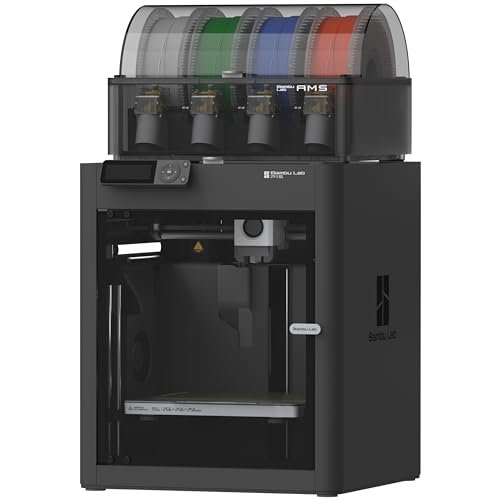
The Bambu Lab P1S Combo remains one of the most reliable options for anyone wanting reliable multi-filament printing without breaking the bank. Its fully enclosed body allows you to reliably run filaments like ABS and ASA alongside standard PLA and PETG. When hooked up to the four-spool AMS unit, you can print up to four colors out of the box or daisy-chain units for up to 16 colors. High-speed travel up to 500 mm/s and 20,000 mm/s² acceleration cuts down the long print times typically caused by multi-spool color purging.
Key features that stand out:
– Expandable multi-color system supporting up to 16 spools
– Blazing-fast 500 mm/s print speeds with heavy-duty motion rails
– Full enclosure for thermal stability with warp-prone filaments
– Automatic bed leveling and vibration compensation
– Broad material compatibility ranging from PLA and TPU to ABS and PC
Pros:
– Proven multi-color track record with low filament jam rates
– Enclosure keeps ambient temperatures stable and traps printing odors
– Smooth, straightforward setup that takes under 20 minutes
Cons:
– The simple button interface on the machine feels outdated compared to full touchscreens.
Best for: Enthusiasts looking for a reliable, enclosed multi-color printer with proven software support.
Expert Opinion: The P1S Combo strikes a practical balance between price and performance in the multi-spool space. While its on-device screen is basic, you will likely control everything through the desktop slicer or mobile app anyway.
FLASHFORGE AD5X Multi-Material 3D Printer
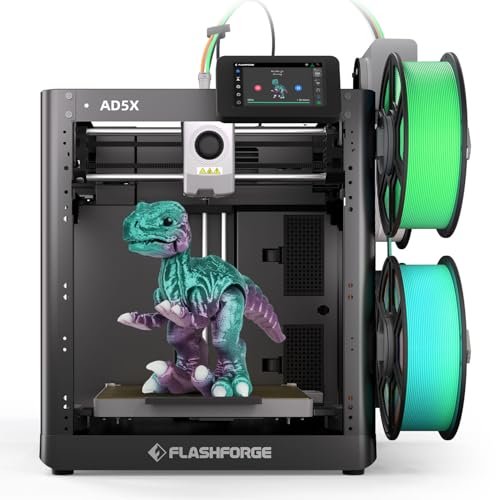
The Flashforge AD5X enters the multi-color arena with a built-in Intelligent Filament System (IFS) designed to streamline 4-color printing. Built on a rigid all-metal CoreXY structure, it handles speeds up to 600 mm/s while dampening mechanical vibration across rapid direction changes. The side-by-side filament layout creates a space-saving footprint on a standard workbench compared to bulky top-mounted spool arrays. Multi-point auto bed leveling ensures the crucial first layer adheres evenly, preventing mid-job detachments when laying down complex multi-shade prints.
Key features that stand out:
– Integrated 4-color Intelligent Filament System (IFS)
– Top speed of 600 mm/s with 20,000 mm/s² acceleration
– Full-metal CoreXY chassis with vibration suppression algorithms
– Automated multi-point sensor bed leveling
– Compatible with PLA, PETG, TPU, and carbon-fiber blends
Pros:
– Compact side-by-side spool arrangement saves vertical desk clearance
– Direct multi-material feeding handles flexible and composite filaments well
– Rapid nozzle heating and fast print startup
Cons:
– Firmware updates are sometimes needed to smooth out early slicing quirks with third-party software.
Best for: Makers with limited desk space who want high-speed 4-color printing in a self-contained footprint.
Expert Opinion: Flashforge did a great job engineering the IFS to minimize horizontal footprint. The machine holds tight tolerances during fast color changes, making it a strong competitor in the sub-$600 multi-material category.
SUNLU PLA 1.75mm 250g Spool Bundle
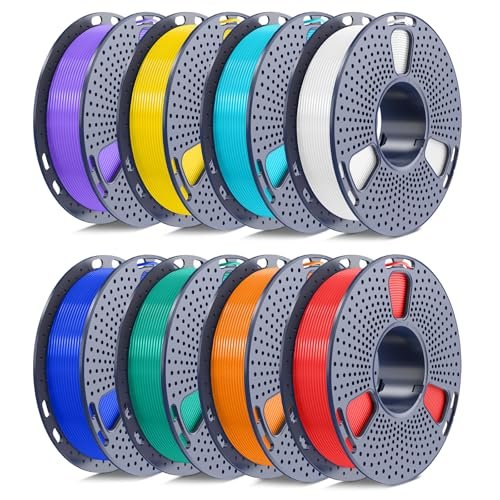
Multi-color prints often need small amounts of accent colors, and the SUNLU 250g Spool Bundle is designed specifically to meet that need. Instead of buying huge, expensive 1kg rolls that sit open absorbing moisture, these compact 250g mini spools let you load diverse color palettes into your multi-spool feeder without waste. The filament is precision wound to reduce cross-overs and snags that can stall automatic multi-material systems during spool retractions. With a consistent 1.75mm diameter (±0.02mm), flow rates stay predictable from the first layer to the final pass.
Key features that stand out:
– Multi-pack of 250g spools ideal for multi-color accents
– Tightly controlled ±0.02mm diameter tolerance
– Clean mechanical winding to prevent feed jams
– Standard 53mm center hole compatible with open spool holders
– Low-warp PLA formula optimized for standard print profiles
Pros:
– Cost-effective way to get multiple colors without buying full 1kg rolls
– High dimensional accuracy reduces under-extrusion risks
– Great bed adhesion across standard textured PEI plates
Cons:
– You will need to print custom spool adapters to use these smaller rolls in an enclosed Bambu AMS.
Best for: Multi-color 3D printer owners who need a rich variety of accent colors for figurines, toys, and multi-hue signs.
Expert Opinion: If you run a multi-spool printer, full-size 1kg spools of accent colors like yellow or pink often go stale before you finish them. These 250g rolls solve that problem completely, provided you print a quick hub adapter for your feeder.
Bambu Lab A1 Combo with LED Lamp Kit
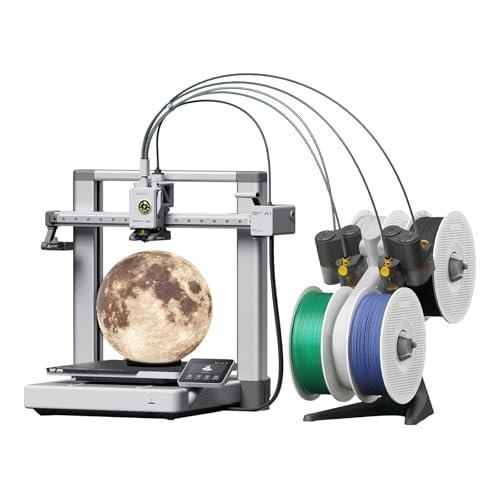
The Bambu Lab A1 Combo pairs an open-bed bedslinger with the AMS lite feeder, delivering an accessible gateway into multi-material making. This version includes an LED Lamp Kit, letting you dive straight into functional lighting prints right after unboxing. The A1 features active motor noise canceling, making it noticeably quiet even when running at its top acceleration of 10,000 mm/s². Thanks to full-auto calibration and active flow rate compensation, bed leveling and pressure advance settings are adjusted on the fly, eliminating tedious manual tuning.
Key features that stand out:
– AMS lite handles 4-color printing with quick external loading
– Active motor noise canceling provides exceptionally quiet operation
– 1-Clip quick-swap nozzle design simplifies nozzle changes
– Included hardware kit for building custom illuminated lamp designs
– Automated Z-offset, bed leveling, and dynamic flow rate compensation
Pros:
– Remarkably quiet during high-speed printing
– Nozzle swaps take under 30 seconds with no tools required
– AMS lite provides simple, visible filament paths that are easy to clear
Cons:
– The open-frame design makes it unsuitable for printing ABS, ASA, or nylon.
Best for: Beginners, educators, and hobbyists who want whisper-quiet multi-color printing in a living room or classroom.
Expert Opinion: The A1 Combo with AMS lite is hands-down the easiest multi-color machine to learn on. It skips the complexity of an enclosed chamber while retaining the precise flow and auto-calibration tech of Bambu’s flagship models.
MarsWork Quick-Swap Reusable Spool for Refill Filament
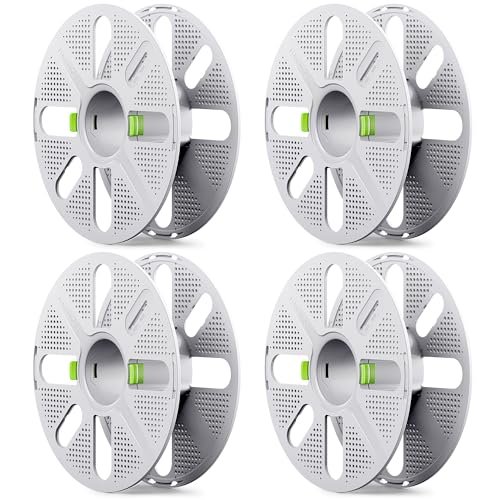
Managing several spools for multi-material setups can quickly create physical clutter and wasted plastic, which is where the MarsWork Quick-Swap Reusable Spool helps. With its two-finger quick-swap design, you can snap the spool open and install refill filament cores in seconds without twisting or fighting tight latches. The included securing straps allow you to pull half-used filament coils off the spool safely to store them without unspooling into a tangled mess. An integrated color card slot makes it simple to label materials and shades, ensuring you never mistake PETG for PLA during complex multi-spool jobs.
Key features that stand out:
– Instant snap-lock mechanism opens and closes with one press
– Filament straps allow safe removal and storage of partially used rolls
– Built-in clip securely anchors filament ends to stop tangles
– Front-facing color card system for quick material labeling
– Designed for refill coils with an ~82mm inner cardboard core
Pros:
– Eliminates empty plastic spool waste while saving shelf storage
– Straps keep half-used filament neatly coiled during swaps
– Fits cleanly into popular automatic material stations
Cons:
– Only fits refill coils compatible with the standard 82mm inner diameter core.
Best for: Eco-conscious 3D printer users looking to streamline spool swapping and organize refill filaments efficiently.
Expert Opinion: Reusable spools often feel fragile, but the MarsWork design locks solidly with a simple push. The ability to pull a half-used coil off the spool with the retaining strap is a massive win for multi-color users rotating frequent accent colors.
ELEGOO PLA Plus 250g Spool Multicolor Bundle
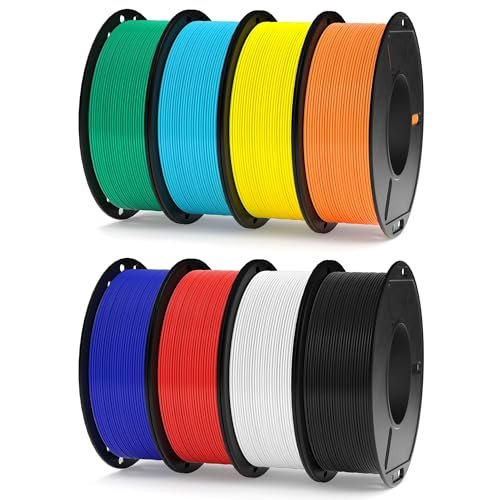
The ELEGOO PLA Plus Bundle delivers an 8-pack of 250g rolls, giving you a diverse palette right out of the box for multi-spool projects. Formulated with enhanced impact strength and toughness, this PLA Plus holds up much better on functional snap-fit components and gaming miniatures than standard brittle PLA. Each roll is mechanically wound under tight factory inspection, avoiding the nasty overlaps that pull feeder gears out of alignment during automatic tool changes. The rolls arrive vacuum-sealed with desiccant, ensuring your multi-spool feeder does not suffer from wet, bubbly extrusion.
Key features that stand out:
– 8-spool pack containing 250g per color for varied design work
– Tough PLA Plus formulation with improved drop and impact resistance
– Strict dimensional consistency of 1.75mm (±0.02mm)
– Precision mechanical winding to prevent tangles during retractions
– Completely dried and vacuum-sealed for immediate out-of-box printing
Pros:
– Stronger mechanical properties than standard everyday PLA
– Offers a wide variety of colors for multi-hue printing at low cost
– Consistent melting behavior prevents clogs in high-speed hotends
Cons:
– Small 250g spools require printable center spacers to seat properly in motorized AMS roller slots.
Best for: Hobbyists printing multi-colored toys, tabletop miniatures, and durable display models that need extra drop strength.
Expert Opinion: ELEGOO PLA Plus flows reliably across a wide temperature range and offers superior toughness compared to generic PLA. For multi-color printing, the bundle gives you a complete color setup without cluttering your shelves with bulky 1kg spools.
Multi Spool 3D Printer Comparison Insights
- Enclosed vs. Open-Frame Performance: The Bambu Lab P2S Combo and P1S Combo feature fully enclosed print volumes, making them vastly superior for printing high-temp multi-material jobs like ABS, ASA, and PC without warping. In contrast, the Bambu Lab A1 Combo is an open-frame bedslinger; while it stays remarkably quiet and handles PLA/PETG smoothly, it cannot safely handle high-shrinkage technical polymers.
- Filament Management and Drying: The P2S Combo with AMS 2 Pro is the only printer in this lineup with active heated filament drying up to 65 °C, protecting your spools from ambient humidity during lengthy multi-day prints. The FLASHFORGE AD5X takes a different approach by focusing on a compact side-by-side IFS footprint, saving vertical desk clearance at the expense of an actively heated drying chamber.
- Spool Size Strategy for Multi-Color Work: Loading four full 1kg spools for small multi-shade prints can tie up your budget and shelf space. Using mini bundles like the SUNLU 250g pack or ELEGOO PLA Plus 8-pack gives you maximum color variation at a lower cost, though both require printed adapter rings to roll smoothly on motorized AMS rollers. If you prefer full-size spools, using the MarsWork Quick-Swap Spool provides an efficient way to swap refill cores without throwing away empty plastic spools.
Final Verdict: Which Multi Spool Setup Should You Choose?
The Top Overall Performer: Bambu Lab P2S Combo
If you want the most refined multi-spool printing experience available, the P2S Combo is worth every penny. The built-in 65 °C spool drying in the AMS 2 Pro, paired with active airflow regulation and a 600 mm/s enclosed chassis, provides unmatched reliability across engineering plastics and decorative prints alike.
The Best Value Enclosed Workhorse: Bambu Lab P1S Combo
For creators who want an enclosed multi-material machine without paying a flagship premium, the P1S Combo remains an exceptional choice. It runs the same proven 4-spool AMS system as higher-tier machines, letting you tackle multi-color ABS, ASA, and PLA with proven software stability.
The Best Entry-Level Pick: Bambu Lab A1 Combo
If you are printing primarily in PLA and PETG for decorative projects, tabletop figures, or home decor, the A1 Combo is the easiest and quietest machine you can buy. Its 1-clip quick-swap nozzles, active motor noise cancellation, and automated bed routines make multi-color printing stress-free for beginners.
Frequently Asked Questions About the Best Multi Spool 3D Printer
How does a multi spool 3d printer handle color changes without mixing colors?
A multi spool 3D printer uses an automated filament feeding system to retract the active filament above the hotend melt zone, cut it cleanly, and feed the new color into the nozzle. To prevent color contamination, the printer purges a specific volume of plastic into a “purge tower” or waste chute until the new color extrudes pure and clean. Slicing software lets you customize purge volumes depending on whether you are switching from a dark color to a light color.
Can I print different materials like PLA and TPU together in one print?
Printing different materials simultaneously depends heavily on your printer’s extruder setup and material adhesion properties. While systems like the FLASHFORGE AD5X and Bambu AMS handle multiple rigid materials like PLA and PETG easily, soft flexible filaments like standard TPU (under 95A durometer) can buckle in long feeding tubes and are generally not recommended inside enclosed multi-spool selector units. However, you can frequently use rigid support filaments like PVA or breakaway support materials alongside PLA for clean overhangs.
Why do multi spool 3d printers produce so much filament waste?
Because single-nozzle multi-spool printers must flush out the molten pool of plastic inside the hotend between every single color swap, they produce waste known colloquially as “filament poop” or purge lines. On a model with hundreds of layer switches, this purged material can sometimes outweigh the finished model. You can reduce this waste by using slicer settings such as “flush into infill,” “flush into support,” or by printing multiple identical models on the same build plate to amortize the flush volume.
Are 250g mini spools compatible with Bambu Lab AMS units?
Yes, but they usually require an adapter. Standard 250g spools, such as those from SUNLU or ELEGOO, have a smaller outer diameter (around 140mm) than standard 1kg spools (around 200mm). In an AMS or AMS lite system, the drive rollers expect standard-sized rims to spin correctly. You can download and print free snap-on adapter rings or spindle extensions from MakerWorld or Printables to adapt 250g rolls for seamless AMS operation.
Is an enclosed multi spool 3d printer necessary for multi-color printing?
An enclosure is not strictly necessary if you are printing primarily with PLA, PETG, or TPU materials. Open-frame printers like the Bambu Lab A1 handle these low-shrinkage filaments without issues. However, if your multi-color projects involve ABS, ASA, or polycarbonate, an enclosed printer like the Bambu Lab P1S or P2S is essential to retain chamber heat and prevent severe layer separation and edge warping.
What is the advantage of using refill filament and reusable spools?
Refill filament coils come without an injection-molded plastic spool core, drastically lowering packaging waste and shipping weight. By pairing refills with reusable hardware like the MarsWork Quick-Swap spool or Bambu Reusable Spools, you save money per roll while keeping empty plastic spools out of landfills. Reusable spools with quick-release mechanisms also make it easier to store partially used filaments cleanly using retention straps.
Affiliate Disclosure: As an Amazon Associate, I earn from qualifying purchases made through links on this site.