Over years of testing additive manufacturing gear, I have watched 3D printers evolve from temperamental DIY kits into intelligent desktop powerhouses. Finding a machine worthy of being called the best 3d printer ever comes down to raw reliability, effortless bed leveling, and blisteringly fast print speeds that do not sacrifice surface quality. In this hands-on guide, I break down five standout machines across different price points to help you choose the right setup for your workshop or living room.
Bambu Lab P2S Combo 3D Printer with AMS 2 Pro
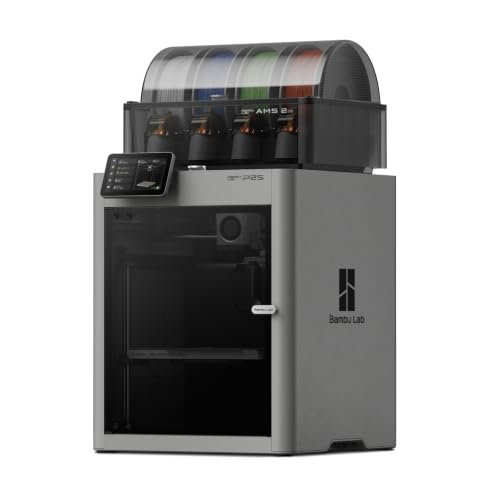
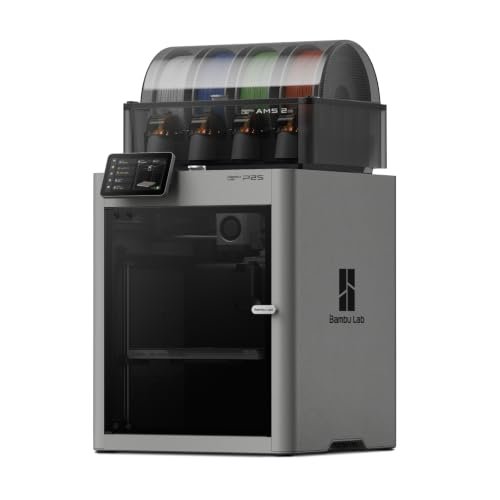
The Bambu Lab P2S Combo pushes desktop manufacturing to new heights with its 600 mm/s high-speed precision powered by a PMSM Servo Extruder and Active Flowrate Compensation. It eliminates typical printing headaches thanks to a 15-minute quick setup supported by AI failure detection and swift nozzle swaps. The included AMS 2 Pro unit offers active filament drying up to 65 °C, ensuring your multi-material and multi-color prints stay crisp without moisture defects. Meanwhile, its Adaptive Airflow System keeps engineering filaments warm in an enclosed chamber while filtering the air through active carbon.
Key features that stand out:
– Active Flowrate Compensation and PMSM Servo Extruder maintain sharp corners and smooth outer walls.
– Fast 15-minute setup with AI-assisted failure detection and automatic calibration.
– AMS 2 Pro system enables seamless multi-color printing alongside active spool drying.
– Adaptive Airflow System regulates chamber heat up to 50 °C with carbon filtration.
– Direct integration with MakerWorld models and Bambu Studio slicer software.
Pros:
– Blazing 600 mm/s print speed with flawless layer consistency
– Integrated filament dryer inside the AMS unit saves workbench space
– Quick-swap nozzle design makes maintenance fast and painless
Cons:
– Higher overall investment compared to standard single-spool desktop units.
– Enclosed chassis requires a dedicated, sturdy desk footprint.
Best for: Demanding makers and small businesses needing multi-color production and engineering-grade material support.
Expert Opinion: The inclusion of active spool drying inside the AMS 2 Pro solves the biggest issue with multi-material printing, making this setup a top contender for the most dependable FDM ecosystem available today.
Bambu Lab P1S Combo 3D Printer with AMS
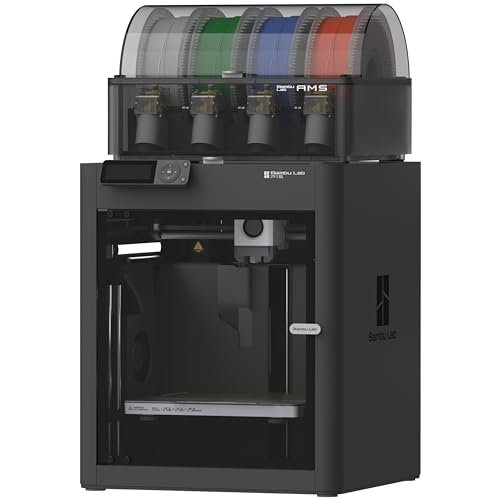
The Bambu Lab P1S Combo delivers industrial-grade performance in a consumer-friendly package, boasting 500 mm/s print speeds with 20,000 mm/s² acceleration. Its fully enclosed body traps heat efficiently, allowing you to print advanced filaments like ABS and ASA without worrying about edge warping. You can dive right into projects with automated bed leveling and an easy 15-minute unboxing process that takes the guesswork out of calibration. With the AMS unit hooked up, you get vibrant multi-color printing across up to 16 colors when daisy-chaining units.
Key features that stand out:
– CoreXY motion structure capable of 500 mm/s speeds and 20,000 mm/s² acceleration.
– Fully enclosed build chamber designed for high-temperature filament stability.
– Automatic bed leveling and vibration compensation for smooth first layers.
– Supports multi-color and multi-material printing right out of the box with the AMS.
– Compatible with wide-ranging filaments including PLA, PETG, TPU, ABS, and ASA.
Pros:
– Enclosed frame prevents warping on high-temperature materials
– Reliable multi-color feeding with minimal user intervention
– Excellent build quality and rigid frame at a mid-tier price point
Cons:
– Built-in display interface is basic and relies heavily on the mobile app.
– Not recommended out of the box for abrasive glass or carbon-fiber composites.
Best for: Serious hobbyists and designers who want enclosed multi-color reliability without the flagship price tag.
Expert Opinion: The P1S strikes an unbeatable balance between price and capability; it handles high-temp materials effortlessly and turns multi-color printing into a routine, push-button task.
FLASHFORGE Adventurer 5M 3D Printer
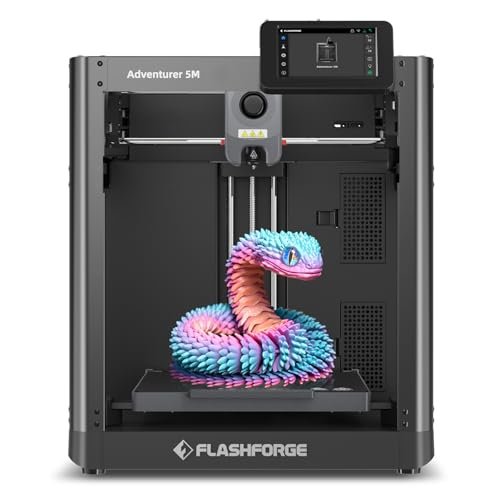
The FLASHFORGE Adventurer 5M stands out as a pure speed demon, reaching 600 mm/s travel speeds on a rigid all-metal CoreXY frame. It features one-click automatic bed leveling that measures nozzle height automatically, guaranteeing a clean first layer without manual leveling sheets. The innovative 3-second quick-swap nozzle lets you switch between detail and high flow effortlessly, heating up to 200 °C in just 35 seconds. Complete with dual-fan cooling and vibration compensation, this printer maintains sharp layer details even during rapid prototype production.
Key features that stand out:
– Rapid CoreXY architecture with 600 mm/s travel speed and 20,000 mm/s² acceleration.
– One-click full auto bed leveling for zero-fuss first-layer adhesion.
– Quick-release nozzle system that swaps in 3 seconds without extra tools.
– High-flow 32 mm³/s hotend capable of reaching 280 °C.
– Remote control and live progress tracking using the Flash Studio mobile app.
Pros:
– Ultra-fast 35-second nozzle heat-up time saves setup minutes
– Quick-change nozzle mechanism is among the easiest to service
– Dual-sided flexible PEI sheet makes print removal effortless
Cons:
– Open-frame design makes it unsuitable for warp-prone materials like ABS.
– Cooling fans can get loud when running at maximum printing speeds.
Best for: Rapid prototypers and educators who prioritize fast turnaround times on PLA and PETG parts.
Expert Opinion: If you do not need an enclosure for specialized materials, the Adventurer 5M offers some of the best speed and first-layer automation you can buy for under $400.
AOSEED AI 3D Printer for Kids
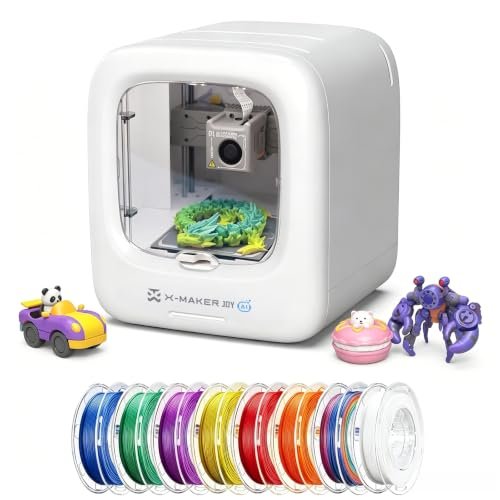
The AOSEED AI 3D Printer reimagines STEM learning by introducing AI-powered generation tools like AI Doodle and AI MiniMe to turn sketches and photos into 3D files. Built with safety at its core, it features a fully enclosed pinch-resistant body and uses non-toxic, certified PLA filament. The machine reaches print speeds up to 400 mm/s, ensuring small toys and school projects finish in as little as 20 minutes so young minds stay engaged. Families can monitor builds using the built-in time-lapse camera, while the included starter pack provides 8 filament rolls to start creating right away.
Key features that stand out:
– AI Doodle and AI MiniMe software turns voice, text, or photos into printable 3D models.
– Completely enclosed, child-safe design with quiet operation and pinch-resistant housing.
– High-speed printing reaching up to 400 mm/s for quick 20-minute toy prints.
– Built-in camera provides live mobile monitoring and automated time-lapse videos.
– Starter bundle includes 8 rolls of PLA, magnetic flexible plate, and craft tools.
Pros:
– Intuitive software eliminates the steep learning curve of CAD modeling for kids
– Enclosed, safety-certified chassis provides peace of mind in home environments
– Generous starter bundle lets kids print dozens of models straight out of the box
Cons:
– Limited strictly to single-color printing per build cycle.
– Smaller build volume limits the scale of functional adult projects.
Best for: Families, elementary classrooms, and young makers taking their first steps into 3D design and STEM.
Expert Opinion: AOSEED bridges the gap between complex 3D software and young creators; the generative AI prompts make designing original toys genuinely accessible for children without adult intervention.
Bambu Lab A1 mini 3D Printer + LED Lamp Kit
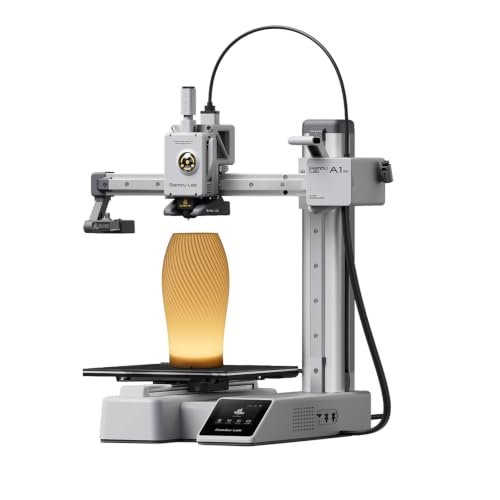
The Bambu Lab A1 mini makes desktop printing utterly painless thanks to full automatic calibration that handles bed leveling, vibration compensation, and nozzle pressure before every job. It operates with whisper-quiet motor noise cancellation, making it subtle enough to run beside your work desk without distraction. This bundle includes a creative LED Lamp Kit, allowing you to assemble your own functional illuminated desk accessories straight away. With smooth integration into the MakerWorld ecosystem and Bambu Handy app, you can start high-resolution prints directly from your phone in seconds.
Key features that stand out:
– Comprehensive auto-calibration covering bed tilt, resonance, and flow dynamics.
– Active motor noise cancellation delivers whisper-quiet operation during fast moves.
– Compact footprint ideal for small apartments, offices, or craft rooms.
– Bundled with hardware components to print and assemble real LED lamp projects.
– One-tap mobile printing via Bambu Handy with access to MakerWorld models.
Pros:
– Silent operation makes it the most apartment-friendly printer tested
– Flawless first-layer consistency with zero manual adjustments required
– Bundled lamp project offers instant hands-on satisfaction
Cons:
– Compact 180 x 180 x 180 mm build plate restricts printing larger single-piece objects.
– Bed-slinger style requires clearance space behind and in front of the unit.
Best for: Beginners, hobby crafters, and apartment dwellers who want clean, silent, reliable printing in a compact size.
Expert Opinion: The A1 mini is the easiest recommendation for any beginner; its whisper-quiet operation and fail-safe automated calibration deliver print quality matching machines three times its size.
Helpful Comparison Insights
Choosing between these top-tier machines depends on the specific materials you plan to run, your physical workspace, and your target projects.
If your goal is multi-color and technical engineering filaments, enclosed machines like the Bambu Lab P2S Combo and Bambu Lab P1S Combo stand above the rest. The P2S takes the lead with its integrated 65 °C filament drying chamber, preventing brittle filament breaks during long prints. However, the P1S delivers roughly 90% of the same printing capability at a lower price point, making it a smarter purchase for hobbyists who do not need active heated drying.
When it comes to pure prototyping speed on a budget, the FLASHFORGE Adventurer 5M holds a distinct advantage. Its open CoreXY frame matches the 600 mm/s velocity of higher-end machines, while its 3-second toolless nozzle change outperforms every competitor for fast maintenance. The trade-off is an open frame, meaning it cannot reliably print temperature-sensitive plastics like ABS or nylon.
For first-time users and specific age groups, form factor and software ease matter more than build volume. The AOSEED AI 3D Printer provides a completely child-safe enclosed environment paired with generative AI tools that allow young learners to design without technical CAD knowledge. On the other hand, the Bambu Lab A1 mini is the gold standard for whisper-quiet desktop performance and compact reliability, making it the top choice for craft spaces, students, and home offices.
Final Verdict
- The Gold Standard for Advanced Makers: Bambu Lab P2S Combo earns top honors for its active filament drying, AI monitoring, and ability to handle both multi-color aesthetics and high-temp engineering plastics seamlessly.
- The Value Workhorse for Serious Hobbyists: Bambu Lab P1S Combo delivers enclosed CoreXY reliability and up to 16-color compatibility without premium enterprise pricing.
- The Speed-to-Price Champion: FLASHFORGE Adventurer 5M is the standout choice for tinkerers who want blazing 600 mm/s PLA/PETG output and instant nozzle swaps on a modest budget.
- The Top Creative STEM Tool: AOSEED AI 3D Printer takes the crown for families and kids, thanks to its AI-driven model creation and completely pinch-safe enclosure.
- The Ultimate Compact Starter Machine: Bambu Lab A1 mini wins for small-space convenience, ultra-quiet printing, and foolproof automated calibration.
Frequently Asked Questions About the Best 3D Printer Ever
What features truly make a machine the best 3d printer ever?
The title comes down to hands-off reliability rather than just top speed. A top-tier machine must feature fully automated bed leveling, active vibration compensation (input shaping), a reliable direct drive extruder, and a well-integrated software ecosystem that eliminates slicing headaches and failed first layers.
Does a fast 600 mm/s print speed reduce final print quality?
Not on modern CoreXY platforms equipped with resonance compensation and dynamic flow control. Printers like the Bambu Lab P2S and Flashforge Adventurer 5M actively measure frame vibrations and adjust motor movements in real-time, allowing you to print four to five times faster than traditional bedslingers while keeping layer lines clean and corners sharp.
Is an enclosed 3D printer necessary for everyday printing?
If you only print standard PLA, PETG, or TPU, an open-frame printer works wonderfully and offers easier access to the build plate. However, an enclosed chamber is essential if you plan to print engineering materials like ABS, ASA, or PC, which warp and delaminate if exposed to ambient room drafts or sudden temperature changes.
Why is automatic bed leveling such an important feature?
Manual bed leveling with paper sheets used to be the primary cause of print failures for beginners. Automated bed leveling utilizes pressure sensors or inductive probes to map out microscopic deviations across the build plate surface. The printer adjusts the Z-axis dynamically during printing to guarantee perfect first-layer adhesion every single time.
How does multi-color 3D printing work on desktop FDM printers?
Systems like the Bambu Lab AMS automatically retract one filament spool, cut it at the toolhead, and feed a new color through the same nozzle during layer transitions. While this process produces a small amount of purged waste filament between color swaps, it allows you to create intricate, multi-colored models without painting or manual assembly.
What is the advantage of built-in filament drying?
Filaments like PETG, TPU, and soluble supports absorb moisture directly from the surrounding air. Wet filament leads to stringing, rough surface finish, popping noises at the hotend, and weak layer adhesion. Having active heating inside the filament feeder (such as on the AMS 2 Pro) keeps materials dry, ensuring optimal tensile strength and smooth print surfaces.
Can absolute beginners start with these high-speed printers?
Yes, modern machines are substantially easier to use than printers from just a few years ago. Units like the Bambu Lab A1 mini and AOSEED AI come virtually pre-assembled, run their own self-calibration routines, and can be operated entirely from a smartphone app with pre-tested print profiles.
Affiliate Disclosure: As an Amazon Associate, I earn from qualifying purchases made through links on this site.