I’ve spent hundreds of hours leveling beds, fine-tuning slicer profiles, and testing print speeds to see which machines truly deliver on their promises. When searching for the best 3d printer cnet tech enthusiasts and makers frequently recommend, you need something dependable, fast, and easy to run without constant tinkering. In this hands-on guide, I break down three standout machines that cover high-temperature engineering, massive build projects, and colorful multi-filament desktop making.
QIDI Q2C 3D Printer

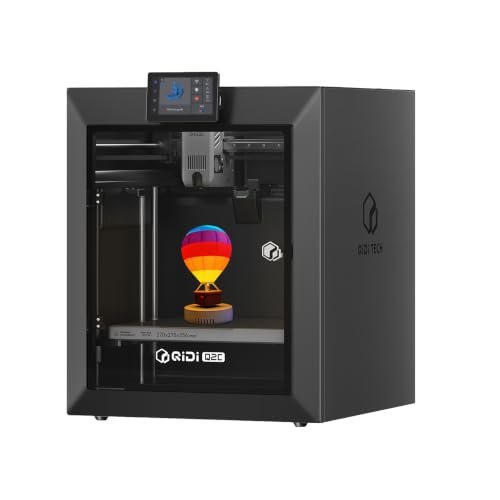
The QIDI Q2C is built for makers who demand industrial-grade capability without a commercial price tag. Its rigid full-metal CoreXY frame and precision linear rails deliver blistering speeds up to 600mm/s while keeping surface artifacts and ringing remarkably low. Thanks to the 370°C high-temperature bimetal hotend, you can reliably extrude abrasive, high-strength composites like PPS-CF right out of the box. An integrated nozzle sensor automates first-layer calibration, saving you from tedious manual adjustments before every print.
Key features that stand out:
– High-Speed CoreXY Motion System: Uses precision linear rails and a reinforced 1.5GT belt to dampen vibrations at speeds up to 600mm/s.
– 370°C High-Temp Hotend: Capable of printing demanding filaments such as PPS-CF, PA, PC, ABS, and carbon/glass-fiber composites.
– Nozzle-Integrated Bed Sensor: Automatically detects bed distance for a reliable, hands-off first layer on every job.
– Multi-Color and Multi-Material Ready: Integrates with the optional QIDI BOX for dry-while-print capability across up to 16 colors.
– Rapid 15-Minute Assembly: Modular components allow you to go from unboxing to running your first test model in a quarter of an hour.
– Open-Source Architecture: Gives you total freedom to customize Klipper configurations and slicer parameters to match your workflow.
Pros:
– Blazing-fast print speeds paired with rock-solid CoreXY stability
– Exceptional material compatibility for high-performance functional parts
– Open-source firmware allows extensive personal tuning and upgrades
Cons:
– It does not include an active chamber heating element for temperature-sensitive materials.
– The optional add-on camera does not feature AI print failure detection.
Best for: Engineers, functional prototype designers, and advanced hobbyists needing high-temperature and composite material capabilities.
Expert Opinion: The QIDI Q2C punches well above its price point when it comes to mechanical rigidity and composite handling. While it lacks the heated chamber of the pricier Q2, its linear rails, 370°C nozzle, and dependable automated compensation make it a workhorse for tough, functional parts.
Longer LK5 Pro 3 3D Printer
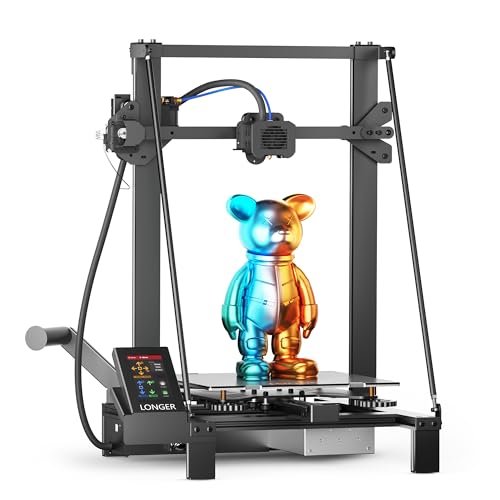
If you want massive build volume without breaking your budget, the Longer LK5 Pro gives your projects room to breathe. Its reinforced triangular gantry structure uses dual diagonal support rods to suppress vibrations and prevent Z-wobble on tall builds across its spacious 300x300x400mm platform. The carborundum lattice glass bed ensures even heat spread and effortless model release once the platform cools down. Equipped with an upgraded 32-bit silent mainboard and TMC2209 stepper drivers, it operates quietly enough for shared workshops, offices, or classrooms.
Key features that stand out:
– Spacious 300x300x400mm Build Volume: Gives you the room needed for full-size cosplay helmets, large mechanical housings, and big batch prints.
– Diagonal Structural Rods: Forms a sturdy triangular frame that eliminates tall-print wobble and maintains 0.1mm layer accuracy.
– Silicon Carbide Glass Build Plate: Provides strong bed adhesion during printing and allows finished models to pop off cleanly once cooled.
– Quiet TMC2209 Stepper Drivers: Keeps motor noise down to a whisper for unobtrusive operation in home offices.
– Power-Loss and Runout Protection: Automatically pauses print progress if filament runs dry or power cuts out, saving wasted material.
– 90% Pre-Assembled Frame: Modular packaging allows for straightforward assembly within an hour.
Pros:
– Massive print envelope offers fantastic value per cubic inch
– Solid triangular frame bracing minimizes print resonance on tall models
– Very quiet stepper performance during extended multi-day print runs
Cons:
– Maximum speeds are capped at 180mm/s, which is slower than newer CoreXY alternatives.
– The bed relies primarily on manual leveling knobs that take extra time to calibrate.
Best for: Cosplayers, prop builders, and educators who need large-format prints at an accessible price.
Expert Opinion: The Longer LK5 Pro focuses on what matters most for large-scale printing: stability. By adding dual support struts to an open bedslinger design, Longer solved the wobble issues that ruin tall prints on budget machines, making it a reliable pick for big builds.
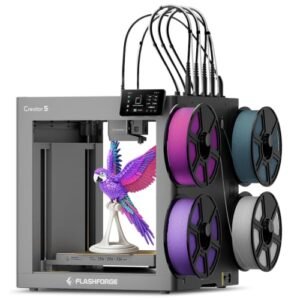
Creality Ender-3 V3 Neo Combo 3D Printer
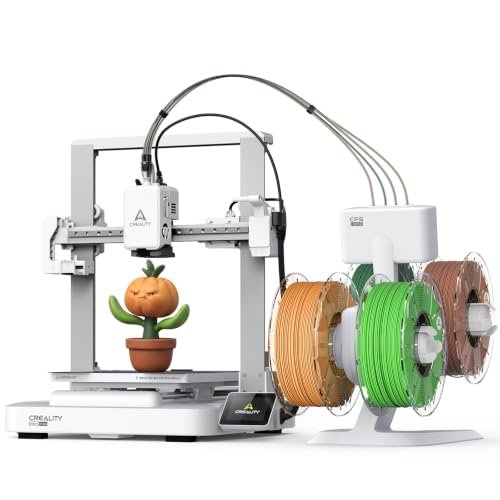
Creality brings high-speed multi-material creation to the desktop with the Ender-3 V3 Neo Combo. It features an automated filament refill and multi-color feeding system that makes multi-hued prints smooth and accessible for beginners. The machine prints at standard velocities around 300mm/s with burst speeds up to 500mm/s, utilizing vibration compensation and dynamic flow control to keep outer walls crisp. Maintenance is simplified through a quick-swap nozzle mechanism, allowing you to change tips in seconds without tearing down the entire printhead assembly.
Key features that stand out:
– Integrated Multi-Color Management: Automatically manages filament changes and spool backups to eliminate runout interruptions during multi-color jobs.
– 500mm/s High-Speed Printing: Built-in accelerometer supports input shaping and dynamic extrusion calibration to eliminate ringing at fast speeds.
– Quick-Swap Nozzle Architecture: Makes regular nozzle changes and maintenance simple without complex hotend disassembly.
– Automated Bed Leveling: Hands-off sensor mapping compensates for bed variations to deliver clean, level first layers.
– Creality Cloud Ecosystem: Provides quick access to slicing presets, downloadable models, and remote monitoring tools.
– Compact 220x220x220mm Work Area: Offers a practical footprint that fits comfortably on standard student desks and workbenches.
Pros:
– Accessible multi-color printing with automated spool backup functionality
– Modern motion algorithms deliver smooth wall finishes at high print speeds
– Tool-free nozzle replacement simplifies everyday routine maintenance
Cons:
– The 220mm cube build volume limits single-piece sizing on larger projects.
– Multi-color filament purging creates extra scrap material during layer transitions.
Best for: Students, DIY creators, and home hobbyists looking for an approachable entry into colorful, fast 3D printing.
Expert Opinion: Creality has adapted to modern user expectations with the Ender-3 V3 Neo Combo. Pairing input shaping with automated multi-color switching and easy nozzle maintenance removes the friction points that traditionally frustrated first-time 3D printer owners.
Practical Comparison Insights
- Print Speed and Frame Dynamics: The QIDI Q2C leads in sheer speed and mechanical stiffness thanks to its enclosed CoreXY kinematic platform, easily reaching up to 600mm/s. The Creality Ender-3 V3 Neo Combo provides agile desktop performance with 300 to 500mm/s print rates, while the Longer LK5 Pro trades peak velocity for slow, steady stability at 180mm/s to protect tall prints.
- Usable Work Envelope: When raw print volume is your primary concern, the Longer LK5 Pro’s 300x300x400mm dimensions clearly outshine the group. The QIDI Q2C (270x270x256mm) strikes a balanced middle tier for functional components, while the Ender-3 V3 Neo Combo (220x220x220mm) remains the most space-efficient desktop companion.
- Filament Capability vs. Multi-Color: For industrial composites and abrasive filaments, the QIDI Q2C is the undisputed front-runner with its 370°C bimetal hotend. Conversely, if your goal is colorful decorative art and functional toys, the Creality Ender-3 V3 Neo Combo offers the smoothest multi-material feeding system.
The Final Verdict
Here is how to match these tested printers to your specific workflow:
Select the QIDI Q2C if you want professional-grade mechanical prototyping. Its linear rails, 600mm/s top speed, and high-temp nozzle let you print carbon-fiber blends and tough technical parts straight away.
Select the Longer LK5 Pro if you are producing large cosplay helmets, architectural miniatures, or oversized prototypes. Its reinforced triangular gantry prevents tall-print failures while keeping initial equipment costs modest.
Select the Creality Ender-3 V3 Neo Combo if you want vibrant, multi-color prints without complex setup. Its automated filament handling, quick-swap hotend, and beginner-friendly firmware make it a fun, versatile creative station.
Best 3D Printer CNET Guide: Frequently Asked Questions
What makes a 3D printer rank well in tech reviews?
Reviewers look for reliable first-layer adhesion, structural frame rigidity, accurate auto-leveling systems, and clear firmware interfaces. Modern testing also weighs real-world print acceleration, noise levels, and maintenance simplicity above pure theoretical specifications.
Is a CoreXY printer better than a traditional bedslinger?
CoreXY printers keep the print bed stationary on the Y-axis or only move it along the Z-axis, reducing moving mass. This architecture allows machines like the QIDI Q2C to print much faster with less surface ghosting than bedslingers, though bedslingers remain cheaper to build in larger formats.
What are the advantages of a quick-swap nozzle?
Quick-swap nozzles let you switch between standard 0.4mm brass tips, wear-resistant hardened steel nozzles, or wide-bore 0.6mm nozzles in minutes. This avoids stripped hotend threads, hot-tightening burns, and lengthy teardowns when changing materials.
How does multi-color 3D printing work on single-nozzle printers?
Systems like the Creality Combo retract the active filament, cut or park it inside a multi-spool feeder, and feed the next color into the hotend. A purge tower or purge bucket is used to clear residual melted plastic so colors don’t bleed into one another.
Can budget 3D printers print carbon-fiber filaments?
Standard brass nozzles wear out quickly when running abrasive filaments like carbon fiber or glass-filled nylon. To run these composites safely, you need a printer with a hardened or bimetal nozzle rated for at least 300°C, like the hotend found on the QIDI Q2C.
Is automatic bed leveling necessary for beginners?
Automatic bed leveling uses sensors to map microscopic variations in the print surface, automatically adjusting the Z-axis height in real time. This feature saves beginners from failed prints caused by uneven beds and removes the steepest learning curve in 3D printing.
How loud are modern desktop 3D printers during operation?
Modern printers using silent stepper motor drivers like the TMC2209 operate around 45 to 55 decibels, which sounds like a quiet conversation or a refrigerator hum. Most of the audible sound today comes from cooling fans rather than motor movements.
Affiliate Disclosure: As an Amazon Associate, I earn from qualifying purchases made through links on this site.