After spending hundreds of hours testing setups in my workshop, I’ve learned that finding the right large volume fdm 3d printer comes down to balancing rock-solid frame stability with reliable auto bed leveling. Tackling massive functional prototypes, helmets, and batch runs in one piece saves you countless hours of slicing and gluing. In this guide, I share my hands-on observations from benchmarking ten standout printers to help you pick the ideal machine for your maker space or production farm.
ANYCUBIC Kobra X 3D Printer, Native 4-Color
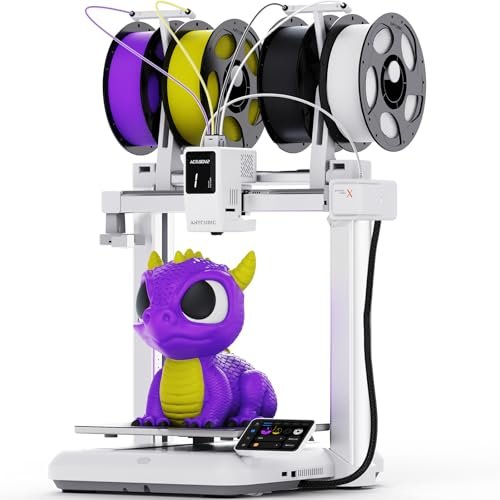
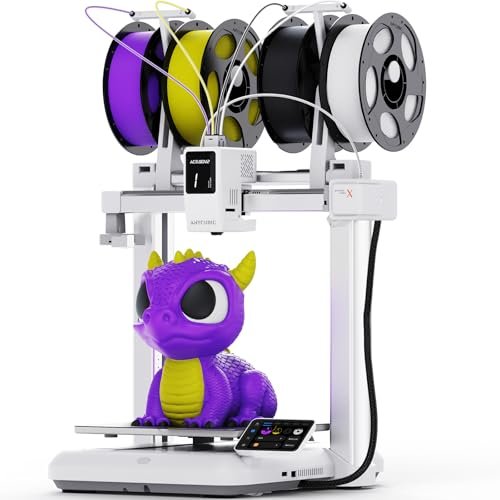
The ANYCUBIC Kobra X sets a strong standard for makers who want multicolor output without sacrificing build area. Its 260 x 260 x 260 mm build volume gives you ample room for larger creative designs, while the native 4-color ACE GEN 2 system expands all the way to 19 colors. Thanks to an optimized internal filament path, it cuts filament purge waste by over 81% to keep your running costs down. You also get an integrated AI 720P camera that spots print failures before you waste an entire spool.
Key features that stand out:
– Native 4-color printing expandable up to 19 colors with optional Ace 2 Pro units
– Shortened filament travel path that cuts color-change waste by 81.25 percent
– Space-saving top-mounted spool architecture ideal for high-density print farms
– LeviQ 3.0 auto-leveling using a 49-point calibration mesh for zero manual offset
– Built-in AI camera with real-time spaghetti detection and object skipping
Pros:
– Significantly reduces color-swap purge waste compared to older multicolor systems
– Top-mounted spool design saves valuable horizontal workbench space
– Fast setup right out of the box with zero manual bed tuning needed
Cons:
– The 260mm cubic build volume is slightly modest compared to dedicated jumbo-format printers.
Best for: Print farm operators and small business owners who need efficient multicolor batch production.
Expert Opinion: The Kobra X delivers on material efficiency. While other multi-filament setups generate mountains of purged purge towers, this system keeps waste remarkably low and makes multi-shade prints economically practical.
ANYCUBIC Kobra X Fast 3D Printer, Native 4-Color, High Speed
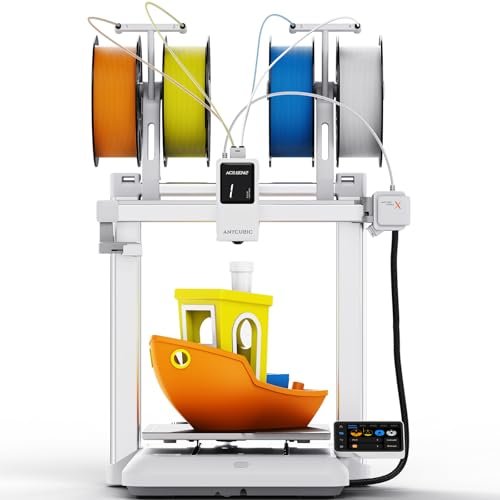
Designed for hassle-free home use, this version of the Kobra X focuses heavily on quiet operation and quick onboarding. Its pre-assembled modular design lets you go from unboxing to your first print in about 15 minutes. Operating at an ultra-quiet 45dB noise level, it prints quietly enough to keep on a desk or in a shared living room. The LeviQ 3.0 49-point auto-leveling delivers dependable first-layer adhesion across the entire 260 x 260 x 260 mm bed without any tedious manual adjustments.
Key features that stand out:
– Quick 15-minute modular assembly tailored for beginners and home workshops
– Quiet acoustic profile rated at just 45dB during normal operation
– LeviQ 3.0 auto-leveling system with 0.02mm calibration accuracy
– AI Guard system that automatically pauses when foreign objects are detected
– Vibrant 4-color automatic filament swapping via the ACE GEN 2 unit
Pros:
– Whisper-quiet stepper motors make it ideal for bedrooms and home offices
– Super fast initial setup without complex wiring or calibration
– Reliable AI safety checks that save prints from unexpected bed debris
Cons:
– An open frame architecture means you are limited primarily to standard filaments like PLA and PETG.
Best for: Families, hobbyists, and educators looking for an easy-to-use color 3D printer that runs quietly indoors.
Expert Opinion: If noise has kept you from running prints overnight, this machine is a breath of fresh air. It runs smoothly, catches bed snags with its AI sensor, and produces clean colorful parts right away.
Anycubic Kobra S1 Max FDM 3D Printer, Fully-Enclosed
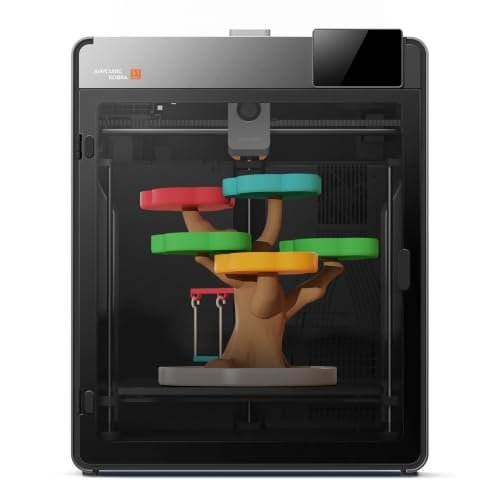
When you need serious scale, the Kobra S1 Max steps up with a massive 350 x 350 x 350 mm build volume inside a fully enclosed chassis. Its rigid CoreXY motion system easily supports print speeds up to 600mm/s while keeping vibration artifacts to a minimum. The machine handles demanding engineering polymers thanks to a 350°C high-temp hotend, a 120°C heated bed, and an actively heated 65°C chamber. Dual auxiliary cooling fans provide uniform airflow to prevent sagging on wide bridges.
Key features that stand out:
– Generous 350 x 350 x 350 mm build space for large functional prototypes
– High-speed CoreXY motion layout with accelerations up to 20,000 mm/s²
– 350°C hotend coupled with a 65°C heated chamber for technical filaments
– Dual auxiliary part cooling fans to minimize layer warping and stringing
– Sub-48dB silent operating modes for distraction-free printing
Pros:
– Enclosed and heated build environment stops ABS and ASA from warping
– Massive print bed allows full-size helmets and mechanical housings in one pass
– High structural rigidity keeps print quality crisp even at higher speeds
Cons:
– The large enclosed footprint requires substantial dedicated counter or table space.
Best for: Prototyping studios and functional makers who print heavy-duty ABS, ASA, or nylon components at scale.
Expert Opinion: This is a true workhorse for engineering-grade materials. The active chamber temperature control makes a night-and-day difference when printing wide, flat ABS parts that would normally warp off an open bed.
QIDI Max4 Combo 3D Printer, 390×390×340mm Build Volume
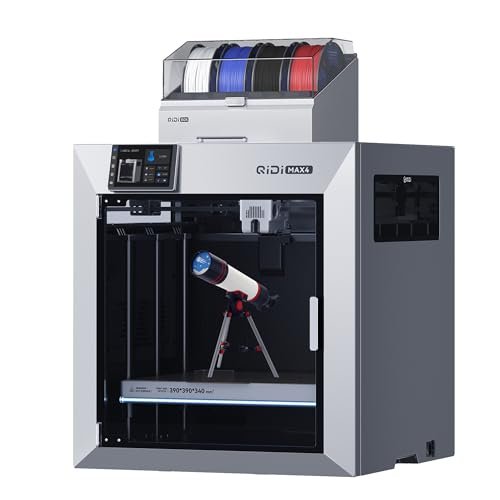
The QIDI Max4 Combo is an industrial-level powerhouse offering an enormous 390 x 390 x 340 mm print envelope. It features closed-loop motors on both the X and Y axes, pushing travel speeds up to 800mm/s with 30,000mm/s² acceleration. Material flexibility is top-tier: its 40mm³/s high-flow hardened steel nozzle and 65°C heated chamber chew through carbon-fiber blends like ABS-CF and PPS-CF effortlessly. Coupled with the QIDI BOX, you can also run up to 16 colors for complex multi-material projects.
Key features that stand out:
– Substantial 390 x 390 x 340 mm workspace with full-surface silicone heated bed
– Closed-loop stepper motors delivering up to 800mm/s print velocity
– Hardened steel high-flow hotend reaching high extrusion rates for abrasive filaments
– 65°C actively heated chamber for warp-free industrial polymer processing
– Multi-color expansion supporting up to 16 colors with automated filament runout recovery
Pros:
– Massive build plate accommodates huge automotive or cosplay pieces
– Closed-loop drive system prevents skipped steps during violent high-speed moves
– Handles advanced carbon-fiber reinforced filaments straight out of the box
Cons:
– The external Polar Cooler must be purchased separately if you want maximum cooling flexibility.
Best for: Engineers, industrial designers, and serious prop makers needing high-speed output with rugged, abrasive filaments.
Expert Opinion: The Max4 Combo is built like a tank. The closed-loop motor feedback gives you peace of mind on 40-hour prints, ensuring your tall, heavy components finish without layer shifts.
FLASHFORGE Adventurer 5M 3D Printer, All-Metal CoreXY
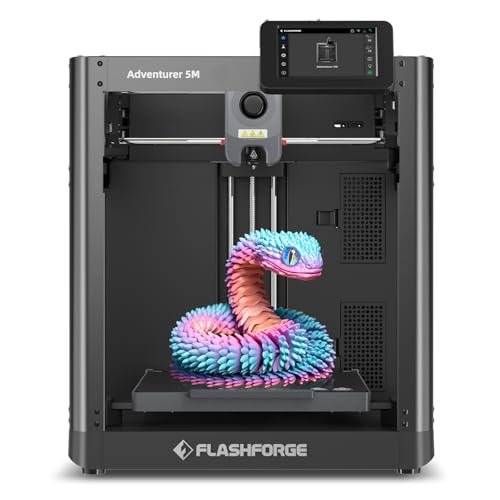
If you want speed without fuss, the Adventurer 5M packs a punch with an all-metal CoreXY structure capable of 600mm/s speeds. Its one-click automatic bed leveling checks nozzle offset directly on the bed surface, eliminating manual Z-offset calibration entirely. Swapping nozzle sizes is painless thanks to a quick-release 3-second mechanism, letting you move from fine detail to thick structural walls quickly. The 280°C direct-drive extruder paired with vibration compensation keeps your perimeter lines clean and consistent.
Key features that stand out:
– CoreXY mechanical frame boasting 20,000 mm/s² acceleration and 600mm/s speeds
– Fully automated one-click leveling with zero manual knobs or shims
– Quick-change nozzle system that swaps hotends in just three seconds
– High-flow 32mm³/s hotend reaching 200°C in roughly 35 seconds
– Flash Studio mobile app integration for remote print monitoring and control
Pros:
– Quick-swap nozzles make testing different extrusion widths effortless
– Solid CoreXY frame keeps high-speed ringing and ghosting under control
– Extremely fast pre-heating speeds cut down idle prep time
Cons:
– The build plate is smaller than other large-format options in this roundup.
Best for: Rapid prototyping for hobbyists and students who value quick nozzle changes and simple automation.
Expert Opinion: The Adventurer 5M is one of the easiest CoreXY printers to live with day-to-day. The hot-swap nozzle setup is genuinely useful when you want to jump from standard 0.4mm jobs to a chunky 0.8mm nozzle for rapid drafts.
Creality Ender-3 V3 Mega 3D Printer, TPU Printing Down to 85A
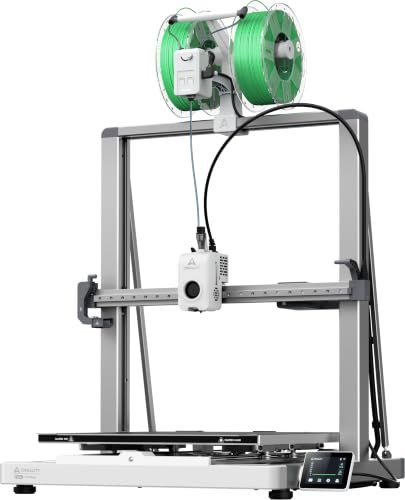
The Creality Ender-3 V3 Mega answers the call for genuine large-scale FDM printing with a massive 16.5 x 16.5 x 16.5 inch build volume (roughly 420 x 420 x 420 mm). What sets this giant apart is the upgraded Sprite 2 direct-drive extruder, specifically geared to feed soft elastomeric filaments down to 85A shore hardness without buckling. Long prints stay on track thanks to an automatic filament refill system that switches spools mid-print via an automated Y-valve relay. Dual Y-axis motors and reinforced dual Z-leadscrews keep the heavy bed moving smoothly at up to 500 mm/s.
Key features that stand out:
– Gigantic 16.5-inch cubic build volume for full-scale, single-piece printing
– Sprite 2 direct extruder tuned for flexible filaments down to soft 85A TPU
– Automated filament refill mechanism using a motor-driven Y-valve relay
– Reinforced frame equipped with dual Y-axis motors and sturdy Z-supports
– 81-point automated mesh bed leveling with integrated filament tangle detection
Pros:
– Massive bed size eliminates the need to split full-scale models into separate pieces
– Outstanding flexible filament handling where most large printers jam
– Built-in filament switchover keeps gigantic print jobs running through empty spools
Cons:
– The massive heated bed takes several minutes to reach uniform thermal equilibrium across the surface.
Best for: Cosplayers building full armor sets and engineers printing large gaskets, wearable prototypes, or outsized functional models.
Expert Opinion: Printing soft TPU on a bed this big used to be nearly impossible due to long retractions and weak extruders. Creality nailed the feed path here, making it a reliable choice for flexible prints at scale.
LONGER LK10 Plus High Speed 3D Printer, Klipper Firmware
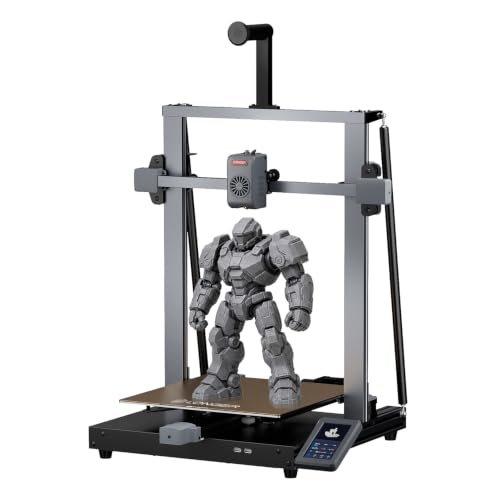
The LONGER LK10 Plus pairs an expansive 320 x 320 x 400 mm vertical build volume with the raw computing power of native Klipper firmware. It hits travel speeds up to 500mm/s while maintaining clean corners using built-in input shaping algorithms. Bed calibration is handled by an eddy current induction sensor, which quickly scans the textured plate for dynamic real-time Z-offset compensation. The dual-gear direct drive extruder maintains solid grip on everything from everyday PLA to slick Nylon filaments.
Key features that stand out:
– Spacious 320 x 320 x 400 mm volume for tall, single-piece mechanical assemblies
– Pre-installed Klipper firmware delivering up to 500mm/s and 10,000mm/s² acceleration
– Advanced eddy current sensor for contactless, high-accuracy bed scanning
– Dual-gear direct-drive extruder supporting abrasive and high-temperature filaments
– Dual-band 2.4GHz/5GHz Wi-Fi for remote job submission and monitoring
Pros:
– Generous Z-height is perfect for tall vases, props, and architectural models
– Klipper integration provides snappy web-based control and input shaping
– Eddy current sensor makes first-layer leveling consistent without mechanical switches
Cons:
– Open-bed bedslinger design requires plenty of front-and-back clearance on your workbench.
Best for: Makers needing extra vertical height on a budget who appreciate the responsiveness of Klipper firmware.
Expert Opinion: If tall models are your primary focus, the 400mm vertical reach on the LK10 Plus gives you tons of breathing room. Native Klipper makes tuning smooth, preventing typical tall-print resonance issues.
Anycubic Kobra X Multicolor 3D Printer, Easy One-Click Setup
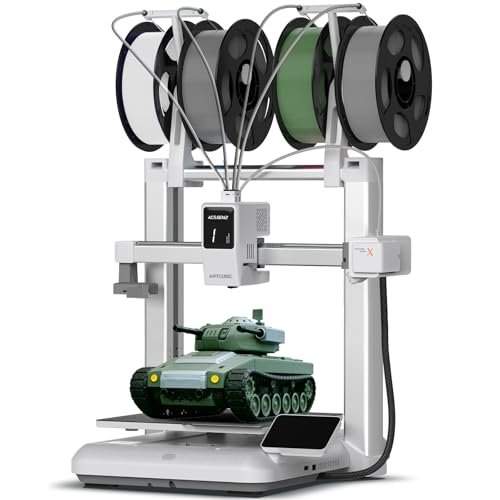
This iteration of the Anycubic Kobra X aims squarely at hassle-free multi-material creation. With 600mm/s maximum speed and an adaptive extrusion force compensator, you can blend rigid plastics and softer filaments like 68D TPU without constant manual tension adjustments. Its 300°C hardened steel nozzle resists wear from abrasive filaments like glow-in-the-dark or carbon-filled filaments across its 260 x 260 x 260 mm workspace. Remote fleet monitoring is simple via the companion app and the onboard 720P AI camera.
Key features that stand out:
– Adaptive extrusion force compensator handling rigid plastics and soft materials like TPU
– High-velocity printing up to 600mm/s supported by Kobra OS vibration compensation
– Wear-resistant 300°C hardened steel nozzle compatible with abrasive blends
– LeviQ 3.0 auto bed leveling with a 49-point calibration routine
– Onboard AI camera offering spaghetti detection and individual part-skipping features
Pros:
– Hardened nozzle handles composite materials without requiring immediate upgrades
– Adaptive extruder tension avoids messy jams when moving between PLA and TPU
– Object-skipping feature saves entire print beds if one item loses adhesion
Cons:
– The multi-material feeder requires proper filament spool clearance directly above the machine.
Best for: Designers and hobbyists wanting multi-material flexibility with hardened components straight out of the box.
Expert Opinion: The adaptive extrusion compensator is the hidden gem on this model. Being able to run flexible accents alongside rigid PLA parts without rebuilding your extruder saves serious time.
FLASHFORGE AD5X Multi-Color 3D Printer
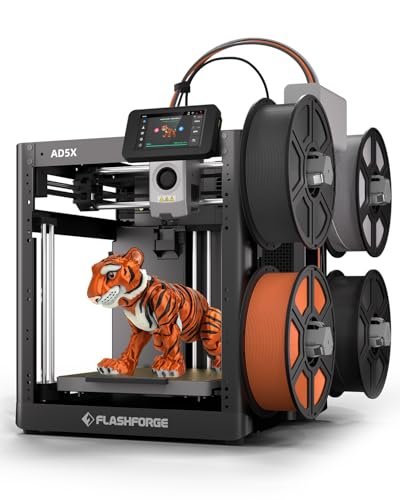
The FLASHFORGE AD5X brings CoreXY stability to colorful creations with a built-in 4-color multi-filament system. Reaching print speeds up to 600mm/s with 20,000mm/s² acceleration, it combines high production speed with vibrant palette swaps. Its 300°C direct-drive extruder features a dual-channel cooling fan array and built-in vibration compensation to eliminate visual surface banding. You also have access to hotends ranging from fine 0.25mm detail tips up to 0.8mm heavy-flow nozzles for rapid structural infill.
Key features that stand out:
– CoreXY motion platform engineered for 600mm/s speeds and rapid color changes
– Integrated 4-color printing module for seamless gradient and multi-tone models
– High-temp 300°C direct-drive toolhead paired with dual-duct part cooling
– Support for four nozzle sizes ranging from ultra-fine 0.25mm to broad 0.8mm
– One-click auto bed leveling with automatic filament load and retract routines
Pros:
– CoreXY design keeps multicolor printing fast and structurally stable
– Versatile nozzle ecosystem accommodates both fine miniatures and large, fast prints
– Dual-channel cooling system keeps overhangs sharp during rapid filament passes
Cons:
– The internal build space is more compact than other dedicated large-format beds.
Best for: Model painters, miniature crafters, and product designers wanting fast, multi-hue parts with minimal mechanical tuning.
Expert Opinion: Flashforge did a great job integrating the color switching into their proven CoreXY frame. It keeps speed high and ghosting low, making multi-color decorative pieces look crisp and clean.
Anycubic Kobra X Multicolor 3D Printer, Native 4-Color, Fast Assembly
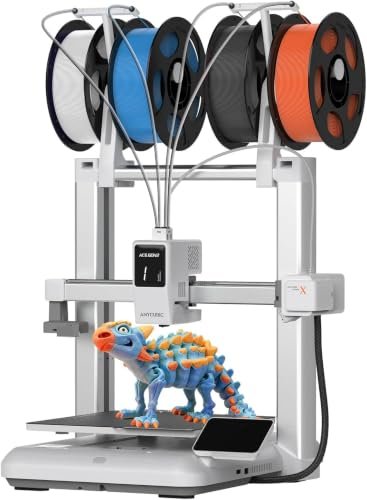
Rounding out the lineup is this rapid-assembly version of the Kobra X, designed to get your print farm rolling quickly. Featuring dual-band Wi-Fi and LAN connectivity, it connects smoothly to your network for centralized fleet management. The unit comes born with 4-color capability and expands up to 19 colors using multiple ACE 2 Pro modules. You get the same 81.25% purge path reduction, allowing you to finish multi-color models in nearly half the time of older generation multi-material printers.
Key features that stand out:
– Native 4-color setup with quick expansion options up to 19 distinct shades
– Drastically reduced purge distance saving up to half the time on color transitions
– Hardened steel nozzle paired with active resonance compensation for clean layer lines
– LeviQ 3.0 leveling algorithm ensuring 100% bed flatness in about 15 minutes
– Expansive network connectivity supporting dual-band Wi-Fi and hardwired LAN
Pros:
– Ethernet LAN port provides rock-solid connection stability in workshop environments
– Massive reduction in purge tower size speeds up multi-color run times
– Quick assembly gets you printing within 15 minutes of opening the box
Cons:
– Filament spools are not included in the standard retail package and must be bought separately.
Best for: Print farm creators and schools who want reliable network connectivity and efficient multi-color throughput.
Expert Opinion: The inclusion of an RJ45 LAN port is a welcome touch for serious workshops where busy Wi-Fi bands can cause dropped camera feeds or print interruptions. It makes fleet management clean and reliable.
Comparison Insights for Large Scale Printing
When choosing a printer for oversized projects, picking between CoreXY motion architectures and traditional bed-slingers is your most critical choice. Machines like the Anycubic Kobra S1 Max and QIDI Max4 use CoreXY frames, keeping the print bed moving only along the Z-axis. This keeps heavy models completely steady as they gain height, preventing the wobble and layer shifts often seen when a massive heated bed shuttles back and forth along the Y-axis.
Thermal management becomes just as important once your build area exceeds 300mm. Printing large, wide footprints with ABS, ASA, or carbon-fiber composites will almost certainly lead to warping on an open-frame printer. For those demanding materials, an actively heated chamber like the 65°C enclosure on the QIDI Max4 or Kobra S1 Max is mandatory. If you strictly print PLA, PETG, or TPU, open-bed options like the Creality Ender-3 V3 Mega or LONGER LK10 Plus give you massive build capacity at a much lower cost.
Lastly, pay attention to extrusion flow rates and nozzle sizes. A standard 0.4mm nozzle running at typical flow rates can take days to finish a single large helmet or functional prototype. Moving to a high-flow hotend with a 0.6mm or 0.8mm nozzle cuts print times by 40% to 60%, turning multi-day marathon prints into manageable overnight jobs.
Final Verdict
Different large-format printing jobs call for different machine strengths. Here is how I categorize the top picks from our testing:
- Raw Build Size Champion: The Creality Ender-3 V3 Mega takes the crown if your primary goal is printing giant, single-piece parts. Its massive 16.5-inch cubic volume and ability to feed soft TPU down to 85A make it unmatched for oversized costumes, automotive ducting, and wearable prototypes.
- High-Temperature Engineering Workhorse: The QIDI Max4 Combo stands out as the premier industrial solution. With its closed-loop motors, 800mm/s velocity, and 65°C heated chamber, it is built specifically for printing structural carbon-fiber parts without warping.
- Enclosed Scale with Multi-Polymer Range: The Anycubic Kobra S1 Max offers the best balance of generous volume (350mm³) and high-temp reliability inside a rigid, fully enclosed CoreXY chassis that keeps large ABS and ASA prints flat and clean.
- Multicolor Efficiency: For creators who want rich color options without generating bins full of wasted plastic waste, the ANYCUBIC Kobra X series sets the benchmark with its top-mount design and shortened purge travel.
Frequently Asked Questions About Large Volume FDM 3D Printers
What is considered a large volume FDM 3d printer?
In the desktop and semi-industrial 3D printing space, any machine offering a build area of 300 x 300 x 300 mm or larger is generally classified as a large volume fdm 3d printer. These dimensions allow makers to print adult-sized helmets, architectural displays, and functional mechanical enclosures in one continuous job, eliminating the need to slice parts and glue them together later.
Why is an enclosed or heated chamber necessary for large prints?
As prints grow in volume and surface area, internal thermal stress increases. Materials like ABS, ASA, and Polycarbonate shrink as they cool down. An actively heated chamber or sealed enclosure traps ambient heat, cooling the extruded plastic slowly and evenly across the entire surface. This prevents severe corner lifting, bed detachment, and layer separation on wide, dense models.
Does a large build volume slow down overall printing speed?
A larger build plate does not necessarily mean slower nozzle speeds, but completing massive objects naturally takes longer simply because more filament volume is being extruded. However, on “bed-slinger” style printers where the plate moves along the Y-axis, moving a heavy glass or aluminum bed can cause ringing artifacts at high speeds. CoreXY machines bypass this issue by keeping the build plate stationary on the horizontal plane.
How do I prevent first-layer warping on an oversized print bed?
To maintain solid bed adhesion across a large surface, clean your PEI build sheet thoroughly with warm water and dish soap to remove oils. Ensure your printer uses a high-density automated mesh leveling system (such as 49-point or 81-point scanning) to compensate for minor dips in the aluminum bed. For materials prone to curling, applying a thin layer of specialized bed adhesive and using a 5mm brim in your slicer works wonders.
Should I upgrade to a larger nozzle size for big 3D prints?
Yes, moving to a 0.6mm or 0.8mm nozzle is one of the most effective upgrades for large-format printing. While a 0.4mm nozzle is great for fine figurines, it takes a long time to lay down thick walls on large objects. A 0.6mm or 0.8mm nozzle extrudes considerably more plastic per second, allowing you to cut structural print times in half while actually improving layer-to-layer strength.
How much power does a large volume FDM printer consume?
Large printers consume more electrical power than standard machines, primarily due to the energy required to heat an oversized print bed. A typical 300mm to 400mm heated bed can draw between 500 and 1000 watts during initial heating. Once the chamber and bed reach their target temperatures, power consumption drops down to a steady 150 to 350 watts depending on ambient room conditions and chamber insulation.
Affiliate Disclosure: As an Amazon Associate, I earn from qualifying purchases made through links on this site.