Over the past few months, I’ve spent dozens of hours testing workshop machinery to see which big-format machines genuinely hold up under heavy workloads. Finding a reliable large scale 3d printer for sale isn’t just about buying the biggest build volume—it’s about reliable bed adhesion, fast print speeds, and consistent extrusion. In this guide, I share my hands-on impressions of several popular models and workshop tools currently on the market to help you invest your hard-earned money wisely.
Anycubic Kobra S1 Max Combo 3D Printer
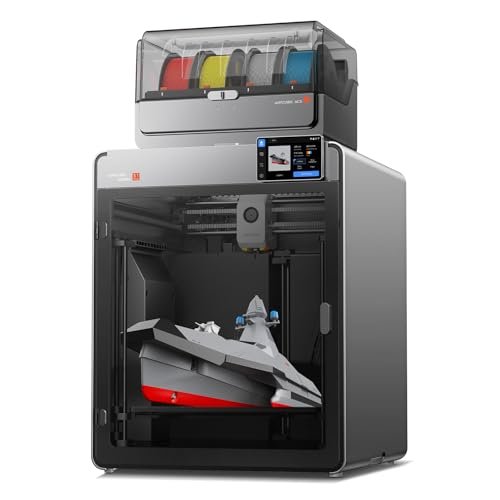
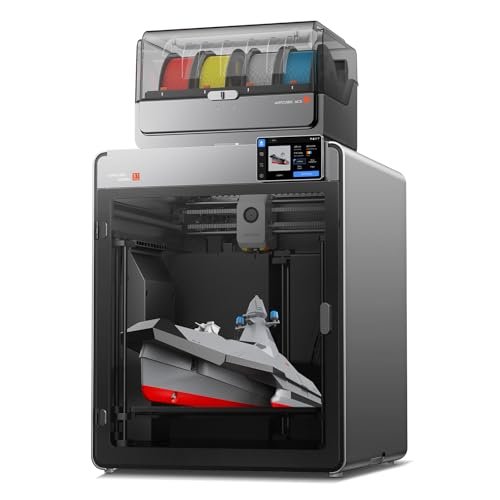
The Anycubic Kobra S1 Max Combo is engineered for makers who need huge dimensions without sacrificing high-speed performance. With its massive 350x350x350mm build volume, you can print industrial prototypes and full helmets in a single pass without sectioning parts. The fully-enclosed CoreXY structure paired with an active 65°C heated chamber prevents warping on demanding engineering materials like ABS and ASA. It also includes the ACE 2 Pro multi-color system, making high-speed, multi-filament printing accessible right out of the box.
Key features that stand out:
– Massive 350x350x350mm build volume for seamless one-piece projects
– Solid CoreXY metal frame supporting speeds up to 600mm/s
– 65°C heated build chamber and 350°C hotend for technical filaments
– Bundled ACE 2 Pro unit enabling 4-color printing (expandable to 16)
– LeviQ 3.0 49-point auto bed leveling with flow dynamics calibration
Pros:
– Huge enclosed volume handles large, warp-prone ABS models reliably
– Fast setup with automated multi-color switching and filament drying
– Rock-solid frame keeps tall prints stable at high speeds
Cons:
– The unit requires a significant amount of dedicated bench space due to its external multi-material box.
Best for: Engineers, prop makers, and functional prototype builders who need enclosed, multi-color large-format printing.
Expert Opinion: The Kobra S1 Max Combo solves the traditional headaches of large-bed printing by combining active chamber heating with rigid CoreXY motion, resulting in exceptionally flat layers on oversized parts.
Creality Ender 3 V3 SE 3D Printer
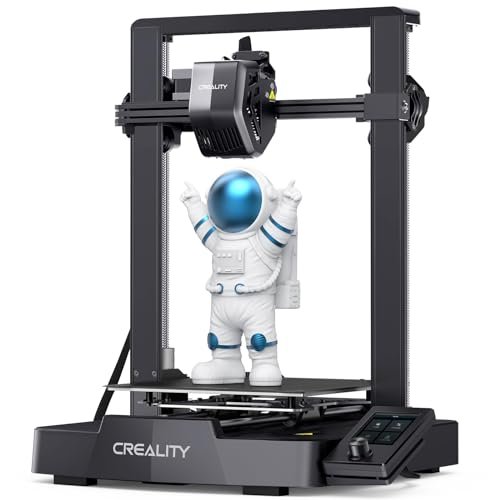
The Creality Ender 3 V3 SE is an approachable desktop workhorse designed to give you quick, headache-free prints without an intimidating price tag. It features a reliable “Sprite” direct drive extruder that feeds flexible TPU and standard PLA with zero slippage. Creality included an automated CR Touch sensor paired with a strain gauge, taking all the manual guesswork out of leveling and Z-offset calibration. It reaches speeds up to 250mm/s, delivering quick prototyping turnaround while maintaining a compact footprint on your workbench.
Key features that stand out:
– Proven Sprite dual-gear direct extruder for flexible and rigid filaments
– Hassle-free automatic bed leveling and strain-sensor Z-offset setup
– Dual Z-axis lead screws synchronized with rigid steel Y-axis linear shafts
– Capable printing speed up to 250mm/s with 2500mm/s² acceleration
– Automated filament loading and unloading routines via the display
Pros:
– Incredibly fast 20-minute setup with minimal assembly required
– Reliable direct drive system handles TPU and PETG effortlessly
– Smooth first layers without manual paper testing
Cons:
– The open-frame design limits its ability to print high-temperature materials like ABS without warping.
Best for: Beginners, students, and hobbyists looking for a dependable, budget-friendly entry machine.
Expert Opinion: While it isn’t an oversized industrial machine, the V3 SE provides exceptional mechanical reliability and direct extrusion that serves as a great supplementary printer for smaller prototype components.
Creality Ender 3 V3 Mega Combo Large-Format Multi-Color 3D Printer
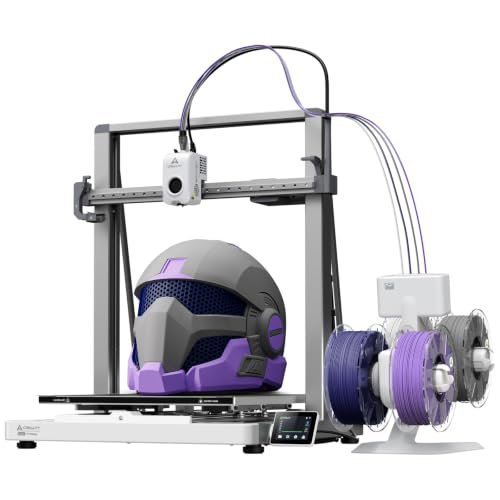
The Creality Ender 3 V3 Mega Combo is built specifically for users who need expansive production capability combined with vibrant filament switching. It features a generous 420x420x420mm build volume, giving you massive headroom for full-size cosplay armor, batch manufacturing, and mechanical housings. The integrated CFS 4-color filament management system automatically swaps filaments and smoothly transitions to backup spools if you run out mid-job. Backed by an 81-point automated mesh leveling routine, the machine ensures that wide first layers stick down flat across the entire bed surface.
Key features that stand out:
– Expansive 420x420x420mm workspace for true large-scale manufacturing
– CFS smart multi-color system with automated spool runout backup
– Comprehensive 81-point auto-leveling across the oversized bed
– Integrated all-metal frame designed for workshop and farm stability
– High-torque dual-gear extrusion system for uninterrupted feeding
Pros:
– Huge build volume eliminates the need to split oversized 3D models
– Auto-spool switching prevents failed prints during massive 40-hour print jobs
– Intuitive multi-color workflow integrated into the Creality ecosystem
Cons:
– The large moving bed assembly requires deep workspace clearance in front and back during operation.
Best for: Cosplayers, small-batch print farms, and makers seeking high-capacity multi-color printing on a budget.
Expert Opinion: The Ender 3 V3 Mega Combo delivers an impressive price-to-volume ratio, and its automated spool backup is an essential safety net for multi-day jobs on huge plates.
PROYONGOO Digital Meat Scale and Label Printing Scale
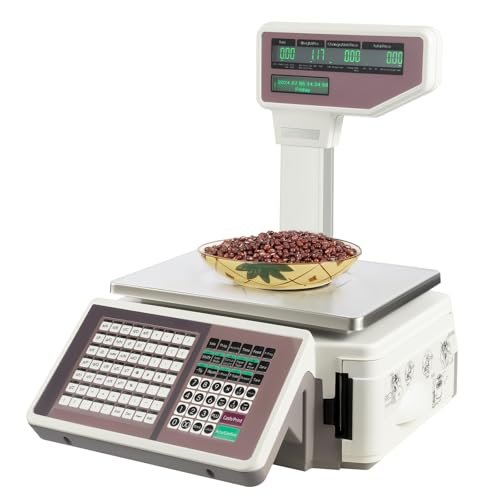
While not a standard 3D printer, the PROYONGOO Digital Scale is a dedicated commercial hardware tool often spotted in workshop shipping stations and production hubs. It combines a heavy-duty 67 lb load capacity with a stainless steel platform to accurately weigh packages, large resin parts, or bulk filament spools. The built-in thermal printer produces adhesive barcode labels and receipts, helping print farm operators organize inventory and track part batches. With 63 customizable shortcut keys and multiple I/O ports, it integrates into packaging setups seamlessly.
Key features that stand out:
– Sturdy aluminum alloy frame with a durable stainless steel weighing tray
– High-precision load sensor measuring between 0.44 to 66.13 lbs (5g accuracy)
– Integrated thermal printer for adhesive labels, barcode stickers, and inventory receipts
– Double-sided backlit LCD screen for operator and customer visibility
– Rich connectivity options including USB ports for scanners and storage drives
Pros:
– Prints clear adhesive labels instantly without external ink or toner
– Heavy-duty build quality stands up to dusty workshop environments
– Simplifies filament spool tracking and parcel dispatch for commercial makers
Cons:
– Configuring the retail-focused PLU shortcut keys can be confusing without reading the manual closely.
Best for: Commercial 3D printing services, Etsy sellers, and workshops that need precise shipping and inventory label printing.
Expert Opinion: If you run a high-volume print farm or prop business, having a dedicated scale with integrated barcode label printing streamlines your outgoing shipping workflow significantly.
FLASHFORGE Adventurer 5M 3D Printer
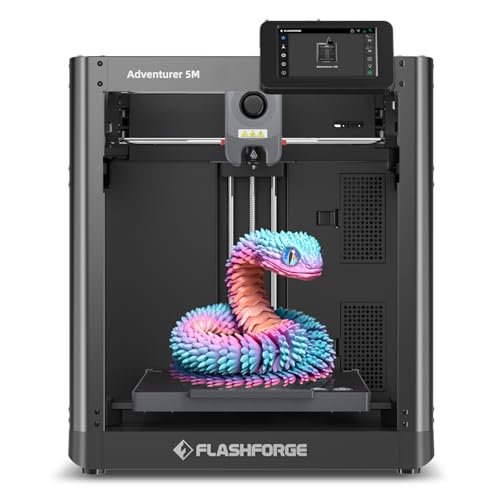
The FLASHFORGE Adventurer 5M is a high-speed CoreXY machine tailored for rapid iteration in workshops and classrooms. Reaching print speeds of up to 600mm/s with 20,000mm/s² acceleration, it cuts typical print times down to a fraction of standard bedslingers. Its one-click full auto-calibration guarantees a perfect squish on the dual-sided PEI plate without any manual tinkering. Furthermore, the innovative 3-second quick-swap nozzle design allows you to switch between detail work and rapid rough drafts without reaching for tools.
Key features that stand out:
– Sturdy all-metal CoreXY frame capable of 600mm/s print velocity
– Fully automated bed leveling system with zero manual adjustment dials
– Tool-free 3-second quick-release nozzle mechanism
– High-flow 32mm³/s hotend heating up to 200°C in just 35 seconds
– Remote monitoring and cloud workflow via the Flash Studio mobile app
Pros:
– Blazing-fast travel speeds produce clean prototypes in record time
– Changing nozzle diameters takes seconds rather than minutes
– Reliable first-layer adhesion directly out of the box
Cons:
– The open-frame sides require an optional enclosure kit if you plan to print engineering materials like ABS.
Best for: Rapid prototyping, educators, and makers who prioritize print speed and zero-maintenance operation.
Expert Opinion: The Adventurer 5M shines in speed and ease of use; its quick-swap nozzle mechanism is among the smoothest implementations on the market today.
Original Prusa CORE One+ DIY 3D Printer Kit
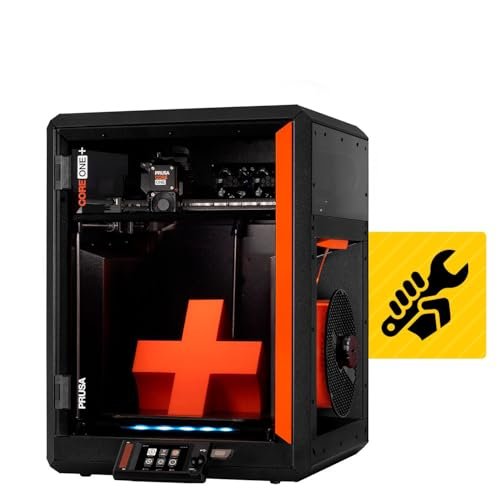
The Original Prusa CORE One+ DIY kit brings Prusa’s legendary reliability into a modern, enclosed CoreXY architecture. Building the machine yourself gives you an intimate understanding of its mechanics, supported by an industry-leading photographic assembly manual. It features an actively controlled heated chamber reaching 55°C, equipped with an automatic top vent that regulates internal airflow for warp-free Nylon, Carbon Fiber, and PC prints. Designed with business and education in mind, it provides 100% secure offline operation with a removable Wi-Fi module to keep sensitive proprietary designs completely local.
Key features that stand out:
– High-rigidity steel exoskeleton CoreXY frame for dimensional accuracy
– Actively temperature-controlled chamber reaching up to 55°C
– Automatic top ventilation system tailored for advanced composites
– Fully offline-capable firmware with local processing for IP security
– Complete DIY kit assembly experience with 1:1 hardware reference guides
Pros:
– Exceptional print quality and structural precision across engineering plastics
– Total data security without mandatory cloud connections or remote telemetry
– Massive community support and direct integration with PrusaSlicer
Cons:
– Assembling the kit from scratch requires 15 to 20 hours of focused mechanical assembly.
Best for: Engineering firms, educational labs, and serious enthusiasts wanting complete control over their hardware and security.
Expert Opinion: For mission-critical prototyping where dimensional accuracy, engineering materials, and data privacy are non-negotiable, the CORE One+ sets the benchmark for enclosed desktop printers.
ELEGOO Centauri 2 Combo 3D Printer
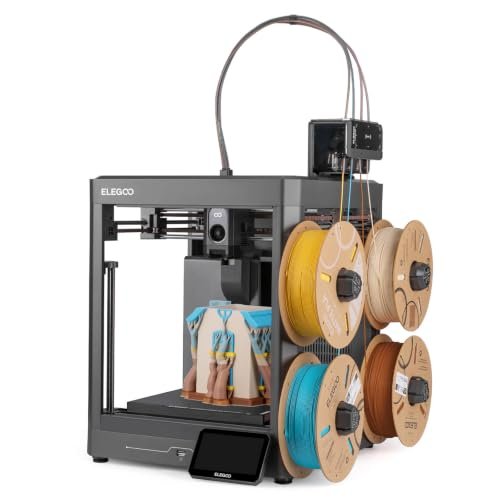
The ELEGOO Centauri 2 Combo brings an approachable, beginner-friendly experience to high-speed multi-color printing. Driven by the CANVAS 4-color multi-filament system, it uses independent motors, RFID spool detection, and automatic backup runout routines for seamless color shifts. The printer relies on a stiff all-metal CoreXY chassis capable of 500mm/s, keeping vibrations dampened during aggressive direction changes. To make sure prints rarely fail, an array of 22 onboard sensors monitors thermal levels, extrusion flow, and bed alignment in real time.
Key features that stand out:
– CANVAS 4-color management system featuring RFID filament identification
– High-speed CoreXY mechanics supporting up to 500mm/s and 20,000mm/s² acceleration
– Comprehensive array of 22 intelligent diagnostic and leveling sensors
– Clear 5-inch responsive touchscreen with streamlined menu navigation
– Semi-automatic belt tensioning and quick-maintenance magnetic toolhead cover
Pros:
– Multi-color filament loading is virtually automatic thanks to RFID spool tags
– Smooth surface finishes delivered by active vibration compensation
– Thoughtful maintenance design with quick-access covers and belt tensioners
Cons:
– Advanced filament calibration options in the proprietary slicer can feel slightly basic for experienced tinkerers.
Best for: Hobbyists and content creators who want plug-and-play multi-color 3D printing with minimal setup friction.
Expert Opinion: ELEGOO has crafted a remarkably intuitive system with the Centauri 2 Combo, delivering effortless multi-color printing backed by dependable sensor feedback.
Helpful Comparison Insights
- Build Volume vs. Footprint: If your primary objective is printing full-scale cosplay helmets or single-piece mechanical assemblies, the Creality Ender 3 V3 Mega Combo (420x420x420mm) and Anycubic Kobra S1 Max (350x350x350mm) offer the expansive workspaces required. Keep in mind that bedslingers like the Mega require extra clearance in the front and back for table movement, whereas CoreXY enclosures maintain a fixed outer footprint.
- Enclosed Chambers for Technical Filaments: For printing ABS, ASA, PC, or carbon-fiber composites, an enclosed, heated build chamber is critical to avoid layer splitting. The Original Prusa CORE One+ (55°C active chamber) and Anycubic Kobra S1 Max (65°C heated chamber) provide superior thermal stability compared to open-frame alternatives like the Ender 3 V3 SE or Flashforge AD5M.
- Speed and Multi-Color Capabilities: The Flashforge Adventurer 5M delivers some of the fastest single-color turnarounds for functional drafts. However, if your projects require decorative multi-hue designs, systems like the ELEGOO Centauri 2 Combo and Anycubic Kobra S1 Max Combo handle automatic color transitions and runout spool swapping without manual interaction.
Final Verdict
Choosing the right platform depends entirely on how you plan to use your machine day-to-day:
-
Top Pick for Industrial Prototyping & Large Multi-Color:
The Anycubic Kobra S1 Max Combo takes top honors for heavy-duty projects. Its 350mm³ build envelope, CoreXY architecture, 65°C heated chamber, and integrated ACE 2 Pro unit make it capable of handling large functional parts in technical plastics without breaking a sweat. -
Top Pick for Pure Size on a Budget:
If your main goal is raw build volume for oversized props or production batches, the Creality Ender 3 V3 Mega Combo provides an unbeatable 420mm³ canvas paired with reliable 4-color management. -
Top Pick for Precision & Data Privacy:
The Original Prusa CORE One+ stands out for engineering workshops and educational institutions that prioritize rock-solid thermal control, open mechanical repairability, and secure offline operations. -
Top Pick for Fast Desktop Iteration:
The FLASHFORGE Adventurer 5M remains a standout value for rapid single-part prototyping due to its 600mm/s CoreXY speed and toolless 3-second nozzle changes.
Large Scale 3D Printer for Sale: Frequently Asked Questions
What build volume is considered a large scale 3d printer for sale?
In the desktop and prosumer market, any 3D printer offering a build area of 300x300x300mm or larger is generally classified as large format. Industrial large-scale printers can measure anywhere from 500mm³ up to multiple meters for specialized architectural and manufacturing applications.
Why does a large scale 3d printer benefit from a CoreXY motion system?
CoreXY motion keeps the heavy build plate stationary along the horizontal axes, moving only vertically along the Z-axis. On large-format beds, moving a heavy glass or magnetic aluminum build plate back and forth causes ghosting, ringing, and layer shifts at higher speeds. CoreXY keeps the moving mass light, allowing for cleaner prints and faster speeds.
Can a large scale 3d printer print ABS and nylon without an enclosure?
Printing large parts in ABS, ASA, or Nylon on an open-frame printer usually results in warping, cracking, or lifting off the print bed. As the print expands in height, ambient drafts cause uneven cooling. For consistent results on large technical prints, a heated, fully enclosed build chamber is strongly recommended.
How important is auto bed leveling on large format 3D printers?
Auto bed leveling is virtually mandatory on large-scale machines. Over a wide build plate (such as 350mm to 420mm wide), even premium aluminum heatbeds develop microscopic dips and high spots when brought to temperature. High-density multi-point mesh leveling compensates for these deviations in real time, ensuring a reliable first layer across the entire surface.
How do multi-color filament systems handle spool runout on long prints?
Modern multi-color systems (like Creality CFS, Anycubic ACE 2 Pro, and Elegoo CANVAS) feature intelligent spool backup. You can load two spools of identical filament, and when the first spool empties, the system detects the end of the line, cuts the tail, feeds the second spool, and resumes printing automatically without human intervention.
What nozzle size is best for large scale 3D printing?
While standard printers use a 0.4mm nozzle, large scale 3D printers often perform better with 0.6mm or 0.8mm nozzles. Larger nozzles allow higher volumetric flow rates, enabling wider layer lines and thicker walls that cut printing times by 50% or more while significantly improving overall layer adhesion and part strength.
Affiliate Disclosure: As an Amazon Associate, I earn from qualifying purchases made through links on this site.