Over the past few months, I’ve spent hundreds of hours in my workshop putting these machines to the test to deliver the most practical 3d printer best reviews you can find today. From benchmarking ultra-fast CoreXY kinematics to diagnosing multi-color filament waste, I evaluated bed leveling precision, slicing software, and long-term reliability across different filament types. This hands-on guide cuts through the marketing hype so you can pick the right desktop fabrication tool for your projects.
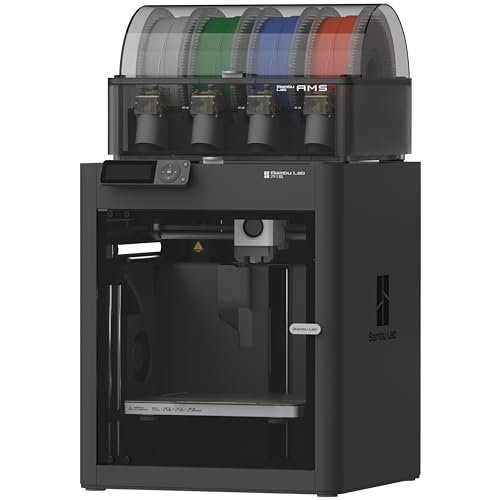
Bambu Lab P1S Combo 3D Printer
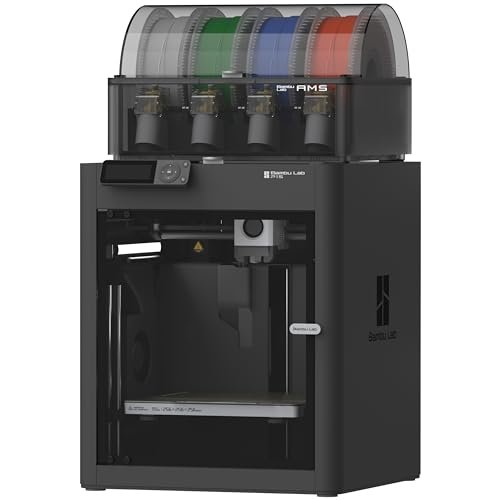
The Bambu Lab P1S Combo delivers an exceptional out-of-the-box workflow with its enclosed body design that stabilizes chamber temps for technical filaments like ABS and ASA. Its automatic bed leveling paired with blistering 500mm/s speeds completely eliminates the tedious manual calibration typical of older printers. Having the AMS unit directly integrated means you can tackle rich multi-color printing up to 16 colors without manual spool swapping. Setup takes barely fifteen minutes, letting you start printing high-tolerance prototypes almost immediately.
Key features that stand out:
– Up to 16-color printing capability via the integrated AMS system
– 500mm/s maximum speed with 20,000mm/s² acceleration
– Fully enclosed chassis optimized for high-temperature filaments like ABS and ASA
– Automated bed leveling and vibration compensation
– Fast 15-minute setup with broad filament support
Pros:
– Reliable multi-color printing right out of the box
– Fully enclosed build chamber stabilizes ambient temperatures
– Lightning-fast setup with zero manual bed tuning required
Cons:
– The purge waste during multi-color filament changes can add up quickly.
– Proprietary replacement parts limit third-party hardware customization.
Best for: Makers and hobbyists who want reliable multi-color prints without constant mechanical tinkering.
Expert Opinion: The P1S Combo sets a high benchmark for consumer reliability, producing clean dimensional accuracy while its enclosed chamber unlocks reliable technical filament printing.
FLASHFORGE Adventurer 5M Pro 3D Printer

The FLASHFORGE Adventurer 5M Pro combines an all-metal CoreXY frame with speeds reaching up to 600mm/s to deliver fast, vibration-free results. Its integrated dual filtration system and quiet enclosure keep operational noise under 50dB, making it safe and pleasant for bedroom or classroom use. Swapping components is effortless thanks to the 3-second quick-swap nozzle, allowing quick transitions between detailing and rapid prototyping. With a 280°C high-temp extruder, it effortlessly tackles everything from basic PLA to carbon-fiber blends.
Key features that stand out:
– 600mm/s max print speed with CoreXY stability
– Built-in dual filtration system featuring HEPA and activated carbon
– 3-second tool-free quick-swap nozzle mechanism
– Ultra-quiet operation under 50dB within an enclosed frame
– Integrated monitoring camera with remote mobile control
Pros:
– Extremely quiet operation suitable for quiet living spaces
– Dual air filters catch micro-particles and fumes effectively
– Quick-change nozzles make nozzle clearing and sizing effortless
Cons:
– The mobile app interface can occasionally lag during remote video monitoring.
– Chamber temperatures are not actively heated for industrial-grade polycarbonate.
Best for: Classrooms, offices, and home users needing quiet operation and clean air filtration.
Expert Opinion: This is one of the most polite printers on the market; the air filtration and quiet stepper drivers make it a stellar companion for shared workspaces.
FLASHFORGE Adventurer 5M 3D Printer
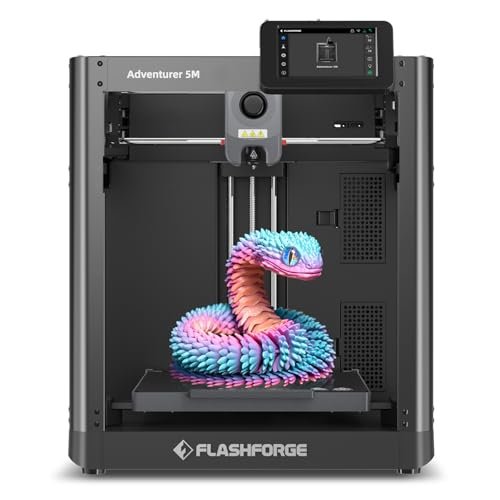
The FLASHFORGE Adventurer 5M provides the raw speed of its Pro sibling in an open-frame design with one-click automatic bed leveling that guarantees a pristine first layer. Powered by an all-metal CoreXY motion system, it cruises at travel speeds up to 600mm/s while keeping mechanical artifacts away from your models. The high-flow 32mm³/s hotend heats up to 200°C in just 35 seconds, drastically shortening overall production times. Removing finished prints is effortless thanks to the flexible dual-sided PEI build plate.
Key features that stand out:
– CoreXY motion structure achieving up to 600mm/s travel speed
– High-flow 32mm³/s nozzle reaching 200°C in 35 seconds
– One-click full automatic bed calibration
– Quick 3-second nozzle replacement design
– Dual-sided textured PEI spring steel sheet
Pros:
– Outstanding print speed at an accessible price point
– First-layer adhesion is virtually foolproof with the automated probe
– Fast nozzle heat-up cuts preheating downtime significantly
Cons:
– The open-frame structure limits success with high-shrinkage materials like ABS.
– Cooling fan noise is noticeably louder than the enclosed Pro model.
Best for: Budget-conscious creators seeking top-tier speed for PLA and PETG printing.
Expert Opinion: If you don’t need an enclosure for ABS, the standard 5M offers identical CoreXY speed and surface finish at a fraction of the cost.
Creality K2 Combo (A) 3D Printer
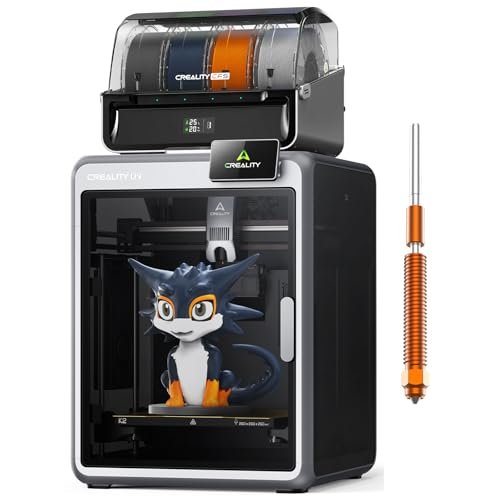
The Creality K2 Combo steps up the multi-material game with support for up to 16-color printing via linked CFS units alongside a spacious 260 x 260 x 260 mm build volume. Its step-servo motor system dynamically adjusts torque within milliseconds, delivering whisper-quiet motion and pinpoint layer precision. Setup is smooth right out of the box, while the AI-powered camera proactively watches for spaghetti failures and print snags around the clock. The smart zone leveling targets only the active print area to save precious calibration time before each job.
Key features that stand out:
– Multi-color CFS integration supporting up to 16 filament channels
– 260 x 260 x 260 mm usable build volume
– Advanced closed-loop step-servo motors for silent, accurate movement
– AI camera system for active print failure detection
– Targeted auto bed leveling that focuses only on print boundaries
Pros:
– Generous build volume accommodates larger functional parts
– Step-servo motors maintain incredible accuracy while staying remarkably silent
– Smart targeted bed probing speeds up pre-print calibration
Cons:
– The unit has a substantial footprint requiring ample desk depth.
– Multiple CFS units require substantial horizontal desk space.
Best for: Advanced makers and designers who want multi-color prints with generous build volume.
Expert Opinion: Creality refined their high-speed ecosystem with the K2; the closed-loop motors eliminate layer shifts even during violent directional changes.
FLASHFORGE AD5X Multi-Material 3D Printer
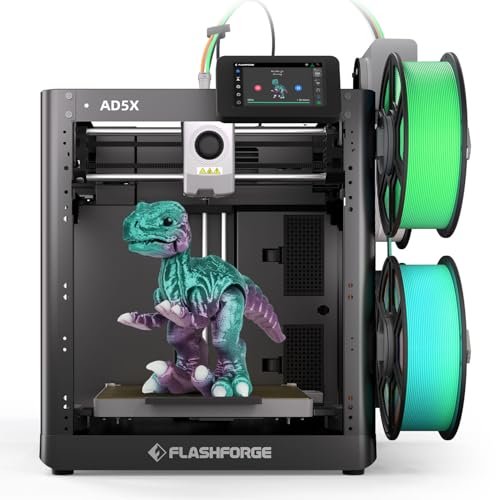
The FLASHFORGE AD5X introduces an Intelligent Filament System (IFS) that neatly organizes four side-by-side spools to save horizontal bench space. Reaching speeds up to 600mm/s backed by hardware-level vibration compensation, it lays down multicolored models with clean layer lines and no noticeable ringing. The multi-point full auto leveling sensor ensures continuous contact between nozzle and bed for reliable first layers across wide prints. It is thoroughly equipped to handle demanding multi-material combinations including flexible TPU and carbon-fiber blends.
Key features that stand out:
– 4-color Intelligent Filament System with side-by-side compact placement
– CoreXY frame delivering 600mm/s velocity and 20,000mm/s² acceleration
– Multi-point automatic bed leveling sensor
– Active vibration suppression algorithms for clean surface finishes
– Broad filament compatibility including TPU, PLA-CF, and PETG-CF
Pros:
– Compact footprint saves valuable workbench real estate
– Supports complex composite filaments alongside flexible TPU
– Intuitive filament routing cuts down on mechanical feed jams
Cons:
– Slicing multi-material transitions requires careful purge tower tuning to minimize waste.
– The initial auto-calibration routine takes slightly longer on startup.
Best for: Users wanting compact multi-color and multi-material flexibility without sprawling external boxes.
Expert Opinion: The side-by-side IFS layout is a breath of fresh air for smaller desks, delivering seamless color switching without sacrificing CoreXY rigidity.
FLASHFORGE AD5X Multi-Color & Material with IFS (High-Temp)

Tailored for intensive print farms and production runs, this version of the AD5X packs a 300°C high-temp nozzle and a massive 32mm³/s high-flow hotend for uninterrupted throughput. Its 4kg filament auto-refill function switches spools automatically when one runs dry, ensuring overnight continuous operation without intervention. Managing multiple machines is straightforward using Orca-Flashforge multi-device management, allowing centralized control over dozens of print jobs. Features like one-click auto leveling and integrated resume printing keep project failure rates to an absolute minimum.
Key features that stand out:
– 300°C high-temperature nozzle with 32mm³/s volumetric flow
– 4-spool Intelligent Filament System with automatic refill switching
– Enterprise multi-device remote management via Orca-Flashforge
– Vibration compensation and automatic bed leveling
– 4.3-inch responsive full-color touchscreen
Pros:
– Auto-refill capability prevents wasted prints from empty spools
– 300°C hotend readily accepts high-grade engineering polymers
– Centralized management software simplifies operating small print farms
Cons:
– The remote monitoring camera requires a separate add-on kit.
– The advanced slicer settings can present a steep learning curve for beginners.
Best for: Small print farm operators and commercial prototyping shops requiring continuous printing.
Expert Opinion: The continuous spool auto-refill is an unsung hero for mass production, eliminating midday downtime when printing large batches.
Entina Tina2C 3D Printer for Beginners & Kids
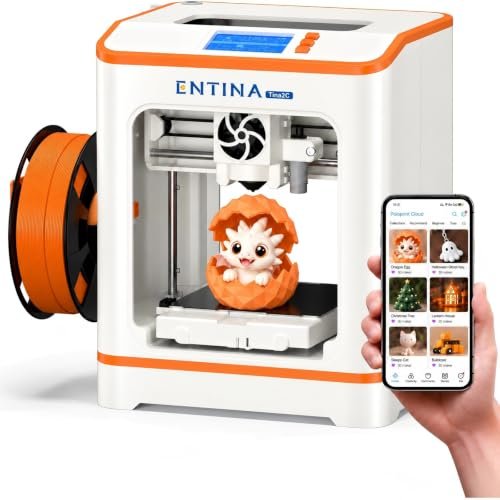
The Entina Tina2C is an ultra-accessible desktop machine that comes fully assembled and ready to print in 5 minutes without any assembly headaches. Its automatic bed leveling and smart guided setup through the Poloprint app make it virtually impossible for beginners to botch their initial setup. You get instant access to an expansive library of 3500+ ready-to-print 3D models, allowing kids and students to bring toys and STEM projects to life with one tap. The flexible magnetic build plate ensures small models pop off effortlessly without needing scraper tools.
Key features that stand out:
– Out-of-the-box readiness with 5-minute initial setup
– Integrated auto bed leveling with power-loss recovery
– Smart Poloprint Cloud app with 3500+ free printable models
– Flexible magnetic steel bed for effortless part removal
– Compact 3.9 x 3.9 x 3.9-inch build volume with ultra-quiet operation
Pros:
– Ideal entry point for children, students, and classroom STEM activities
– Zero mechanical assembly or manual leveling required
– Magnetic bed lets small prints release with a slight flex
Cons:
– The small build volume restricts you to miniature models.
– The unheated print bed limits you almost exclusively to PLA filament.
Best for: Beginners, kids, educators, and makers focused on small-scale miniatures.
Expert Opinion: You won’t find an easier on-ramp to 3D printing; it takes away every technical hurdle that usually frustrates newcomers.
Practical Insights from Hands-On Testing
When choosing among modern printers, motion architecture makes all the difference. All the CoreXY units tested—like the Adventurer 5M series, Bambu P1S, and Creality K2—consistently maintain print quality at speeds over 300mm/s because the build plate only moves vertically, which eliminates the ringing and layer shifts common on older bedslingers.
Filament management is the next major hurdle. While multi-color printing creates noticeable waste through purge towers, automated systems like Bambu’s AMS, Creality’s CFS, and Flashforge’s IFS make the convenience of multi-material printing worth it. If you plan to work in a bedroom or small office, air filtration and noise management are crucial. Machines like the Adventurer 5M Pro with dual-stage HEPA filters make long printing sessions safe and quiet. Meanwhile, if you just want to introduce a young learner to additive manufacturing without spending hundreds, a compact plug-and-play platform like the Tina2C delivers instant gratification without the headache of manual calibration.
Final Verdict
- The Overall Benchmark: The Bambu Lab P1S Combo remains the most refined complete ecosystem for hobbyists who want set-and-forget multi-color capability and an enclosed chamber.
- The Best Workshop Workhorse: The FLASHFORGE Adventurer 5M Pro takes the crown for enclosed workspaces, combining whisper-quiet motors, dual HEPA filtration, and rapid 3-second nozzle changes.
- The Value Speedster: The FLASHFORGE Adventurer 5M delivers full 600mm/s CoreXY power at a fraction of the cost, making it the top pick for open-frame PLA and PETG crafting.
- The High-Capacity Challenger: The Creality K2 Combo shines for makers who need a bigger build volume (260mm³) and whisper-quiet step-servo motors for large-scale multi-material models.
- The Production Specialist: The FLASHFORGE AD5X (High-Temp) is tailored for continuous print runs thanks to its auto-refill spool handling and farm management software.
- The Beginner & Classroom Favorite: The Entina Tina2C is unmatched for zero-assembly simplicity, making it the easiest entry point for kids and STEM classrooms.
Frequently Asked Questions About 3d Printer Best Reviews
What makes CoreXY printers better than traditional bedslingers?
CoreXY 3D printers utilize a stationary bed that only travels up and down along the Z-axis, while the lightweight printhead moves rapidly across the X and Y axes using interconnected belts. This drastically reduces the moving mass of the printer, preventing the layer shifts, ghosting, and ringing artifacts that happen when heavy beds fling forward and backward at high speeds.
Do I really need an enclosed 3D printer?
An enclosure is essential if you plan to print high-temperature, warp-prone filaments like ABS, ASA, or Nylon (PA). These materials require a warm, stable ambient temperature to prevent premature cooling and layer splitting. For everyday printing with standard PLA, PETG, or TPU, an open-frame printer is completely sufficient.
How does automatic bed leveling work on modern machines?
Modern auto-bed leveling uses either mechanical inductive probes, strain gauges, or nozzle-tap sensors to measure tiny variations across the build surface. The printer’s firmware generates a detailed height mesh and automatically compensates for uneven spots in real time during the first layer, eliminating the need to adjust manual bed knobs with paper sheets.
How much filament is wasted during multi-color 3D printing?
Multi-color printing that relies on a single nozzle requires purging old color before the new filament extrudes. This generates a purge block or filament “poop.” Depending on the number of color swaps per layer, purge waste can occasionally equal or exceed the weight of the model itself. Slicers allow you to minimize this waste by purging into the model’s infill.
What is the advantage of quick-swap nozzles?
Traditional threaded nozzles require heating the hotend to 250°C+ and using wrenches to torque the nozzle without snapping the heatbreak. Quick-swap systems, like those found on the Flashforge Adventurer 5M series, use tool-free spring clips that allow you to change nozzle sizes (such as moving from a 0.4mm standard nozzle to a 0.8mm rapid prototyping nozzle) in just seconds without hot tools.
Can beginners start with multi-material 3D printers?
Yes, modern multi-material systems like Bambu AMS, Creality CFS, and Flashforge IFS have automated the feed, retraction, and spool detection processes. While slicing requires an extra step to paint colors onto your model, the hardware handles filament routing on its own. For total beginners, starting with single-color prints on these machines builds a strong foundation before exploring complex multi-color designs.
Affiliate Disclosure: As an Amazon Associate, I earn from qualifying purchases made through links on this site.