When I first started printing structural brackets and custom shop jigs, standard plastics kept cracking under stress until I stepped up to reinforced composites. After pushing dozens of abrasive spools through hardened steel nozzles, I dialed in the exact materials that define the strongest carbon fiber filament for high-load projects. In this guide, you’ll discover which blends offer uncompromising industrial rigidity, which handle extreme engine-bay heat, and which deliver clean, warp-free parts right out of the box.
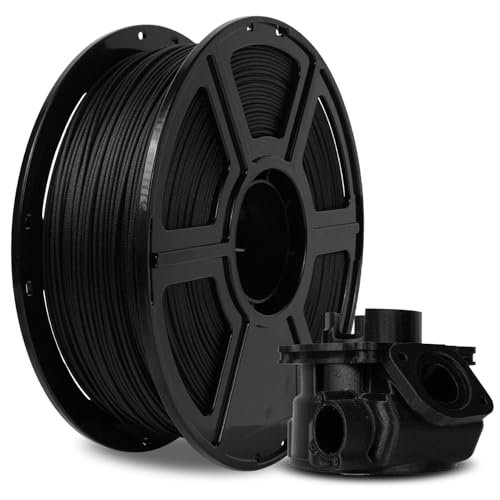
FLASHFORGE Carbon Fiber PETG Filament 1.75mm
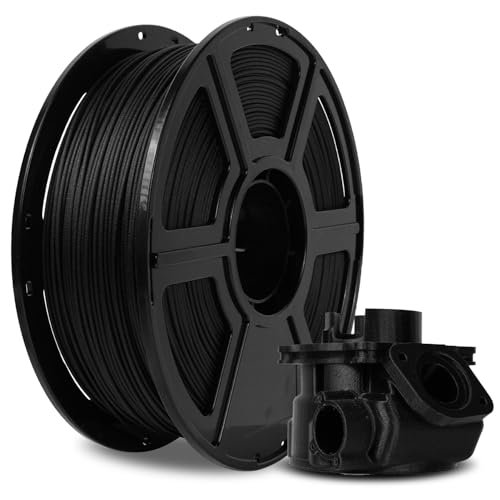
FLASHFORGE Carbon Fiber PETG blends structural stiffness with everyday printability, making it a reliable workhorse for shop tools and drone frames. The carbon fiber infusion creates a rigid dimensional core that drastically limits warping compared to unfilled plastics. You get the reliable impact resistance typical of PETG alongside superb surface finish quality that hides layer lines effortlessly. Every spool arrives thoroughly pre-dried and vacuum-sealed so you can jump right into printing without immediate moisture problems.
Key features that stand out:
– Infused chopped carbon fiber reinforcement for elevated tensile rigidity
– Outstanding dimensional stability with virtually zero print warping
– Carefully pre-dried for 24 hours and vacuum-packaged with desiccant
– Neat automated winding to prevent snags and mid-print tangles
– Generous two-month warranty backed by responsive customer support
Pros:
– Prints easily on standard open-frame beds without curling
– Hides layer lines under a clean matte texture
– Excellent chemical and moisture resistance for outdoor use
Cons:
– It is significantly more abrasive than standard PETG and will quickly ruin brass nozzles.
Best for: Functional outdoor brackets, drone frames, and shop fixtures that need weather resistance without tricky enclosure requirements.
Expert Opinion: This filament hits the sweet spot between structural durability and hassle-free printing. While it doesn’t match the thermal resistance of nylon blends, its dimensional stability on non-enclosed beds makes it an easy recommendation for functional daily parts.
SUNLU PA6-CF20 Carbon Fiber Nylon 3D Printing Filament
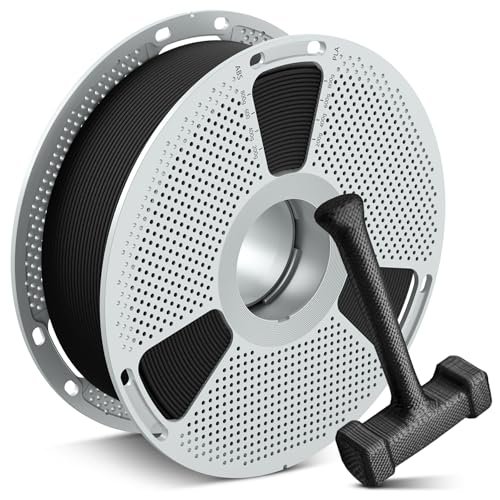
SUNLU PA6-CF20 is an engineering-grade powerhouse containing a heavy 20% carbon fiber load inside a tough Nylon 6 base. This material achieves an extreme heat resistance up to 209°C, allowing prints to live comfortably inside engine bays or high-temperature machinery. The dense reinforcement delivers exceptional torsional and tensile stiffness, holding its shape under heavy mechanical stress. Because of its rigidity, you’ll need an abrasive-resistant nozzle and a dedicated dry box during printing.
Key features that stand out:
– 20% chopped carbon fiber blend mixed into durable PA6 nylon
– High heat deflection capability resisting continuous temperatures up to 209°C
– High resistance against twisting, tension, and direct impact forces
– Tight diameter tolerance held within +/- 0.03mm
– Secure vacuum packaging designed to keep moisture penetration at bay
Pros:
– Incredible rigidity suitable for replacing machined metal brackets
– Unmatched heat resistance for high-temperature mechanical assemblies
– Dense layer bonding when printed at proper hotend temperatures
Cons:
– The material is brittle in raw strand form and cannot be used with automated multi-material feeder systems.
Best for: Automotive engine components, functional gears, and high-load industrial tools subjected to friction and heat.
Expert Opinion: If pure mechanical strength and thermal deflection are your priorities, SUNLU PA6-CF20 is a beast. Just make sure to bake it in a filament dryer before every run, as wet nylon will ruin your layer bonding and surface quality.
FLASHFORGE Carbon Fiber PETG Filament 1.75mm Black
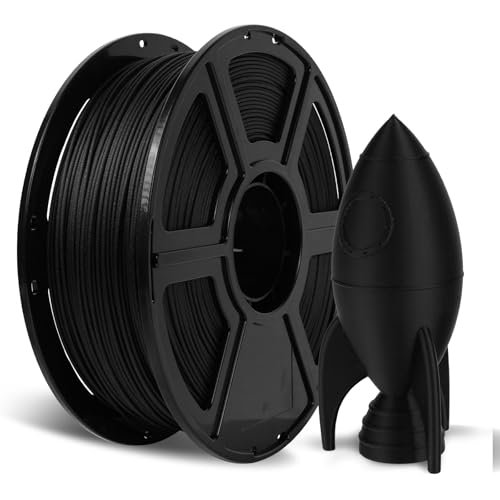
This dedicated black variant of FLASHFORGE PETG-CF focuses on high-friction durability and sleek industrial aesthetics. It provides enhanced mechanical wear resistance, making it a great pick for custom sliders, bushings, and low-speed gears. The chopped fibers form an anti-deformation matrix that ensures complex overhangs and wide structural bases print flat without lifted corners. It also handles elevated thermal loads much better than standard unmodified PETG spools.
Key features that stand out:
– Reinforced structural matrix for high-load bearing parts
– Enhanced resistance against sliding friction and surface abrasion
– Elevated heat resistance compared to standard PETG formulations
– Reliable anti-warping behavior across wide-surface prints
– Uniform matte black finish that diffuses light and conceals seams
Pros:
– Minimal shrinkage ensures precise hole diameters and joint tolerances
– Low odor emission during printing makes it comfortable for home workshops
– Resists road salts, oils, and general workshop chemicals
Cons:
– Requires higher hotend temperatures than regular PETG to prevent weak layer adhesion.
Best for: Sliding mechanical guides, robotics chassis plates, and tough functional brackets.
Expert Opinion: I love using this specific black PETG-CF when tolerances matter. It doesn’t shrink or pull away from the bed like nylon, saving you hours of test prints when designing tight-fitting assemblies.
Polymaker Fiberon PA6-CF20 Carbon Fiber Nylon Filament
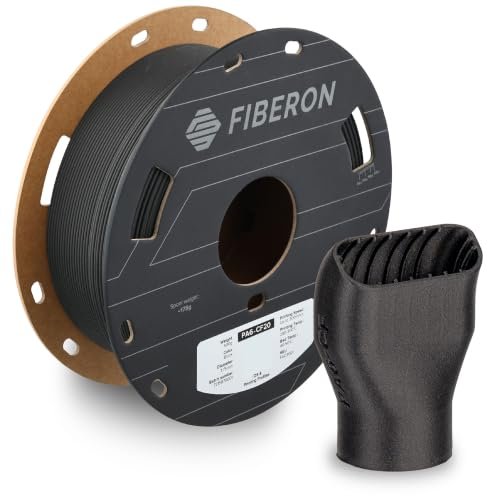
Polymaker Fiberon PA6-CF20 represents top-tier engineering composite development, boasting a verified dry tensile strength of 109.3 MPa along the X-Y axis. Once annealed, parts printed with this filament achieve an astonishing 215°C heat deflection temperature, standing up to extreme environmental punishment. Polymaker formulated this blend to print reliably even at high speeds without requiring an actively heated chamber. It is designed from the ground up for functional fixtures, production tooling, and demanding automotive prototypes.
Key features that stand out:
– Verified 20% carbon fiber reinforcement in a premium Nylon 6 matrix
– Immense 8.64 GPa Young’s modulus delivering unmatched mechanical stiffness
– High thermal deflection reaching up to 215°C after proper annealing
– High-speed flow properties supporting speeds up to 300 mm/s
– Predictable dimensional behavior during thermal post-processing
Pros:
– True industrial-grade mechanical strength backed by verifiable technical datasheets
– Prints cleanly at high travel speeds on modern core-XY machines
– Outstanding impact resistance that won’t shatter under sudden shock loads
Cons:
– You must dry this filament at high heat before printing and feed it directly from a sealed dry box.
Best for: End-use manufacturing jigs, under-hood brackets, and structural drone arms where failure isn’t an option.
Expert Opinion: Fiberon PA6-CF20 is one of the closest things to aluminum you can push through an FDM hotend. The post-annealing strength is phenomenal, provided you follow Polymaker’s strict drying protocols to the letter.
YXPOLYER PC-CF Filament Polycarbonate Carbon Fiber
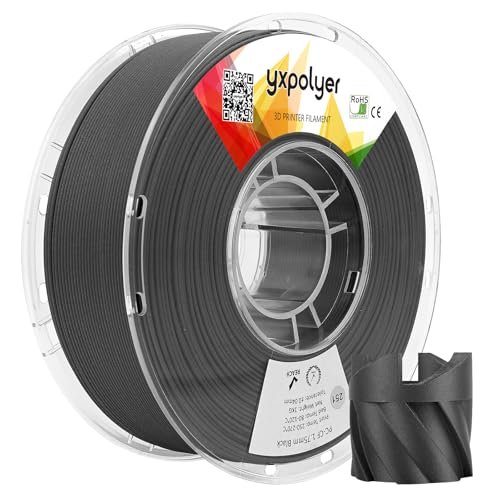
Combining the impact resistance of polycarbonate with the stiffness of carbon fiber, YXPOLYER PC-CF delivers exceptional strength without excessive brittleness. The calibrated 15% chopped carbon fiber ratio preserves the natural toughness and elongation properties of raw PC while eliminating its notorious warping tendencies. It provides an impressive continuous heat threshold of 140°C, handling punishing operational environments with ease. High internal flowability allows your extruder to push infill at speeds reaching up to 350 mm/s.
Key features that stand out:
– High-grade polycarbonate base loaded with 15% chopped carbon fiber
– High thermal endurance withstanding operating temperatures up to 140°C
– High-flow polymer matrix supporting rapid infill speeds up to 350 mm/s
– Self-supporting geometry design that makes support removal clean and effortless
– Superior resistance against impact and structural flexural stress
Pros:
– Bridges the gap between extreme stiffness and shatter-resistant toughness
– Far easier to print than standard virgin polycarbonate
– Supports pop away cleanly without leaving scarred surface patches
Cons:
– Demands hotend temperatures of around 280°C or higher for strong layer bonding.
Best for: High-speed printing of impact-resistant drone frames, robotics components, and protective motor enclosures.
Expert Opinion: Polycarbonate can be a nightmare to print, but the 15% carbon fiber in this spool tames the material completely. It yields incredibly strong parts that withstand heavy impacts without shattering like stiffer nylon-carbon composites sometimes do.
SUNLU Carbon Fiber PLA 3D Printer Filament
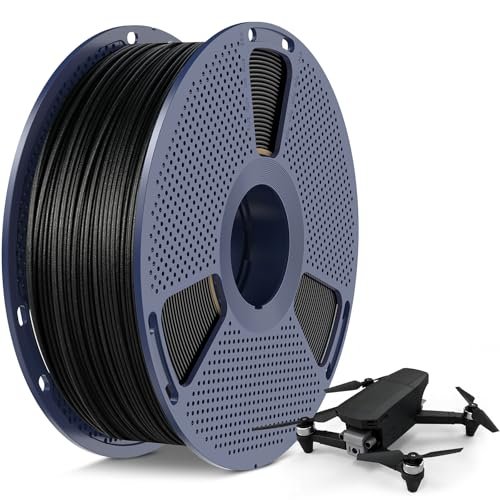
If you want the structural stiffness and cosmetic appeal of carbon composites without high-temperature hardware, SUNLU PLA-CF is an ideal gateway. This blend incorporates 15% micro-carbon fibers into an easy-flowing PLA base to boost flexural modulus and eliminate edge curling. It prints with a frosted matte surface finish that turns rough prototypes into professional-looking display models. It runs happily on basic open-bed printers using standard nozzle temperatures between 190°C and 230°C.
Key features that stand out:
– 15% micro-carbon fiber infusion to reinforce everyday PLA
– Frosted low-glare matte texture that erases visible layer lines
– Standard printing temperature profile compatible with basic FDM extruders
– Tight manufacturing diameter tolerance within +/- 0.02mm
– Minimal stringing and low-drag flow formulation to prevent nozzle blockages
Pros:
– Zero bed-warping issues even when working without an enclosure
– Incredibly easy to tune and print straight out of the box
– Clean overhangs and support structures that break away effortlessly
Cons:
– It retains the low temperature resistance of PLA and will soften inside a hot car.
Best for: Cosmetic prototypes, camera rigs, tabletop robotics, and non-heated functional assemblies.
Expert Opinion: While not built for hot environments, SUNLU PLA-CF is unbeatable for fast, rigid parts on entry-level printers. It offers incredible dimensional precision and the cleanest surface finish you’ll ever get out of a budget spool.
FLASHFORGE Carbon Fiber PLA Filament Volcanic Rock
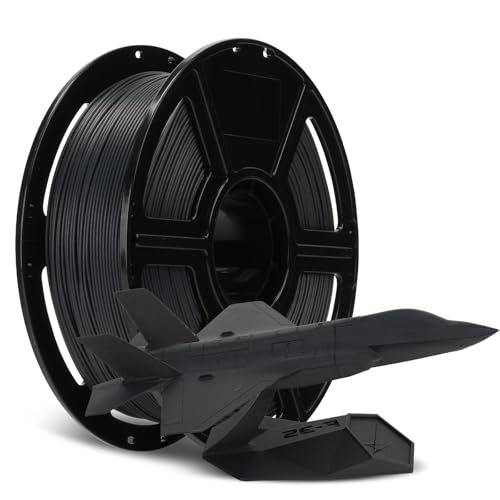
FLASHFORGE Volcanic Rock PLA-CF is tailored for makers who need crisp structural details paired with a unique, textured stone-like appearance. The chopped fiber reinforcement creates enhanced structural rigidity that prevents tall thin prints from wobbling on fast-moving beds. It delivers exceptional dimensional accuracy across complex mechanical joints, hinges, and snap-fit assemblies. The subtle volcanic texture adds tactile grip while masking minor layer inconsistencies across large flat surfaces.
Key features that stand out:
– Reinforced PLA composite featuring a distinct volcanic rock aesthetic
– High-rigidity matrix designed to resist flexing under light structural loads
– Low thermal shrinkage for dependable snap-fit and interlocking tolerances
– Low-odor formulation suitable for classroom and home office environments
– Smooth spool winding to ensure trouble-free overnight printing jobs
Pros:
– Distinct textured appearance that looks like machined injection-molded composite
– Excellent bed adhesion using basic PEI spring steel sheets
– Negligible warping across broad, flat mechanical parts
Cons:
– Low impact toughness means thin parts can snap under sudden shear forces.
Best for: Architectural scale models, designer tool handles, and lightweight rigid enclosures.
Expert Opinion: This filament is a dream for aesthetic housings and lightweight shop organizers. The subtle rock texture completely hides layer lines, giving your finished prints a premium, molded look without requiring post-processing.
PRILINE Carbon Fiber Polycarbonate Filament
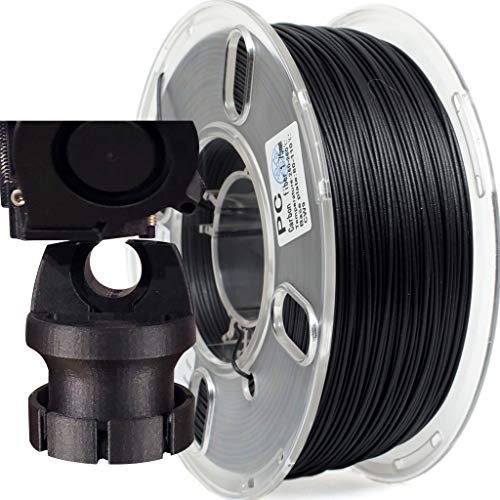
PRILINE Carbon Fiber PC is formulated specifically for engineering-grade structural components that demand high surface hardness and tensile stamina. It forms a dense carbon-polycarbonate alloy capable of withstanding rough workshop environments, chemical splashes, and abrasive contact. The chopped fibers drastically counteract polycarbonate’s natural tendency to shrink, yielding superb dimensional control on functional parts. It releases zero unpleasant odors during extrusion, keeping your shop air clean.
Key features that stand out:
– High-strength chopped carbon fiber reinforcement in an industrial PC base
– High surface hardness and abrasion resistance for sliding components
– Weather-resistant and chemically durable formulation
– Odor-free printing characteristics suitable for small workshop spaces
– Tight dimensional tolerances supported by strict manufacturing controls
Pros:
– High rigidity makes it suitable for structural brackets under continuous load
– Drastically reduced warping compared to unfilled polycarbonate filaments
– Excellent resistance to outdoor weather and industrial oils
Cons:
– Requires careful thermal calibration and a completely dry spool to prevent layer delamination.
Best for: Heavy-duty brackets, machinery guards, and mechanical parts subjected to harsh friction and outdoor exposure.
Expert Opinion: PRILINE PC-CF takes some patience to dial in, but the payoff in raw structural hardness is massive. Keep your hotend hot and draft fans low, and you’ll get rock-solid parts that can replace light cast-metal hardware.
Creality Hyper PLA-CF Filament 1.75mm
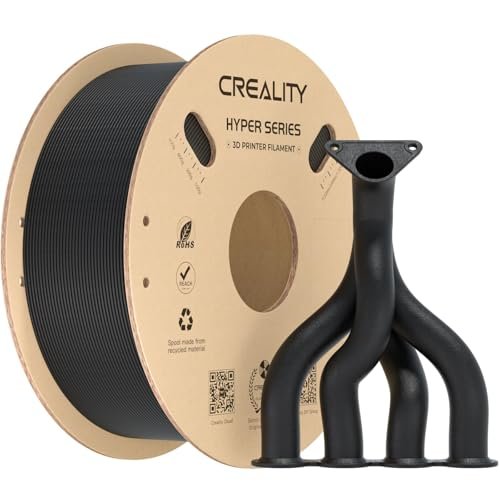
Engineered for the new generation of high-speed 3D printers, Creality Hyper PLA-CF maintains full structural integrity at speeds up to 300 mm/s. It delivers a 30% boost in mechanical properties over standard PLA, specifically across flexural strength and impact resistance. The carbon fibers stabilize the molten plastic instantly upon extrusion, producing flawlessly delicate surface details even during rapid direction changes. The self-supporting formulation also ensures that dense support lattices peel off without scarring the model.
Key features that stand out:
– High-speed flow properties optimized for print speeds up to 300 mm/s
– 30% increase in flexural modulus and impact toughness over standard PLA
– Quick-cooling composite structure that preserves delicate bridge spans
– Specially tuned self-supporting release characteristics for clean support removal
– Broad compatibility with both enclosed and open-frame Core-XY setups
Pros:
– Prints at blisteringly fast speeds without losing mechanical strength
– Clean support detachment that leaves minimal connection blemishes
– Zero warping or corner lifting even on wide-format build plates
Cons:
– Does not offer the high thermal threshold needed for engine or direct sun applications.
Best for: Rapid functional prototyping, high-speed Core-XY printing, and lightweight aerial vehicle components.
Expert Opinion: If you run a Bambu Lab, Creality K1, or Voron, this filament keeps pace with your machine’s top speed without breaking a sweat. It combines rapid print times with the stiffness needed for reliable structural testing.
ELEGOO PETG-CF 3D Printer Filament 1.75mm Black
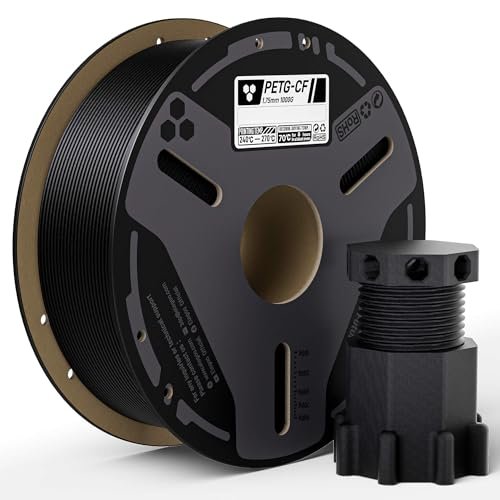
ELEGOO PETG-CF offers an outstanding balance of structural toughness, ease of use, and budget-friendly accessibility. Unlike stiffer filaments that tend to be brittle, this blend features high impact strength and fracture resistance, allowing it to absorb sudden shocks without cracking. The added carbon fibers impart impressive abrasion resistance, which keeps functional gears and pivot points working smoothly over time. It creates a smooth, fine matte surface that hides print artifacts while maintaining high dimensional repeatability.
Key features that stand out:
– Impact-resistant PETG composite blended with micro-carbon reinforcement
– High fracture toughness that resists catastrophic brittle failures under stress
– Abrasion-resistant surface properties ideal for functional mechanical wear parts
– Refined matte texture that effectively conceals layer lines and minor seams
– Broad printer compatibility using standard 240°C to 270°C hotend settings
Pros:
– Excellent balance of flexural strength without becoming brittle
– Far more forgiving on bed adhesion than nylon or polycarbonate composites
– Great price-to-performance ratio for everyday functional prints
Cons:
– Prone to mild stringing if your retraction settings and print temperatures are not perfectly dialed.
Best for: Functional household fixes, protective electronics cases, and low-wear gears needing impact absorption.
Expert Opinion: ELEGOO knocked it out of the park with this PETG-CF. It avoids the brittle nature of many budget carbon filaments, giving you a tough, impact-ready component that prints smoothly on almost any modern machine.
Carbon Fiber Filament Comparison Insights
Choosing the right composite comes down to understanding how the base polymer behaves under stress:
- Base Polymer Dictates Practical Strength: Carbon fiber adds stiffness and prevents warping, but the base polymer determines impact, thermal, and chemical limits. Nylon composites (PA-CF) provide the highest tensile strength and heat deflection, while Polycarbonate (PC-CF) offers extreme impact toughness and structural stiffness.
- Thermal Resistance Varies Drastically: If your printed parts are going under a car hood or inside hot enclosures, PA6-CF blends from Polymaker and SUNLU withstand temperatures exceeding 200°C. Meanwhile, PLA-CF blends will soften around 55°C, limiting them strictly to indoor and low-heat applications.
- Ease of Use vs. Mechanical Peak: If you don’t own an enclosed printer or an active filament dryer, PETG-CF provides the best balance of printability, weather resistance, and stiffness. It gives you 80% of the rigidity of high-end nylon without the nightmare of moisture absorption and bed adhesion failures.
- Hardware Requirements: Every carbon-reinforced spool is abrasive. Printing any of these filaments requires a hardened steel or ruby nozzle, as standard brass nozzles will bore out and lose diameter accuracy within a single print.
Final Verdict: Which Filament Should You Choose?
The Ultimate Heavy-Duty Performer: Polymaker Fiberon PA6-CF20
When you need the absolute maximum tensile strength and extreme heat deflection, this is the composite to load. After annealing, its mechanical properties rival machined metals, making it the undisputed champion for industrial jigs, engine components, and heavy-duty load-bearing fixtures.
The Best Everyday Functional Choice: ELEGOO PETG-CF
For workshop organizers, brackets, and outdoor fixtures, ELEGOO PETG-CF offers the ideal balance. It doesn’t demand an enclosure, resists moisture far better than nylon, and absorbs sudden impacts without snapping, all while keeping costs manageable.
The Top Pick for High-Speed Machines: Creality Hyper PLA-CF
If your priority is churning out stiff, structurally sound prototypes in record time on a modern Core-XY printer, Creality Hyper PLA-CF takes the crown. It flows cleanly at 300 mm/s, bridges effortlessly, and leaves you with gorgeous, line-free matte parts.
Frequently Asked Questions About the Strongest Carbon Fiber Filament
Does carbon fiber filament make parts significantly stronger?
Carbon fiber reinforcement primarily increases the stiffness, flexural modulus, and dimensional stability of a print rather than its raw layer-to-layer bonding. While standard plastics can bend and deform under weight, carbon-filled filaments resist flexing and keep their shape under heavy mechanical loads. However, because chopped carbon fibers can slightly disrupt layer adhesion (Z-axis tensile strength), you must print at higher nozzle temperatures to ensure maximum layer bonding.
Can I print the strongest carbon fiber filament with a standard brass nozzle?
No, you should never run carbon fiber composites through a standard brass nozzle. The chopped carbon strands act like liquid sandpaper against soft metals, widening a 0.4mm brass orifice within just a few hours of printing. Always swap in a hardened steel nozzle, tungsten carbide nozzle, or ruby-tipped nozzle before starting a composite print to preserve dimensional accuracy.
Why does carbon fiber nylon require drying before every print?
Nylon (polyamide) is inherently hygroscopic, meaning it rapidly pulls moisture directly out of the surrounding air. When wet filament enters the hotend, water boils instantly into steam, causing internal micro-voids, severe stringing, and catastrophic loss of tensile strength. To achieve the manufacturer’s rated mechanical strength, dry PA6-CF at 80°C to 100°C for at least 8 to 12 hours, and print straight from a heated dry box.
What is the difference between PA-CF, PC-CF, and PETG-CF?
The difference lies in their heat deflection, chemical resistance, and ease of printing:
– PA-CF (Nylon): Offers the highest continuous working temperatures (up to 200°C+ after annealing) and superior torsional strength, but is prone to moisture absorption.
– PC-CF (Polycarbonate): Incredibly rigid and impact-resistant with high heat deflection (around 140°C), but requires hot printing temperatures (280°C+).
– PETG-CF: Extremely easy to print on basic beds, highly resistant to moisture and weather, and rigid, but softens around 75°C.
Is carbon fiber filament toxic or hazardous to print?
While printing carbon-reinforced filament does not release free-floating airborne carbon fibers into your room, the base polymer will off-gas standard volatile organic compounds (VOCs). Materials like PLA-CF and PETG-CF release very little odor, but PA-CF and PC-CF should always be printed in a well-ventilated space or an enclosed printer with an active carbon HEPA filter. Avoid aggressively sanding raw prints without wearing a protective dust mask.
How does annealing improve the strength of carbon fiber prints?
Annealing is the process of baking your finished print in a controlled oven to relieve internal molding stresses and increase polymer crystallinity. For high-temp composites like Polymaker Fiberon PA6-CF, annealing at 100°C for several hours locks the carbon matrix together, dramatically boosting heat deflection thresholds and tensile stiffness so the part can withstand extreme operational environments without warping.
Affiliate Disclosure: As an Amazon Associate, I earn from qualifying purchases made through links on this site.