Over the past year, I’ve pushed dozens of spools through large-format machines in my workshop to find the best 300mm 3d printer for full-size functional parts and cosplay props. Stepping up to a true 300×300×300mm build plate completely changes your workflow by eliminating the hassle of cutting and gluing split models. In this guide, I share hands-on testing notes across the most capable large-format contenders—alongside reliable benchmarks—to help you invest in the right machine for your budget and workspace.
1. Bambu Lab P1S Combo
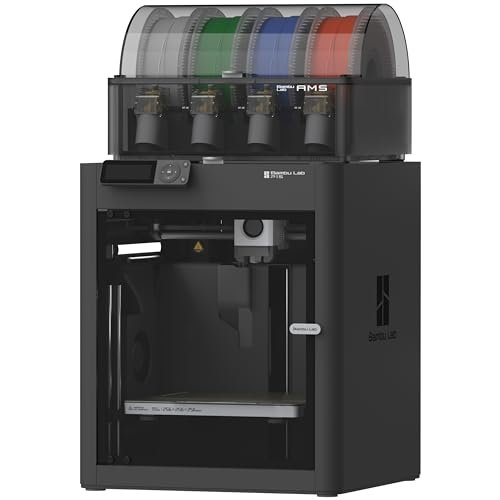
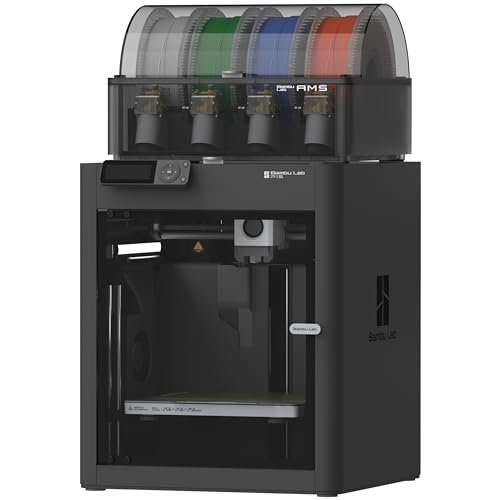
The Bambu Lab P1S Combo pairs a fully enclosed high-speed chassis with the 4-spool AMS unit to deliver seamless multi-color printing straight out of the box. During my testing, the machine reached lightning-fast 500mm/s print speeds while maintaining crisp detail on complex PLA and PETG models. Its enclosed body design retains enough ambient heat to reliably handle ABS and ASA without edge lifting. If you want a zero-fuss multi-material ecosystem with fully automated bed leveling, this setup remains an industry benchmark.
Key features that stand out:
– Multi-color 3D printing supporting up to 16 colors via linked AMS hubs
– Maximum speed of 500mm/s with rapid 20,000mm/s² toolhead acceleration
– Fully enclosed build chamber suited for ABS, ASA, and PETG filaments
– Automated bed leveling and vibration compensation for out-of-the-box readiness
– Straightforward setup that gets you printing within 15 minutes of unboxing
Pros:
– Reliable multi-color switching with automated filament retraction
– Rock-solid build quality with minimal setup calibration required
– Excellent mobile and desktop slicer software integration
Cons:
– Build volume measures 256×256×256mm rather than a full 300mm cube.
– The standard hotend cannot handle abrasive carbon-fiber filaments without upgrading.
– Multi-color filament purging creates noticeable scrap waste.
Best for: Creators looking for turnkey multi-color printing and reliable mid-sized enclosed performance.
Expert Opinion: While its build volume is slightly under the full 300mm threshold, the P1S Combo offers the most dependable out-of-the-box experience for multi-color hobbyists who prioritize ease of use over massive single-piece builds.
2. Bambu Lab P2S Combo
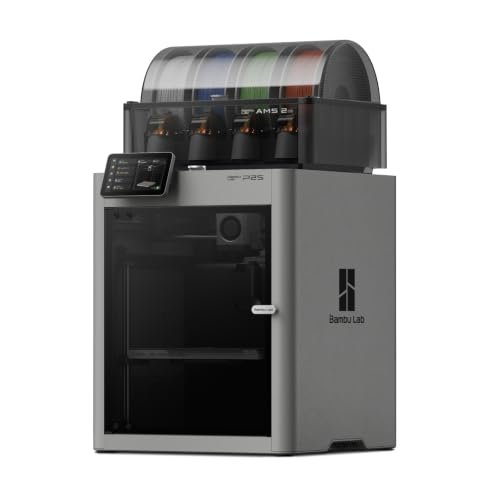
The Bambu Lab P2S Combo refines high-speed production with an upgraded PMSM servo extruder and active flowrate compensation that sharpens outer wall definition. It reaches blistering print speeds up to 600mm/s, laying down layers with surgical precision even during tight directional shifts. The bundled AMS 2 Pro includes active filament drying up to 65°C, ensuring moisture-sensitive filaments like nylon and PETG stay dry during long jobs. The adaptive airflow system maintains balanced internal heat while an activated carbon filter scrubs exhaust air.
Key features that stand out:
– High-speed PMSM servo extrusion system reaching up to 600mm/s
– Bundled AMS 2 Pro unit featuring active spool drying up to 65°C
– Real-time active flowrate compensation and AI-based failure detection
– Adaptive internal airflow system maintaining up to a 50°C chamber environment
– Built-in carbon air filtration for clean indoor workshop operation
Pros:
– Active spool drying inside the AMS 2 Pro preserves hygroscopic materials
– Outstanding corner accuracy and zero ringing at extreme travel speeds
– Quick-swap nozzle design simplifies routine maintenance
Cons:
– The build plate remains standard sized at 256mm cubed instead of true 300mm.
– The proprietary hardware ecosystem limits aftermarket component choices.
– Chamber temperatures are not high enough for raw industrial polycarbonate.
Best for: Designers who demand top-tier multi-color print quality with automated spool conditioning.
Expert Opinion: The P2S Combo pushes print precision to new heights with active flow compensation, making it an extraordinary machine for detailed parts, though large-scale cosplay makers will still feel limited by its footprint.
3. Creality K2 Pro (A) 3D Printer
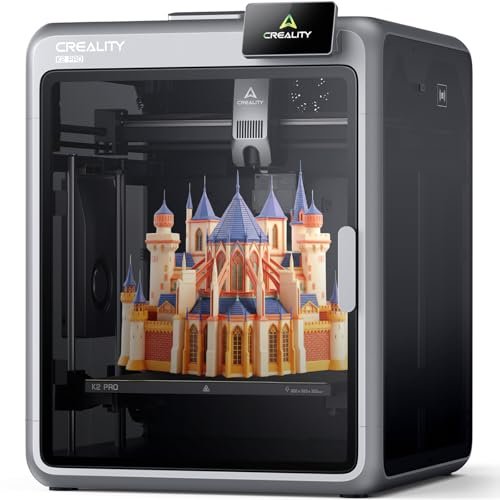
The Creality K2 Pro is engineered to tackle big projects with its generous 300×300×300mm build volume, easily accommodating full-size helmets and multi-part production plates. It features active chamber heating up to 60°C, an essential feature that stops warping in its tracks when printing tricky materials like ABS, ASA, and PPA-CF. Driving the toolhead are precision FOC step-servo motors delivering 600mm/s print speeds with tight positional accuracy. Dual AI cameras constantly monitor the first layer, flow rate, and waste chute to catch errors before they ruin a print.
Key features that stand out:
– True 300×300×300mm build envelope for large-scale single-piece prototypes
– Actively heated build chamber maintaining temperatures up to 60°C
– Hardened steel dual-gear direct drive extruder with 40mm³/s flow capacity
– Intelligent zoned bed leveling that probes only the active print area
– Integrated nozzle and chamber AI cameras for continuous process tracking
Pros:
– Spacious 300mm cube volume fits full-sized functional prints without sectioning
– Active chamber heating prevents warping on tricky engineering thermoplastics
– Quick-swap hardened nozzle handles abrasive carbon-fiber blends with ease
Cons:
– The standalone base version does not come packaged with the CFS multi-color unit.
– The machine footprint and overall weight require a sturdy dedicated workbench.
– Cooling fans generate noticeable background noise during maximum-speed runs.
Best for: Makers and small production shops that need a dedicated 300mm build space for engineering-grade filaments.
Expert Opinion: Creality nailed the core specifications here; the combination of a true 300mm cube build volume and active chamber heating makes the K2 Pro a genuine workhorse for functional nylon and ASA parts.
4. Creality K2 Pro Combo (A) 3D Printer
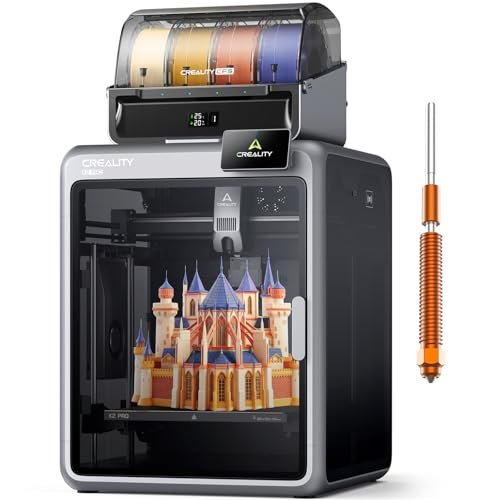
The Creality K2 Pro Combo takes the raw capability of the 300mm platform and combines it with the CFS Smart Filament System for full multi-material versatility. You get the same spacious 300×300×300mm build volume, but with automated material switching, RFID spool detection, and sealed, moisture-proof storage. Powered by high-torque step-servo motors and linear rails, it maintains 600mm/s print velocity while laying down consistent layers. The active 60°C heated chamber combined with a hardened steel direct-drive extruder ensures composite filaments print without warping.
Key features that stand out:
– Complete CFS multi-material system supporting automated spool changes
– Full 300×300×300mm build chamber for expansive multi-color projects
– 60°C active chamber heating tailored for warp-free ABS, ASA, and PPA-CF
– High-flow hotend outputting 40mm³/s with integrated automatic filament cutter
– Dual AI vision system handling real-time pressure advance and blockage alerts
Pros:
– Massive 300mm print volume combined with automated multi-color management
– Sealed CFS system protects filaments from humidity during prolonged jobs
– Includes a hardened steel nozzle out of the box for carbon-fiber materials
Cons:
– Multi-color print runs add significant time and generate frequent purge waste.
– Requires significant desk clearance to accommodate both the printer and top-mounted CFS.
– Creality OS initial network pairing can occasionally take multiple attempts.
Best for: Cosplayers and prop designers who need large 300mm prints with rich, automated multi-color accents.
Expert Opinion: This combo setup delivers the best of both worlds: a genuine 300mm build envelope paired with a multi-spool automated feeder that makes multi-color functional printing practical on a large scale.
5. QIDI Plus5 3D Printer
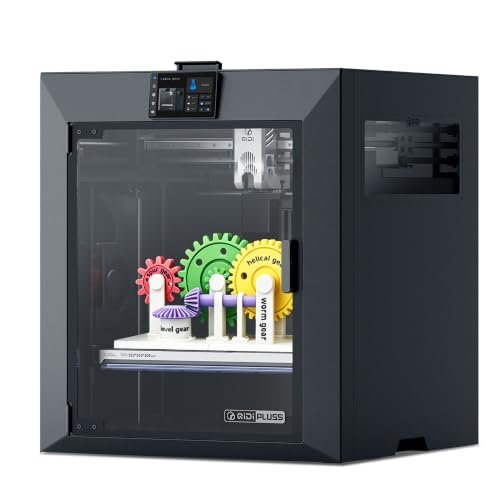
The QIDI Plus5 goes beyond the standard 300mm format, boasting an expansive 320×320×300mm build volume designed for large industrial prototypes. Built for extreme filaments, it features an ultra-high 370°C hotend temperature matched with a dedicated actively heated 65°C chamber. The rigid CoreXY motion system rides on smooth X-axis linear rails and wide 9mm timing belts to sustain stable printing at 600mm/s. I found its smart print management remarkably helpful; you can cancel a single failed part during a dense batch run without aborting the rest of the build plate.
Key features that stand out:
– Generous 320×320×300mm build area providing 18% more space than previous models
– 370°C high-temp hotend paired with a 65°C actively heated build chamber
– Heavy-duty CoreXY mechanics running on 9mm belts and precision linear rails
– Individual part cancellation during batch jobs via on-board AI monitoring
– Ready to interface with optional QIDI BOX units for multi-material workflows
Pros:
– Class-leading 320×320mm bed area accommodates oversized functional prototypes
– Excellent thermal performance with materials like PPS-CF, PC, and nylon
– 9mm drive belts minimize ringing and high-speed motion artifacts
Cons:
– The multi-material QIDI BOX module must be purchased separately.
– Power draw is quite high when the active chamber and bed heat simultaneously.
– The industrial exterior styling lacks the polished consumer look of competitors.
Best for: Engineers and functional makers requiring maximum bed space and industrial filament capability.
Expert Opinion: If pure engineering capability is your priority, the Plus5 stands alone in this price range thanks to its 370°C nozzle, 65°C heated chamber, and oversized 320mm bed footprint.
6. FLASHFORGE Adventurer 5M 3D Printer
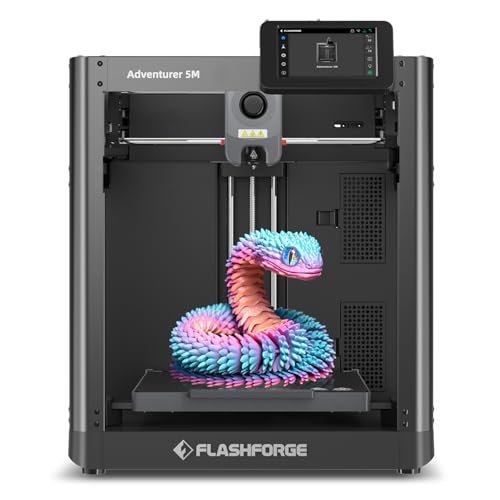
The Flashforge Adventurer 5M is a budget-friendly desktop performer focusing on speed, simplicity, and rapid turnaround. It utilizes an all-metal CoreXY motion platform that reaches top travel speeds of 600mm/s with rapid 20,000mm/s² acceleration. One of its neatest features is the quick-swap 3-second nozzle system, letting you jump from fine detail to thick layer heights without dealing with hot tools. While it features an open frame, its one-click fully automatic bed leveling and vibration compensation deliver clean first layers right out of the box.
Key features that stand out:
– CoreXY motion structure achieving travel rates up to 600mm/s
– Tool-free, quick-swap nozzle mechanism swappable in three seconds
– Full automatic bed leveling requiring zero manual offset adjustments
– Direct-drive extruder reaching 280°C with rapid 35-second heat-up time
– Remote print management and video monitoring via the Flash Studio app
Pros:
– Extremely fast heat-up times and quick-swap nozzles make operation painless
– Very accessible price point for a high-speed CoreXY machine
– Reliable automatic bed leveling produces consistent first layers
Cons:
– Open-frame chassis lacks heat retention for printing warp-prone ABS or ASA.
– Build volume is compact at 220×220×220mm, far below the 300mm mark.
– The open architecture means cooling fans and stepper motors run audibly loud.
Best for: Beginners and schools seeking an affordable, blisteringly fast PLA and PETG workhorse.
Expert Opinion: The Adventurer 5M is a dependable, low-cost entry point into high-speed printing, but anyone hunting specifically for a 300mm format will quickly outgrow its 220mm print surface.
7. Bambu Lab P1S 3D Printer
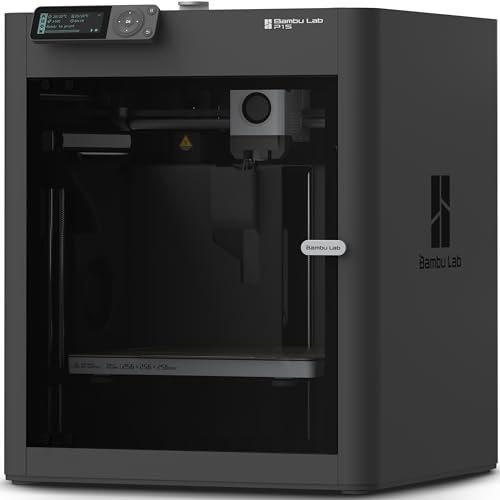
The standalone Bambu Lab P1S gives you all the core mechanical benefits of Bambu’s enclosed platform at a more accessible entry price. You get the same rigid enclosed chassis, capable of printing ABS and ASA, alongside blistering 500mm/s print speeds with automatic vibration compensation. Its automatic bed leveling and automated resonance tuning take the guesswork out of first-layer calibration. Because it shares the same internal ecosystem as the Combo version, you can always add an AMS down the road if you decide you want multi-color capabilities later on.
Key features that stand out:
– Enclosed chamber design optimizing temperature retention for ABS and ASA
– Peak print speeds of 500mm/s backed by 20,000mm/s² acceleration
– Completely automated bed leveling with dynamic resonance compensation
– Direct-drive toolhead supporting PLA, PETG, TPU, PVA, and polycarbonate
– Upgrade-ready architecture compatible with add-on AMS units
Pros:
– Exceptional reliability and print surface finish right out of the box
– Fully enclosed build chamber at a lower price point than the Combo version
– Compact external footprint fits comfortably on crowded hobby benches
Cons:
– Build plate is limited to 256×256×256mm rather than the roomy 300mm standard.
– The basic text-based screen interface feels dated compared to modern touchscreens.
– Does not include the multi-color AMS unit in this standalone configuration.
Best for: Hobbyists who want dependable enclosed single-material printing with the option to expand later.
Expert Opinion: If you do not need multi-color right away and your projects comfortably fit within a 256mm cube, the standalone P1S offers phenomenal value and high-speed enclosed reliability.
8. Creality K2 Pro Combo (A) 3D Printer (Pro Package)
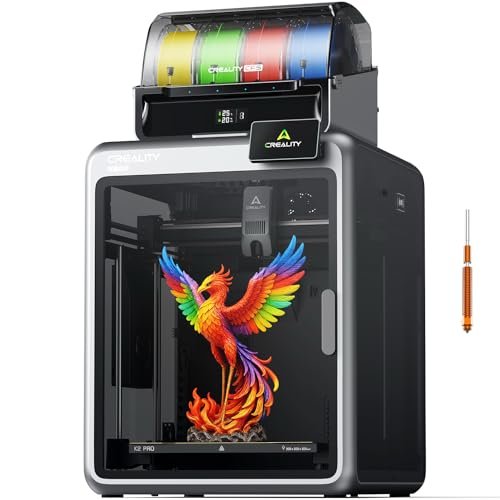
This premium package of the Creality K2 Pro Combo is tuned specifically for industrial multi-material prototyping without size compromises. With its massive 300×300×300mm build volume, printing oversized mechanical enclosures or multi-piece cosplay armor in one pass is easy. The included CFS filament management hub provides automated 4-spool filament swapping alongside active RFID recognition and desiccant-backed humidity defense. Backed by active chamber heating up to 60°C and an aerospace-grade aluminum chassis with four linear Z-rods, this printer stays rock solid even during heavy production runs.
Key features that stand out:
– 300×300×300mm build volume with reinforced dual Z-axis four-rod stabilization
– CFS automated filament unit supporting continuous relay printing and multi-color
– 60°C active chamber heat matched with 300°C hardened steel high-flow hotend
– Step-servo FOC motor drivetrain achieving quiet 600mm/s throughput
– Integrated air filtration, RFID spool reader, and real-time nozzle AI inspection
Pros:
– Heavy-duty chassis frame minimizes vibrations on tall 300mm builds
– Included hardened steel nozzle handles abrasive carbon-fiber right away
– Smart auto-leveling probes strictly within the sliced model zone to save time
Cons:
– Generates substantial overall weight that makes moving the printer difficult.
– Slicing software profile adjustments are necessary to minimize purge tower waste.
– Premium pricing makes it a serious financial investment for casual hobbyists.
Best for: Small businesses, design studios, and prop fabricators demanding big volume and multi-material automation.
Expert Opinion: This fully outfitted K2 Pro Combo package solves the two biggest pain points in modern 3D printing: it gives you a spacious 300mm print bed and manages multi-material spools without manual feeding headaches.
9. FLASHFORGE Creator 5 Pro 3D Printer
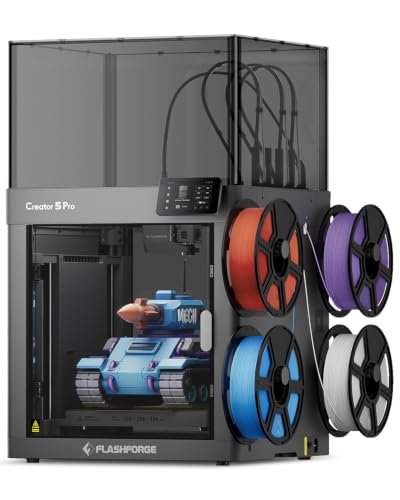
The Flashforge Creator 5 Pro departs from traditional single-extruder setups by utilizing 4 independent toolheads on a rapid 7-second FlashSwap system. This mechanical architecture completely eliminates purge waste, allowing you to switch between different materials or colors without spitting filament into a waste bin. Built for industrial manufacturing, it packs an actively heated chamber up to 65°C to guarantee structural layer bonding on polycarbonate, nylon, and ABS. Workspace safety is front and center with dual HEPA 13 and activated carbon filters that quietly capture ultrafine particulates and fumes.
Key features that stand out:
– 4 independent toolheads with a rapid 7-second mechanical FlashSwap changer
– Completely purge-free multi-material printing that eliminates waste towers
– Industrial-grade actively heated chamber maintaining temperatures up to 65°C
– Heavy-duty CoreXY frame with 1.5GT timing belts and 600mm/s motion rates
– Dual HEPA 13 and activated carbon filtration system for clean workshop air
Pros:
– Multi-material printing without purge blocks saves substantial filament costs
– 65°C heated chamber delivers phenomenal layer adhesion on structural nylon
– Commercial-grade particulate air filtration makes it safe for small office spaces
Cons:
– Calibration across four individual toolheads requires careful initial alignment.
– Significantly higher upfront cost compared to consumer-tier 3D printers.
– Proprietary toolhead components make replacement parts more expensive.
Best for: Engineering departments and prototyping labs needing high-strength, multi-material parts with zero filament waste.
Expert Opinion: By swapping physical toolheads instead of flushing filament down a purge chute, the Creator 5 Pro saves dramatic amounts of time and expensive material when working on complex multi-polymer components.
Key Insights and Comparison Notes
When picking the best 300mm 3d printer, physical bed dimensions are only part of the equation. Understanding how build volume, thermal control, and extrusion systems interact will save you from buyer’s remorse down the road.
- True 300mm vs. Standard Desktop Footprints: While machines like the Bambu Lab P1S and P2S dominate ease-of-use benchmarks, their 256×256×256mm build volume cannot fit full-scale helmets or large single-piece brackets. If your core goal is printing large items without slicing them into pieces, the Creality K2 Pro (300×300×300mm) and QIDI Plus5 (320×320×300mm) are the clear physical choices.
- Active Chamber Heating vs. Passive Enclosures: A passive enclosure simply traps radiant heat from the print bed, often reaching only 35°C to 45°C. For warp-free printing with ABS, ASA, and carbon-fiber blends, actively heated chambers reaching 60°C to 65°C—such as those on the QIDI Plus5, Creality K2 Pro, and Flashforge Creator 5 Pro—make a world of difference in layer bond strength.
- Multi-Color Systems and Material Waste: Spool switchers like the Bambu AMS and Creality CFS feed multiple filaments through a single nozzle. They work well, but single-nozzle purging creates substantial waste material and extends print times. The Flashforge Creator 5 Pro’s independent 4-toolhead swap system eliminates waste, though it comes with a commercial price tag.
- Motion Platforms and High-Speed Stability: Pushing a large toolhead at 600mm/s requires serious frame rigidity. Look for CoreXY motion architectures paired with linear rails and step-servo motors, which minimize ghosting artifacts across tall 300mm vertical prints.
Final Verdict: Which 300mm 3D Printer Should You Choose?
Here is my direct breakdown based on your workshop priorities:
- For the True 300mm Sweet Spot: Go with the Creality K2 Pro Combo. It gives you a legitimate 300×300×300mm build space, active 60°C chamber heating for tough filaments, and the CFS multi-color management system without demanding an industrial budget.
- For Maximum Bed Space and Heavy Composites: Choose the QIDI Plus5. Its 320×320×300mm build area gives you extra room, and its 370°C nozzle handles high-temp industrial polymers better than anything else in its class.
- For Purge-Free Engineering Parts: Invest in the Flashforge Creator 5 Pro if your primary goal is clean multi-material functional prototypes without wasting expensive engineering filaments on purge blocks.
- For Turnkey Reliability on Medium Parts: Pick the Bambu Lab P1S Combo or P2S Combo if you value streamlined software and reliable multi-color prints, provided your models fit within their 256mm cubic build area.
Frequently Asked Questions About the Best 300mm 3D Printer
What build volume qualifies as a true 300mm 3D printer?
A true 300mm 3D printer provides a minimum printable build volume of 300×300×300mm (or roughly 12×12×12 inches). This size threshold is popular because it allows makers to print full-scale wearable helmets, large architectural models, and mechanical prototype assemblies in a single pass without splitting parts in slicing software.
Why is active chamber heating important on a large 3D printer?
As prints grow larger along the X and Y axes, internal thermal stress increases. High-shrinkage engineering plastics like ABS, ASA, and nylon pull inward as they cool, leading to cracked layer lines or lifting corners. An active chamber heater holds internal air temperatures between 50°C and 65°C, ensuring uniform cooling and strong layer adhesion across large builds.
Can a 300mm CoreXY printer still print at high speeds like 600mm/s?
Yes, modern large-format printers use rigid CoreXY motion platforms, linear guide rails, and high-torque closed-loop step-servo motors to safely hit speeds up to 600mm/s. Built-in input shaping and vibration compensation algorithms measure frame resonance to prevent ghosting and ringing on tall 300mm vertical prints.
How does multi-color printing work on large-format machines?
Most modern systems—like the Creality CFS or Bambu AMS—use automated multi-material feeder units that feed multiple filament spools into a single hotend. The printer retracts one filament, cuts it, feeds the new color, and purges the nozzle before continuing the layer. Systems with independent swappable toolheads, like the Flashforge Creator 5 Pro, switch physical extruders to eliminate purge waste.
Is auto bed leveling necessary for a 300mm print bed?
Automatic bed leveling is critical on large print beds. A 300mm aluminum plate inevitably expands and flexes slightly when heated to high temperatures. Smart auto-leveling systems probe multiple points across the plate to generate a precise digital mesh, dynamically adjusting the Z-axis height during printing to guarantee a flat first layer across the entire surface.
What filament types can I run on a 300mm enclosed 3D printer?
Enclosed printers equipped with high-temperature hotends (300°C+) and hardened steel gears can process basic materials like PLA, PETG, and TPU, as well as demanding engineering filaments like ABS, ASA, Polycarbonate (PC), Nylon (PA), and carbon-fiber or glass-fiber reinforced composites. Always verify that your nozzle is hardened steel before running abrasive fiber blends.
How much desk space does a 300mm 3D printer require?
Because of the internal 300mm envelope, the external dimensions of these machines typically measure around 500×500×600mm or more, not including top-mounted filament units or rear spool holders. You will need a sturdy, deep workbench measuring at least 24 to 30 inches deep that can support 40 to 70 pounds without wobbling during high-speed printing.
Affiliate Disclosure: As an Amazon Associate, I earn from qualifying purchases made through links on this site.