I’ve spent hundreds of hours feeding composite spools through my hotends to see how carbon filament 3d printing performs when put under real mechanical loads. Mixing short carbon fibers into base polymers yields stiffer functional brackets, crisper surface finishes, and remarkably tight tolerances. In this guide, I share hands-on testing notes on ten popular options so you can choose the ideal spool for your next project without wasting time or money.
1. FLASHFORGE Carbon Fiber PETG Filament 1.75mm
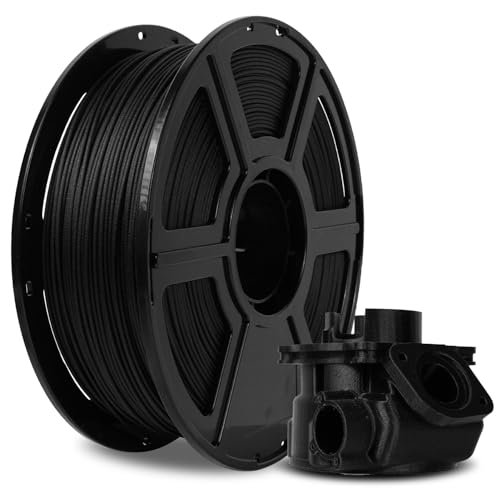
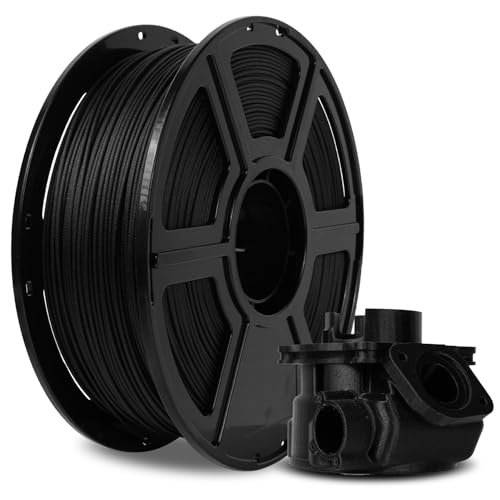
FLASHFORGE PETG-CF blends the chemical resilience of standard PETG with the structural rigidity of micro-carbon fibers. During test prints, it produced exceptional dimensional stability across thin-walled structural enclosures with virtually zero edge curling. The fiber matrix helps mask layer lines while delivering enhanced impact resistance that handles vibration better than standard brittle composites. It feeds reliably right out of the vacuum-sealed pack thanks to careful factory pre-drying.
Key features that stand out:
– 24-hour factory pre-drying process with tight vacuum sealing
– Enhanced impact and temperature resistance over base PETG
– Snag-free neat winding layout for smooth spool unrolling
– High compatibility across open-source 1.75mm FDM extruders
Pros:
– Strong structural integrity with minimal warping across broad flat prints
– Matte exterior hides layer lines cleanly right off the plate
– Backed by responsive customer service and a reliable replacement window
Cons:
– A hardened steel nozzle is mandatory because the chopped fibers quickly erode stock brass nozzles.
Best for: Functional outdoor brackets, drone arms, and automotive interior mount plates.
Expert Opinion: This PETG-CF offers one of the smoothest feeding profiles among mid-temperature composites, striking an ideal compromise between stiffness and layer toughness.
2. SUNLU PA6-CF20 Carbon Fiber Nylon 3D Printing Filament
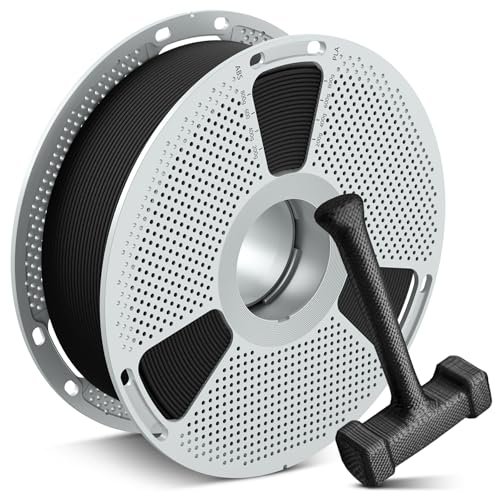
SUNLU PA6-CF20 is an engineering-grade powerhouse loaded with an 80/20 polyamide-to-carbon fiber ratio designed for demanding functional builds. In test assemblies, parts printed with this nylon composite demonstrated immense torsional strength and withstood substantial mechanical abuse. It handles operating environments reaching up to 209°C after a steady annealing cycle, making it suitable for under-hood automotive brackets. You will need an all-metal hotend running up to 290°C and a dry box running continuously while printing.
Key features that stand out:
– 20% chopped carbon fiber reinforcement by weight
– High heat deflection threshold up to 209°C post-annealing
– Tight +/- 0.03mm dimensional diameter accuracy
– High tensile and torsional stress endurance
Pros:
– Extremely rigid finished parts suitable for working industrial machinery
– High resistance to engine heat and mechanical friction
– Outstanding layer cohesion when printed hot with proper enclosure control
Cons:
– The filament is too stiff and abrasive for multi-material feeder units like the Bambu AMS.
– It pulls moisture from the ambient air rapidly and requires extensive pre-drying before extrusion.
Best for: High-stress mechanical gears, custom tools, and high-temp automotive components.
Expert Opinion: If you have an all-metal setup capable of 290°C, SUNLU PA6-CF20 produces production-grade mechanical pieces that rival injection-molded parts once properly annealed.
3. ELEGOO Carbon Fiber PLA 3D Printer Filament 1.75mm Black
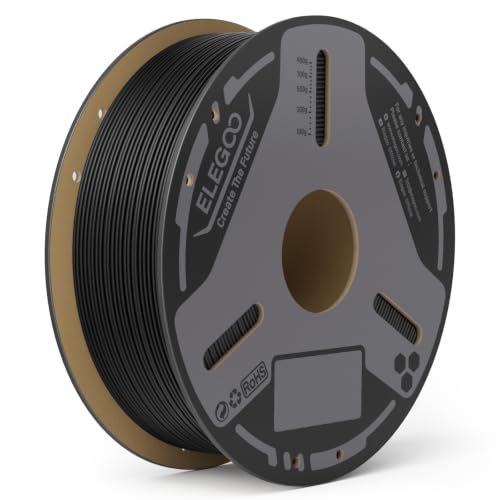
ELEGOO PLA-CF provides a straightforward entry point into composite printing without demanding high-temperature hotends or heated enclosures. The integrated fibers provide impressive flexural rigidity to the standard PLA base, preventing drooping on bridging sections and eliminating corner lift. The finished models present a refined matte charcoal appearance that looks like an end-use consumer product rather than a typical 3D print. It extrudes cleanly through standard temperatures around 200°C to 220°C.
Key features that stand out:
– Finely milled carbon fiber blend with PLA base
– Tight diameter tolerance held within +/- 0.02mm
– Precision mechanical winding to prevent spool tangles
– Low printing temperature requirements compatible with entry-level machines
Pros:
– Prints easily on basic desktop 3D printers with zero chamber heating required
– Delivers a uniform textured finish that completely hides Z-seams
– Excellent dimensional repeatability for interlocking mechanical components
Cons:
– It lacks the high thermal threshold needed for parts exposed to hot summer car interiors.
Best for: Ergonomic tool grips, functional desktop organizers, and lightweight RC aircraft components.
Expert Opinion: ELEGOO PLA-CF is my go-to choice when I need stiff, presentation-ready prototypes with zero warping headaches on open-frame printers.
4. YOUSU 3D Printer Filament Galaxy PLA Filament 1.75mm
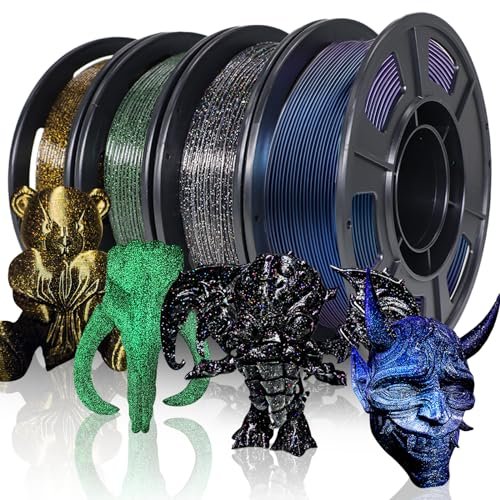
YOUSU Galaxy PLA brings a different dynamic to rigid filaments by blending deep glitter flecks and glow-in-the-dark properties into a multi-color mini-spool pack. While not an industrial structural carbon composite, this blend features increased material stiffness over standard PLA, offering clean bridging performance and crisp edges. The four 250g spools allow you to run specialized styling projects without buying full-size rolls of multiple finishes. It flows smoothly, though using a larger nozzle size helps prevent particulate buildup during extended runs.
Key features that stand out:
– Four-spool sample variety bundle containing distinct visual finishes
– Enhanced flexural rigidity compared to standard decorative PLA options
– Consistent layer bonding without mid-print separation issues
– Cleanly vacuum-sealed packaging with dry desiccant packs
Pros:
– Beautiful surface dispersion that masks layer stepping naturally
– Ideal variety pack for small artistic sculptures and themed prototypes
– Good bed adhesion on basic PEI sheets at mild bed temperatures
Cons:
– You need a 0.6mm nozzle to reliably clear the embedded glitter and glow particles without clogging.
– The small 250g spools require printable spindle adapters to seat securely inside larger multi-spool automated feeders.
Best for: Visual display models, custom hobbyist enclosures, and mixed-color artistic prints.
Expert Opinion: While designed primarily for aesthetics rather than raw tensile load, this filament delivers surprising structural rigidity and unique visual finishes.
5. FLASHFORGE Carbon Fiber PETG Filament 1.75mm Black
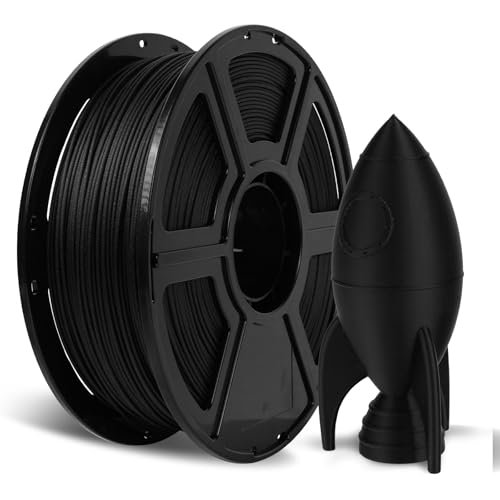
This dedicated black spool of FLASHFORGE PETG-CF focuses on high strength-to-weight ratios and superior wear resistance. In testing, bearing guides and slide plates printed with this material showed minimal surface degradation when subjected to continuous movement. The inclusion of chopped strands limits thermal expansion, providing reliable anti-warping stability when printing large enclosures on non-enclosed beds. It maintains PETG’s inherent resistance to moisture and chemicals while shedding the high gloss that often highlights flaws.
Key features that stand out:
– Reinforcing carbon strands matched to an industrial PETG resin
– Increased friction and abrasion resistance for moving assemblies
– Low moisture absorption compared to nylon alternatives
– Formulated to suppress edge warping on standard build surfaces
Pros:
– Excellent chemical resistance makes it suitable for workshop fluid exposure
– Maintains high rigidity under moderate operational temperatures
– Cleaner stringing control than standard unreinforced PETG formulations
Cons:
– It tends to leave fine whisker strings if your retraction tuning is not fully dialed in.
Best for: Sliding mechanism guides, workshop jigs, battery mounting trays, and protective camera cages.
Expert Opinion: This specific black formulation balances practical printability and chemical resilience, making it a reliable workhorse for shop fixtures and brackets.
6. FLASHFORGE Carbon Fiber PLA Filament 1.75mm Volcanic Rock
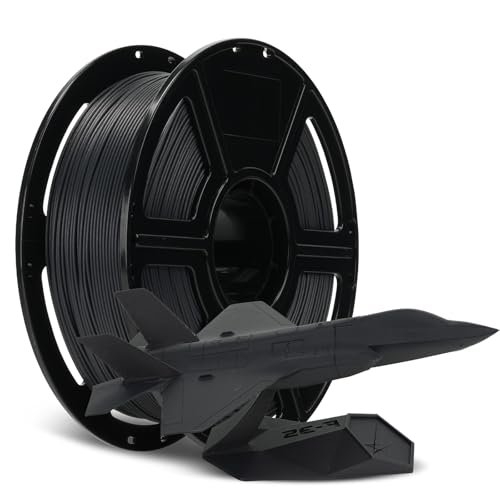
FLASHFORGE Volcanic Rock PLA-CF offers a distinctive dark stone texture that combines structural stiffness with a tactile matte profile. In dimensional tests, parts matched CAD specifications closely thanks to the zero-shrinkage performance of its carbon-infused PLA backbone. The fibers pull heat through the extruded line evenly, resulting in crisp bridging over long gaps where unreinforced filaments would sag. It flows well through 0.4mm hardened nozzles without frequent micro-clogs.
Key features that stand out:
– Textured volcanic rock aesthetic with deep matte toning
– Low shrinkage profile ideal for high-precision snap-fit parts
– High tensile strength along the X and Y axes
– Tidy layer stacking that minimizes visible stepping
Pros:
– Bridges wide unsupported gaps with minimal sagging
– Snaps cleanly away from standard support structures
– Produces clean edges and crisp corners without needing enclosure heat
Cons:
– The material is relatively brittle on thin horizontal clips subjected to repeated bending.
Best for: Architectural mockups, camera mounting plates, and high-detail aesthetic assemblies.
Expert Opinion: The volcanic rock finish looks clean and professional, while the low-warp nature makes printing wide, flat chassis parts trouble-free.
7. YXPOLYER PC-CF Filament Polycarbonate Carbon Fiber 3D
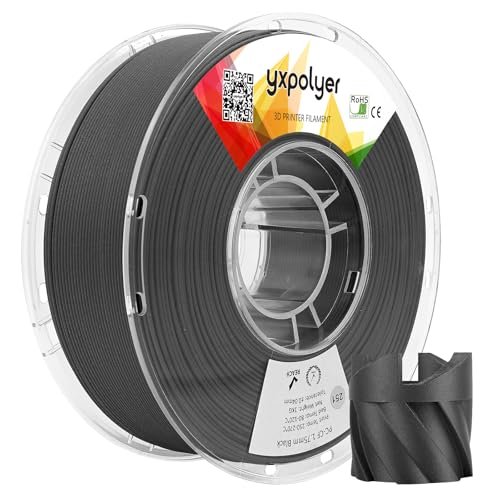
YXPOLYER PC-CF blends industrial polycarbonate with a 15% chopped carbon fiber ratio to build parts that survive high stress and direct heat. Unlike unreinforced polycarbonate, which is notorious for severe shrinkage, the carbon fibers provide substantially reduced warping while holding heat resistance up to 140°C. It exhibits high flow characteristics, letting you push infill print speeds comfortably on coreXY machines. The layer-to-layer adhesion remains strong when extruded at temperatures approaching 280°C.
Key features that stand out:
– 15% high-modulus chopped carbon fiber reinforcement
– Thermal deflection endurance resisting deformation up to 140°C
– Supports print speeds up to 350 mm/s for internal infill paths
– Clean breakaway support characteristics when using single-nozzle prints
Pros:
– Retains rigidity in high-heat operational environments like engine bays
– Prints significantly flatter than standard unfilled polycarbonate filaments
– Excellent strength-to-weight balance for high-speed dynamic assemblies
Cons:
– Printing requires an enclosed build chamber and an all-metal hotend running at 280°C or higher.
Best for: High-velocity drone frames, robotics brackets, and functional automotive engine accessories.
Expert Opinion: This is one of the most accessible true polycarbonate blends available, giving you industrial-grade heat resistance and stiffness without unmanageable bed warping.
8. Polymaker Fiberon PA6-CF20 Carbon Fiber Nylon Filament
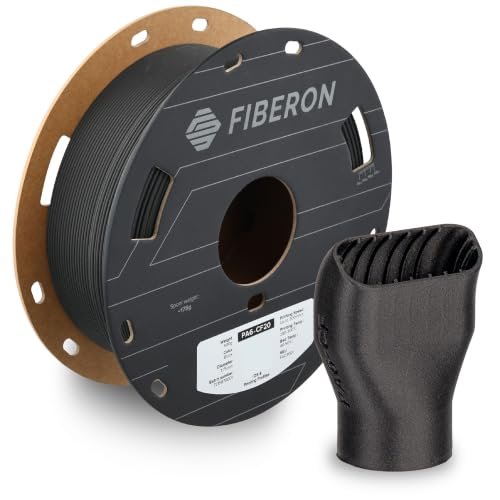
Polymaker Fiberon PA6-CF20 is engineered for demanding industrial tasks requiring documented engineering specs. Backed by extensive technical data sheets, it achieves a dry tensile strength of 109.3 MPa and an 8.64 GPa modulus when annealed. The 20% fiber content enables impressive heat deflection up to 215°C, making it capable of handling extreme mechanical friction and sustained loads. It extrudes smoothly at high speeds up to 300 mm/s when paired with an abrasion-resistant hardened steel or ruby nozzle.
Key features that stand out:
– Verified 20% carbon fiber reinforcement inside high-grade Polyamide 6
– Heat deflection threshold of 215°C at 0.45 MPa post-annealing
– High-speed flow formulation supporting modern coreXY systems
– Engineered to print rigid parts even in room-temperature chambers
Pros:
– Industrial mechanical strength suitable for end-use manufacturing fixtures
– Detailed technical data available for engineers calculating structural loads
– Predictable and uniform shrinkage rates when running post-print annealing
Cons:
– Must be baked at 100°C for ten hours prior to printing and fed from an active dry box.
Best for: Heavy-duty manufacturing jigs, functional drivetrain components, and structural aerospace brackets.
Expert Opinion: Polymaker has set a high standard with Fiberon; when dried and annealed according to spec, its strength matches machined aluminum in many functional contexts.
9. FLASHFORGE Carbon Fiber PETG Filament 1.75mm (Grey/Natural)
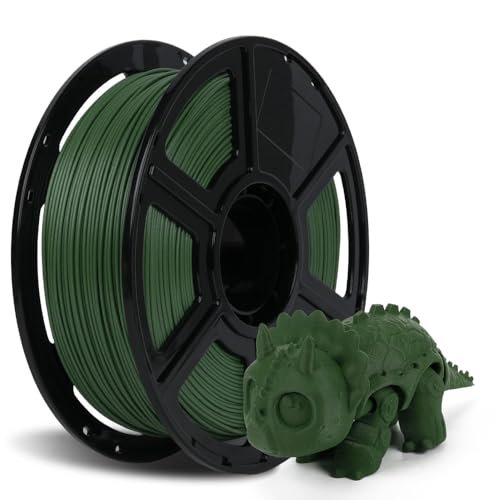
This variation of FLASHFORGE PETG-CF provides the same dependable composite stability in an understated industrial grey/natural tone. The chopped carbon structure delivers enhanced flexural modulus over standard translucent PETG, keeping structural frameworks from twisting under load. It features tight factory spooling that runs reliably through reverse Bowden setups without binding on the spool holder. The matte finish diffuses ambient light, giving everyday workshop prints a clean, uniform look.
Key features that stand out:
– High-modulus carbon fibers embedded into an impact-resistant PETG base
– Low moisture sensitivity compared to hygroscopic nylon alternatives
– Factory vacuum-sealed spooling with moisture-indicating desiccant
– Balanced flow rates suitable for both direct-drive and Bowden extruders
Pros:
– Excellent UV and weather resistance for functional parts mounted outdoors
– Less abrasive on printer drive gears than higher-percentage nylon composites
– Delivers predictable dimensional sizing across tight bolt-hole tolerances
Cons:
– Retraction settings must be tuned carefully to prevent small zits at layer starts.
Best for: Outdoor radio housings, electronic sensor brackets, and functional workshop adaptors.
Expert Opinion: If you need outdoor weather resistance without the intense drying and heating requirements of nylon, this PETG-CF formulation is a reliable everyday choice.
10. SUNLU Carbon Fiber PLA 3D Printer Filament, 1KG Spool
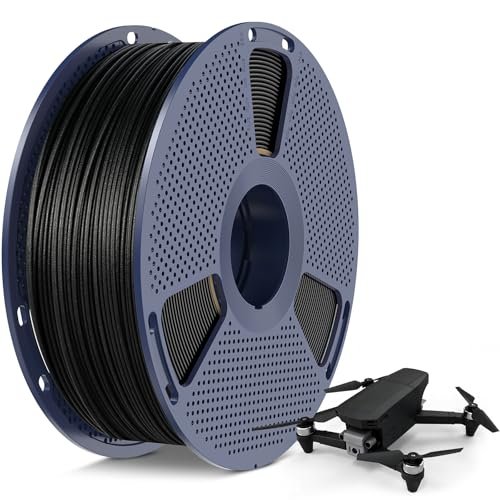
SUNLU PLA-CF combines a user-friendly PLA base with a 15% carbon fiber loading, giving you structural stiffness without demanding complicated machine upgrades. It extrudes smoothly at standard temps between 190°C and 230°C, providing warp-free bed adhesion on textured PEI sheets without needing adhesives. The printed finish features a frosted matte surface that looks clean while hiding layer interfaces. It is an approachable option for hobbyists wanting the composite look and rigidity without high-temp setups.
Key features that stand out:
– 15% milled carbon fiber reinforcement
– Standard low extrusion temperature range (190°C to 230°C)
– Diameter tolerance held to +/- 0.02mm across the entire 1kg roll
– Frosted anti-glare finish that hides exterior layer lines
Pros:
– Extremely easy to print on virtually any standard open-frame 3D printer
– Clean, string-free overhangs and simple support separation
– Great value option for makers looking to try carbon composite filaments
Cons:
– Low thermal resistance means parts can soften if left in a parked car on a hot day.
Best for: Cosmetic structural enclosures, desktop tool organizers, and drone canopies.
Expert Opinion: SUNLU PLA-CF delivers an easy printing experience while providing sufficient stiffness to prevent flex in structural shells and prototype cases.
Practical Insights: Comparing Carbon Fiber Composites
Choosing the right composite filament comes down to balancing mechanical needs against your 3D printer’s hardware capabilities:
- PLA-CF (ELEGOO, FLASHFORGE, SUNLU): These are the easiest carbon filaments to run. You do not need an enclosure or ultra-high temperatures. They offer high tensile stiffness along the horizontal axis and produce an attractive matte finish. However, their low heat resistance makes them unsuitable for automotive interiors or high-temperature environments.
- PETG-CF (FLASHFORGE): A step up in functional utility. PETG-CF resists moisture much better than nylon and provides superior chemical and UV resilience for parts used outdoors. It prints well at 240°C to 260°C and offers a good balance of rigidity and impact absorption without becoming overly brittle.
- PA-CF / Nylon (SUNLU PA6, Polymaker Fiberon): The gold standard for working mechanical parts. These filaments provide exceptional thermal thresholds up to 215°C and strong impact resistance. On the downside, nylon is extremely hygroscopic, requiring thorough drying at 80°C to 100°C and an abrasive-resistant hardened steel nozzle.
- PC-CF (YXPOLYER): The go-to choice when you need high thermal deflection and structural toughness without the extreme moisture sensitivity of nylon. The carbon fiber loading helps stabilize the polycarbonate base, cutting down on the aggressive corner curling typical of standard PC filaments.
Final Verdict
Different projects call for different material characteristics:
- The Reliable Daily Driver: FLASHFORGE Carbon Fiber PETG takes this spot. It delivers functional rigidity, outdoor weather resistance, and dependable layer adhesion without demanding specialized drying equipment every time you print.
- The Heavy-Duty Engineering Pick: Polymaker Fiberon PA6-CF20 stands out for real-world mechanical parts. Its high heat deflection and documented tensile numbers make it the best option for brackets, motor mounts, and working tools that face continuous stress.
- The Beginner-Friendly Option: ELEGOO PLA-CF wins for simplicity. It allows anyone with an entry-level printer to enjoy the matte texture and structural stiffness of composite printing without warping issues or high hotend temperatures.
- The High-Speed, High-Temp Performer: YXPOLYER PC-CF offers a great combination of high-temperature endurance and stable flow rates, making it an excellent match for enclosed CoreXY machines producing functional drone parts.
Frequently Asked Questions About Carbon Filament 3D Printing
Do I need a hardened steel nozzle for carbon filament 3d printing?
Yes, you should always use a hardened steel, ruby, or tungsten carbide nozzle when working with carbon fiber composites. Chopped carbon fibers are abrasive, and pushing even half a spool of carbon filament through a standard brass nozzle will quickly erode the orifice, ruining your print dimensions and causing inconsistent extrusion.
Does carbon filament make 3D printed parts stronger in every direction?
Carbon fibers increase rigidity, tensile strength, and flexural modulus along the X and Y axes, but they do not automatically improve Z-axis layer bonding. Because the micro-fibers align horizontally as the material extrudes through the nozzle, layer adhesion can actually be slightly weaker than in unreinforced plastics if you print too cool or with excessive fan cooling.
Why is moisture control critical for carbon fiber nylon (PA-CF)?
Polyamide resins naturally absorb ambient humidity within just a few hours of exposure. When wet filament enters a 280°C hotend, that trapped moisture turns to steam, creating voids, severe stringing, and weak internal structures. Always dry PA-CF at 80°C to 100°C before printing and feed it directly from a sealed dry box.
Can I print carbon filament in multi-material systems like the Bambu AMS?
PLA-CF and some PETG-CF filaments can run through automated multi-material systems, provided the manufacturer approves them. However, high-percentage nylon blends like PA6-CF20 are often too stiff and brittle for tight internal tubing bends, which can cause breaks inside the feeder unit. Always verify the manufacturer’s AMS recommendations before loading a composite spool.
What nozzle diameter works best for carbon-filled filaments?
While a 0.4mm hardened nozzle works with well-milled composites like PLA-CF and PETG-CF, stepping up to a 0.6mm nozzle reduces your chances of micro-clogs significantly. The larger opening lets chopped fibers pass through cleanly and improves your layer-to-layer weld strength on structural parts.
What is the main benefit of carbon filament 3d printing over standard plastics?
The biggest advantages are increased stiffness-to-weight ratios, reduced thermal expansion, and cleaner aesthetic finishes. Carbon fibers limit shrinkage as the extruded plastic cools, which dramatically reduces corner warping on large builds while leaving a smooth matte surface that hides layer steps.
Do carbon fiber prints require post-print annealing?
Annealing is optional for PLA-CF and PETG-CF, but it is strongly recommended for engineering filaments like PA6-CF and PC-CF. Baking your finished nylon parts in an oven at roughly 100°C for 12 to 16 hours realigns the crystalline polymer chains, allowing the material to reach its maximum heat deflection and tensile strength ratings.
Affiliate Disclosure: As an Amazon Associate, I earn from qualifying purchases made through links on this site.