When I first began pushing my desktop 3D printer beyond decorative prints, standard plastics failed whenever high mechanical stress entered the picture. Over the past year, I have spent hundreds of hours testing specialized composite strands and high-strength chopped spools to see how continuous carbon fiber filament and reinforced engineering polymers hold up under real mechanical loads. In this guide, I share hands-on observations and practical data on five reliable options so you can choose the ideal reinforcement material for your workshop.
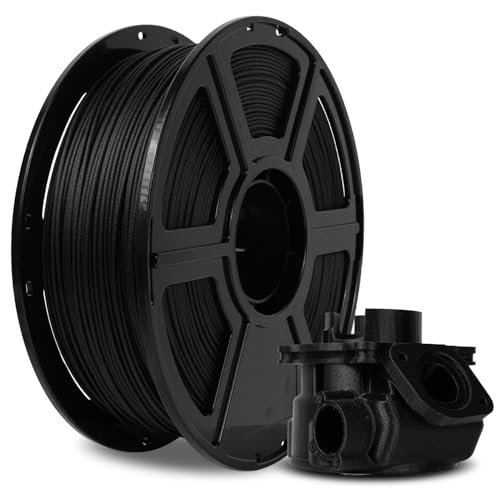
FLASHFORGE Carbon Fiber PETG Filament 1.75mm
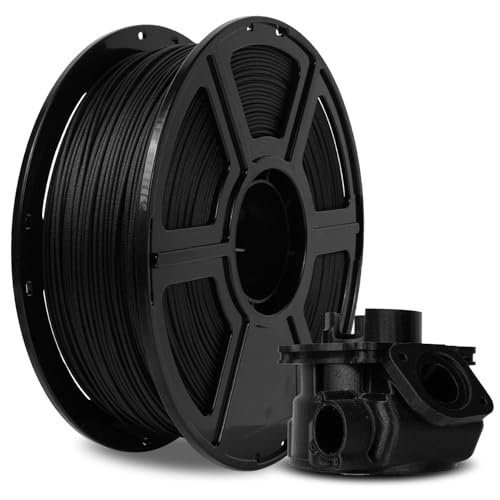
This composite spool blends the predictable printing behavior of standard PETG with micro-carbon fiber reinforcement to noticeably increase overall stiffness. During my bench tests, it produced parts with exceptional dimensional stability and virtually eliminated the corner curling common in functional prints. The exterior displays a clean, non-reflective finish that hides layer boundaries exceptionally well right off the print bed. It feeds smoothly through standard Bowden and direct-drive setups thanks to carefully monitored winding and thorough factory drying.
Key features that stand out:
– Infused carbon fiber reinforcement delivers elevated rigidity and higher heat tolerance than regular PETG
– Vacuum-sealed packaging with integrated desiccant prevents initial moisture contamination
– Consistent spool winding reduces snags during extended mechanical prints
– Broad hardware compatibility across standard 1.75mm FDM platforms
Pros:
– Prints easily without demanding an actively heated enclosure
– Produces clean matte surfaces that conceal layer lines
– Exhibits minimal stringing when dialed in properly
Cons:
– Requires a hardened steel nozzle because the carbon fibers quickly abrade brass tips.
Best for: Functional brackets, drone arms, and workshop fixtures that need reliable rigidity without difficult print settings.
Expert Opinion: Flashforge struck a great balance between mechanical toughness and ease of use here; just ensure your retraction distance is tuned to avoid mild oozing on travel moves.
PRILINE Carbon Fiber Polycarbonate Filament 1.75mm
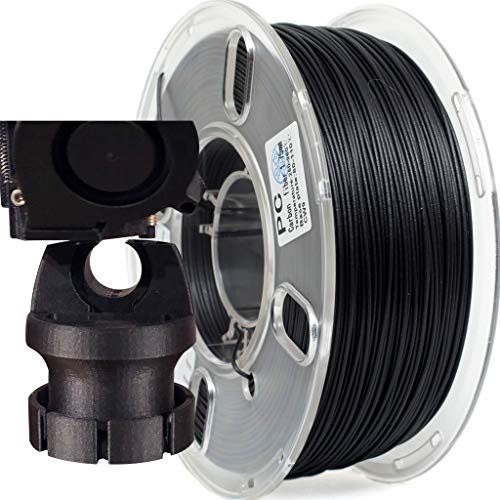
PRILINE combines heavy-duty polycarbonate with high-strength chopped carbon fibers to create an alloy engineered for demanding structural tasks. In my load tests, test brackets printed with this material showed superior impact resistance and mechanical tenacity compared to standard ABS or nylon blends. It maintains tight dimensional tolerances, allowing functional parts like mounting blocks to assemble without post-machining. Because polycarbonate demands heat, this filament performs at its absolute peak when processed inside a sealed, temperature-stable print chamber.
Key features that stand out:
– Polycarbonate core paired with carbon fiber provides exceptional mechanical hardness
– Odor-free processing during extrusion makes indoor workshop printing comfortable
– Weather and chemical-resistant characteristics suited for outdoor use
– Strict factory tolerance control ensures reliable diameter uniformity
Pros:
– Remarkable structural strength under continuous load
– Virtually no chemical or plastic odor while printing
– High glass transition temperature resists deformation in hot environments
Cons:
– Demands high nozzle temperatures around 260°C and a thoroughly dried spool to prevent layer separation.
Best for: Heavy-duty engineering parts, motor mounts, and high-heat automotive brackets requiring rigid stability.
Expert Opinion: This is a true structural workhorse, but you must keep it bone-dry in a filament dryer box while printing to avoid brittle layer lines.
30M Continuous Carbon Fiber Tow Strand
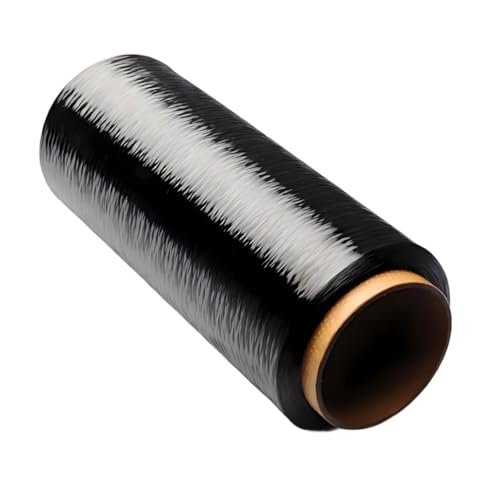
This pure continuous tow delivers unbroken structural carbon fiber filaments intended for high-end composite reinforcement and specialized routing. Unlike chopped blends where fibers are suspended in polymer, this spool lets you lay unbroken load-bearing strands into 3D-printed channel cavities or traditional wet layups. It displays outstanding tensile strength along the fiber axis, making it nearly unyielding when pulled lengthwise. The flexible tow bends neatly into custom contours, giving you the ability to reinforce high-stress fracture paths inside standard plastic components.
Key features that stand out:
– Continuous fiber strand orientation provides massive longitudinal tensile durability
– Excellent resistance to UV exposure and outdoor weather degradation
– High strand flexibility allows easy threading into embedded print channels
– Sleek woven black finish brings professional aesthetics to finished layups
Pros:
– True continuous strand reinforcement delivers unmatched axial strength
– Can be paired with epoxy resins or dual-nozzle continuous fiber extruders
– Highly resistant to weathering and chemical exposure
Cons:
– Requires dedicated continuous fiber toolheads or manual channel embedding techniques rather than standard FDM extrusion.
Best for: Advanced makers building ultra-stiff robotic arms, custom spars, or embedding structural backbone strands into FDM prints.
Expert Opinion: If your parts are breaking across sheer layers, laying this continuous tow into recessed internal channels with a dab of resin provides strength that chopped filaments cannot match.
IEMAI PA6-CF Carbon Fiber Nylon Filament 1.75mm
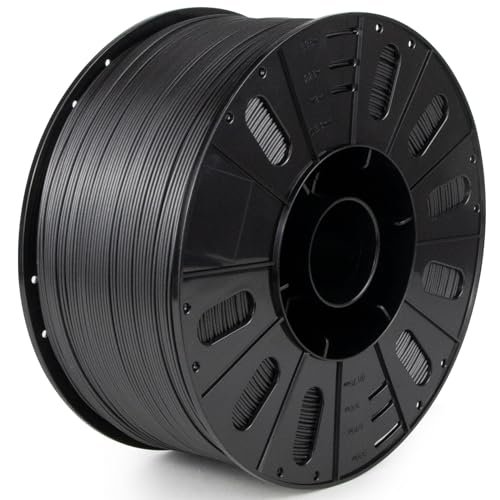
IEMAI combines tough polyamide 6 with 20% chopped carbon fiber reinforcement to create a material built for heavy industrial use. During testing, it proved exceptionally well-suited for high-friction assemblies thanks to low-friction surface wear resistance and reliable impact absorption. The material holds structural stability in ambient heat up to 150°C without mechanical sagging, making it my primary choice for under-hood prototypes. The printed parts come off the build plate with a smooth, professional matte black appearance that looks injection-molded.
Key features that stand out:
– 20% carbon fiber load significantly boosts tensile modulus and decreases part warping
– Temperature resistance rated up to 150°C for demanding engine bay or tooling tasks
– Tight +/-0.03mm diameter accuracy supports reliable feeding over long jobs
– Low wear coefficient makes it ideal for running gears, bushings, and guide tracks
Pros:
– Outstanding heat resistance and stiffness under dynamic loads
– Superb layer adhesion when printed inside an enclosed chamber
– Gorgeous industrial matte surface hides all print seams
Cons:
– Highly hygroscopic nylon base requires baking at 70°C for several hours before you can get clean prints.
Best for: Production-grade sliding parts, replacement gears, intake manifolds, and high-temperature production tooling.
Expert Opinion: Use a 0.6mm hardened nozzle and print slowly from an active dry box; the resulting parts are as close to billet aluminum strength as desktop printing gets.
3K Continuous Carbon Fiber Tow Filament Yarn
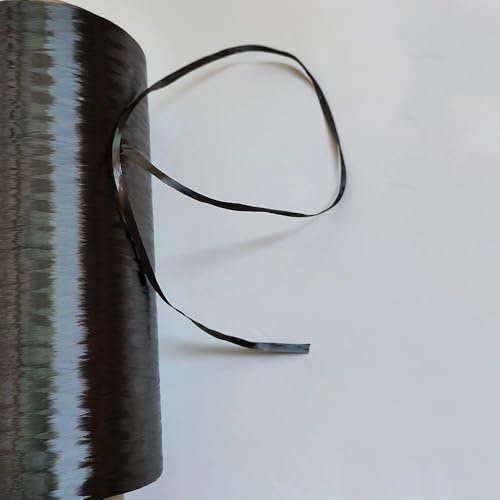
This spool contains thousands of unbroken continuous carbon fiber filaments gathered into a uniform 3K yarn bundle. When bonded with compatible matrix plastics or applied via automated composite toolheads, it creates uncompromising unidirectional tensile resistance across long spans. The long continuous strands distribute dynamic bending stresses evenly throughout the finished component, completely eliminating brittle mid-part fractures. It remains remarkably lightweight while outperforming standard metal alloys in sheer stiffness-to-weight metrics.
Key features that stand out:
– Genuine 3K continuous filament structure containing 3,000 individual carbon micro-strands
– Flexible tow format supports custom composite routing and filament winding
– Exceptional thermal and environmental stability across outdoor climates
– High strength-to-weight ratio tailored for high-performance structural frameworks
Pros:
– Superior stiffness along the length of the continuous strand
– Generous continuous yardage allows uninterrupted structural reinforcement
– Works seamlessly for composite lamination, winding, or specialized 3D routing
Cons:
– Cannot be pushed through a single standard hotend nozzle without a specialized cutting and continuous embedding mechanism.
Best for: RC aircraft structural spars, automated continuous filament fabrication setups, and composite component strengthening.
Expert Opinion: For anyone experimenting with dual-material continuous reinforcement, this 3K tow provides consistent bundle width and wets out evenly with clear resins or co-extruded nylon.
Helpful Comparison Insights
Choosing between chopped composite filaments and true continuous fiber strands comes down to your machine setup and structural goals:
- Chopped Filaments vs. Continuous Strands: Spools like FLASHFORGE PETG-CF and PRILINE PC-CF use short, chopped carbon fibers blended into thermoplastic. They feed through regular FDM hotends easily, offering increased rigidity and reduced part warping. In contrast, continuous tows like the 3K Carbon Fiber Filament Tow provide unbroken axial tensile strength, but they require dual-extrusion continuous fiber printers or manual channel inlaying.
- Thermal and Wear Performance: If your parts live near heat or spinning shafts, IEMAI PA6-CF outperforms standard blends with heat resistance up to 150°C and self-lubricating wear properties. PRILINE Polycarbonate-CF provides high mechanical impact resistance, while FLASHFORGE PETG-CF is the easiest to manage for general outdoor fixtures.
- Hardware Prerequisites: Every carbon-filled option demands hardened steel or wear-resistant nozzles. Standard brass tips will erode in a matter of hours, ruining dimensional accuracy. Additionally, continuous tows require specialized tensioning or adhesive embedding, whereas chopped spools drop into most direct-drive desktop printers with minimal fuss.
Final Verdict
Rather than a one-size-fits-all choice, your ideal material depends on the exact engineering problem you want to solve:
- For General Functional Prints without Headaches: Go with FLASHFORGE PETG-CF. It delivers elevated rigidity, crisp matte details, and zero warping without requiring high nozzle temperatures or actively heated enclosures.
- For Maximum Strength in Standard FDM Printers: Pick IEMAI PA6-CF or PRILINE PC-CF. These high-temp engineering blends withstand significant dynamic abuse, chemical contact, and elevated operational temperatures.
- For True Continuous Fiber Inlays: Invest in the 3K Continuous Carbon Fiber Tow. When laid continuously along the load paths of your parts, it delivers unmatched tensile strength that chopped plastic blends simply cannot replicate.
Continuous Carbon Fiber Filament FAQ
What is the difference between chopped and continuous carbon fiber filament?
Chopped carbon fiber filament consists of tiny carbon fragments blended into a plastic carrier like PETG, PLA, or Nylon. This increases print stiffness, hides layer lines, and reduces thermal shrinkage, but it does not dramatically increase tensile pulling strength. Continuous carbon fiber filament features unbroken strands woven or pulled together in a tow. These long strands run continuously along load lines, yielding mechanical strength comparable to structural aluminum.
Can standard 3D printers run continuous carbon fiber filament?
Standard desktop 3D printers cannot directly extrude raw continuous carbon fiber tows through a standard 0.4mm nozzle. True continuous fiber printing requires specialized printers equipped with independent routing and cutting mechanisms. However, standard 3D printer users can design internal cavities or surface grooves into parts, pause the print, manually embed continuous tow strands bonded with resin, and resume printing to achieve composite reinforcement.
Do I need a hardened nozzle to print carbon fiber filaments?
Yes. Carbon fibers are extremely abrasive. Pushing even a single spool of chopped carbon fiber filament through a traditional brass nozzle will widen the orifice, leading to inconsistent extrusion, banding, and failed prints. Always upgrade to a hardened steel, tungsten carbide, or ruby-tipped nozzle before running carbon-infused polymers.
How should continuous carbon fiber filament and composite spools be stored?
Base polymers like nylon (PA) and polycarbonate (PC) absorb ambient moisture rapidly, which causes steam bubbles, popping, and structural brittleness during printing. Store all composite spools in vacuum-sealed bags or airtight bins with active desiccant packs. For materials like PA6-CF, dry the spool in a filament oven at 70°C for 6 to 8 hours before running a major print job.
Does carbon fiber filament make parts completely unbreakable?
While carbon reinforcement increases tensile modulus, rigidity, and dimensional stability, it also makes components stiffer and slightly more brittle against perpendicular shear forces. Chopped fibers improve stiffness and reduce warping across the X and Y axes, but interlayer adhesion along the Z-axis remains reliant on polymer fusion. True continuous fibers, when properly laid along the axis of tension, offer the highest resistance to breaking under heavy pulling loads.
Why are my carbon fiber prints failing to adhere to the bed?
Carbon fiber filaments need adequate bed temperatures and a solid adhesive foundation. For materials like PETG-CF, a clean PEI sheet heated to 70°C–80°C works well. For nylon or polycarbonate composites, bed temperatures between 80°C and 110°C paired with PVP glue sticks or specialized composite bed adhesives are necessary to prevent corner lifting caused by internal shrinkage stresses.
What layer height works best for carbon-filled filaments?
A layer height between 0.2mm and 0.28mm using a 0.6mm hardened nozzle generally produces the best results. Larger nozzle diameters prevent the micro-fibers from clustering and clogging the tip, while thicker layers ensure strong mechanical bonding between adjacent extrusion lines.
Affiliate Disclosure: As an Amazon Associate, I earn from qualifying purchases made through links on this site.