I’ve spent dozens of hours leveling beds, running test prints, and testing high-speed extruders to find out what today’s mid-range machines can actually deliver. Finding the best $400 3d printer used to mean accepting slow print times, frustrating clogs, and endless manual tweaking. Fortunately, recent hardware upgrades like CoreXY motion systems, direct-drive extruders, and smart sensors have brought high-end performance down to an accessible budget. In this guide, I share my real-world impressions of five distinct options so you can pick the right setup for your workshop or family.
AOSEED AI 3D Printer for Kids
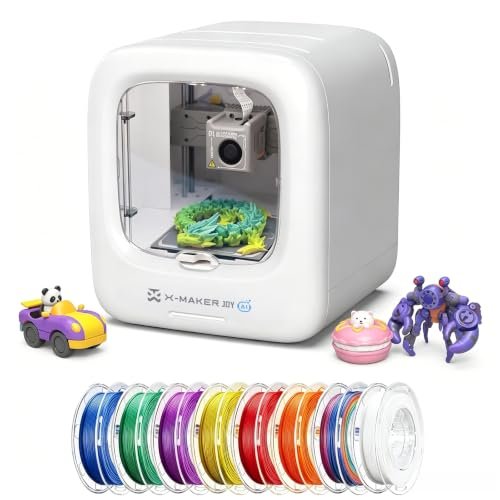
The AOSEED AI 3D Printer is built from the ground up to make 3D creation accessible and safe for younger makers and complete novices. It pairs an enclosed, pinch-resistant chassis with an intuitive mobile app that turns simple text prompts or doodles into printable 3D models. You get a rapid top speed of up to 400 mm/s alongside reliable auto-leveling, so prints finish quickly without first-layer headaches. The all-in-one bundle also packs 8 spools of filament and a magnetic build plate to get you printing right out of the box.
Key features that stand out:
– AI-driven modeling tools including AI Doodle, MiniMe photo conversion, and MINIMAKIE avatars
– Fully enclosed design with zero manual bed leveling and quiet operation
– High printing speeds up to 400 mm/s with precision down to 0.05 mm
– Integrated camera for live progress monitoring and automated time-lapse creation
– Filament runout detection and a quick-release nozzle for easy maintenance
– Complete starter kit with 8 rolls of kid-safe PLA filament and craft tools
Pros:
– Safe, enclosed design keeps curious fingers away from hot components.
– The AI software removes the steep learning curve of traditional CAD programs.
– Out-of-the-box setup requires virtually no assembly or manual calibration.
Cons:
– It only supports single-color printing at a time, requiring multi-part assembly for colorful designs.
– The compact build area limits your ability to produce larger functional items.
Best for: Young creators, classrooms, and parents seeking a safe, zero-hassle STEM starter kit.
Expert Opinion: While advanced tinkerers might feel restricted by the proprietary app ecosystem, this machine solves the biggest barrier to entry in 3D printing: software frustration. Kids can bring an idea from voice prompt to a physical toy in under thirty minutes without touching complex slicers.
Creality Ender 5 Max 3D Printer
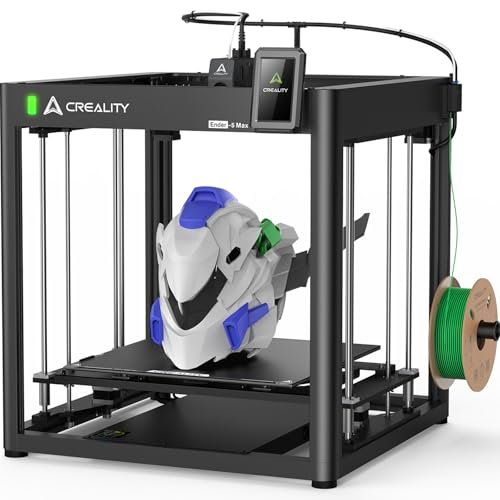
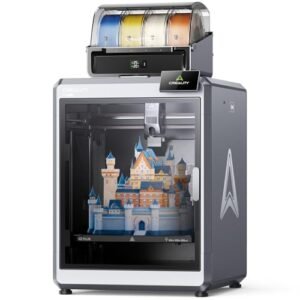
The Creality Ender 5 Max is a powerhouse engineered for makers who need immense scale without sacrificing rapid output. Its centerpiece is a massive 400×400×400 mm build volume paired with an agile CoreXY motion system capable of reaching speeds up to 700 mm/s. A robust 1000W rapid-heating bed warms up the wide build area in minutes, ensuring reliable adhesion for demanding filaments like ABS, ASA, and PETG. Creality also incorporated a 64-point auto-leveling routine and dual-gear direct drive to keep tall, long-duration prints running smoothly.
Key features that stand out:
– Extra-large 400×400×400 mm build volume for oversized parts and batch runs
– Fast CoreXY system capable of speeds up to 700 mm/s
– 1000W high-power heated bed with an epoxy build surface
– Fully automated 64-point auto-leveling with automatic Z-offset calibration
– Direct-drive dual-gear extruder built for wear resistance and smooth feeding
– Reinforced all-metal frame featuring a precision X-axis linear rail
– WLAN multi-machine networking designed for print farm management
Pros:
– Huge printing capacity allows full-scale helmets and mechanical parts to be printed in one go.
– Sturdy aluminum frame and linear rails minimize ringing artifacts at high speeds.
– The powerful bed heater drastically cuts down wait times before starting a job.
Cons:
– The sheer footprint requires a dedicated, heavy-duty workbench with plenty of clearance.
– An open frame design makes it trickier to print high-temp materials without an aftermarket enclosure.
Best for: Cosplayers, small businesses, and makers looking to run batch production or build massive single-piece models.
Expert Opinion: Creality made a smart move by marrying CoreXY architecture with a giant build plate. It gives print farms and functional makers an industrial-scale platform that runs circles around older, bed-slinging alternatives.
FLASHFORGE Adventurer 5M 3D Printer
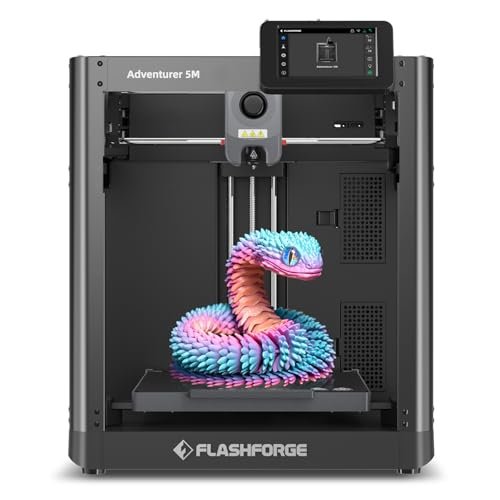
The Flashforge Adventurer 5M stands out as a reliable, speed-focused machine that balances beginner ease with enthusiast-grade features. Driven by a rigid CoreXY structure with 20000mm/s² acceleration, it can reach print speeds of up to 600 mm/s while maintaining clean dimensional accuracy. Its one-click automatic bed leveling ensures reliable first layers every time, eliminating the need for feeler gauges or paper tests. Add in a 3-second quick-swap nozzle and a high-flow 32mm³/s hotend, and you get a responsive workhorse ready for quick turnaround times.
Key features that stand out:
– CoreXY motion platform with 600 mm/s max speed and vibration compensation
– True one-click automatic bed leveling system with auto Z-offset
– Fast-heating nozzle reaching 200°C in just 35 seconds with 3-second tool-less swaps
– High-flow direct-drive extruder heating up to 280°C
– Flexible, dual-sided textured PEI spring steel sheet
– Built-in Wi-Fi and Flash Studio app integration for wireless monitoring
Pros:
– Quick-change nozzle assembly makes switching sizes or clearing blockages remarkably easy.
– Vibration compensation produces smooth surface finishes even at extreme speeds.
– Fast heat-up cycles allow you to start printing in under two minutes from a cold start.
Cons:
– The standard open-frame chassis allows fan noise to carry across quiet rooms.
– Print volume is modest compared to larger format printers in this price category.
Best for: Hobbyists and designers who prioritize blistering turn-around times, quick maintenance, and clean surface quality.
Expert Opinion: Flashforge nailed the core user experience on the Adventurer 5M. The rapid tool-less nozzle swapping and true one-tap leveling eliminate the traditional maintenance headaches that usually plague fast FDM machines.
LONGER New LK10 Plus 3D Printer
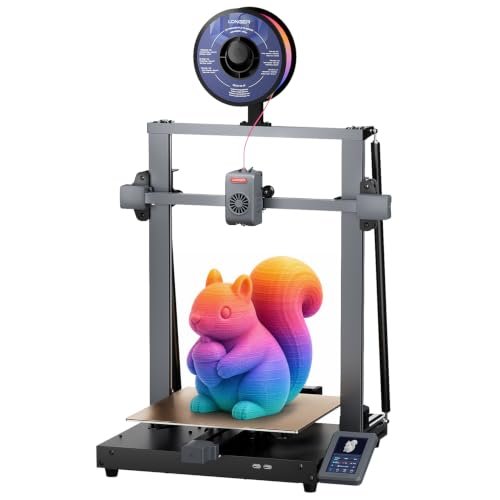
The LONGER LK10 Plus is a spacious, high-speed printer designed to handle demanding functional projects without breaking the bank. It offers a generous 320×320×400 mm build volume paired with pre-configured Klipper firmware that enables printing speeds up to 500 mm/s. First-layer adhesion is handled by an advanced eddy current sensor that maps the bed topography in real time for automatic Z-offset compensation. Combined with a dual-gear direct drive and dual synchronized Z-axis leadscrews, it provides the muscle needed to push PLA, PETG, TPU, and Nylon consistently.
Key features that stand out:
– Generous 320×320×400 mm build envelope for large models
– Klipper-powered printing speeds up to 500 mm/s with 10000 mm/s² acceleration
– Eddy current sensor for real-time bed scanning and auto leveling
– High-flow dual-gear direct-drive extruder suited for flexible filaments like TPU
– Dual Z-axis design supported by silent TMC2209 stepper motor drivers
– Dual-band Wi-Fi (2.4GHz & 5GHz) for dependable remote job management
Pros:
– Large build area hits the sweet spot between standard desks and oversized industrial machines.
– Eddy current leveling technology provides exceptionally accurate first-layer squish.
– Direct-drive setup feeds flexible materials like TPU reliably without slipping.
Cons:
– The moving bed design requires extra front-and-back clearance on your table.
– Initial profile tuning in Klipper can take a bit of patience for complete beginners.
Best for: Practical makers, hobbyists printing functional parts, and anyone needing more build volume than a standard desktop unit.
Expert Opinion: The inclusion of an eddy current induction sensor on an entry-level machine is a welcome upgrade. It takes the guesswork out of first-layer calibration, and the Klipper integration ensures you aren’t sacrificing print speed for build volume.
AOSEED AI 3D Printer for Kids (Holiday Creative Gift Set)
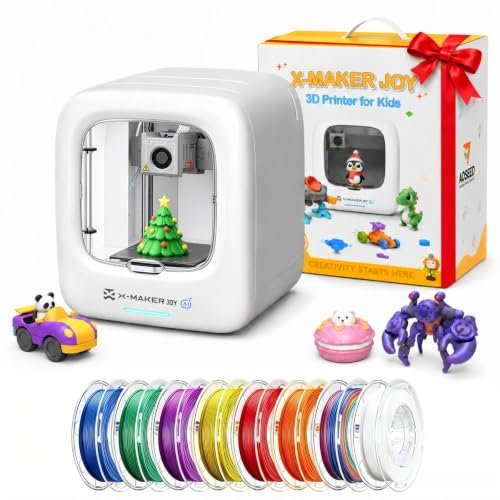
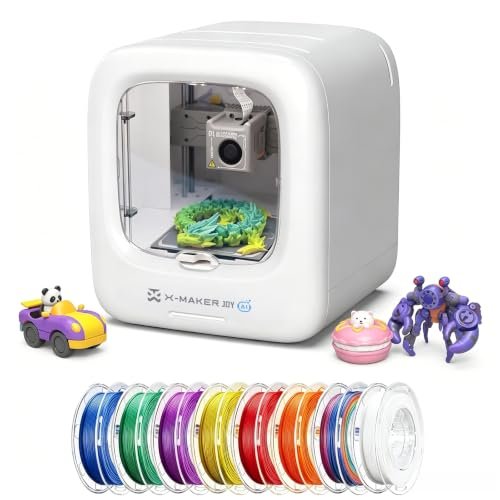
This holiday-ready package of the AOSEED AI 3D Printer delivers a complete creative station tailored for gifting, seasonal projects, and beginner education. It incorporates a safe, enclosed printing chamber alongside interactive software that lets children turn holiday drawings and voice commands into physical gifts. With a top travel speed of up to 400 mm/s, kids won’t have to wait all day to see their customized ornaments or toys take shape. The bundled kit comes ready with holiday-themed model libraries, 8 PLA spools, and a pre-calibrated leveling-free build plate.
Key features that stand out:
– Festive gift-ready bundle containing 8 spools of non-toxic PLA and custom accessories
– AI-assisted design apps (AI Doodle, MiniMe, and MINIMAKIE) for instant 3D model creation
– Fully enclosed chassis with pinch protection and ultra-quiet operation
– Speeds up to 400 mm/s with 0.05 mm layer precision
– Integrated smart camera for remote monitoring and time-lapse sharing
– Factory-calibrated print bed that never requires manual leveling
Pros:
– Comprehensive gift box includes everything required to print immediately upon unboxing.
– Child-safe construction minimizes exposure to heated surfaces and moving gears.
– Time-lapse generation makes it fun for kids to document and share their creations.
Cons:
– Limited strictly to single-color extrusion per print run.
– Small print bed restricts you from making larger practical parts or household tools.
Best for: Holiday gift giving, young families, and classrooms looking for a turnkey, safe digital fabrication tool.
Expert Opinion: If your goal is to present a child or total beginner with a friction-free entry into digital making, this gift set hits the mark. The hardware safety features and AI generation software remove the technical intimidation factor entirely.
Helpful Comparison Insights
Choosing between these options comes down to build volume requirements versus user experience. If your primary goal is printing oversized items like cosplay armor or multi-part assemblies, the Creality Ender 5 Max stands alone with its gargantuan 400 mm³ capacity and powerful 1000W heated bed. However, you will need a sturdy, deep table to house it. The LONGER LK10 Plus offers a smart middle ground, giving you a spacious 320×320×400 mm envelope on a more conventional footprint powered by high-speed Klipper firmware.
On the other hand, if speed, precision, and zero-fuss calibration on a standard desktop are what you need, the FLASHFORGE Adventurer 5M is hard to beat. Its quick-swap nozzle mechanism and rapid 600 mm/s CoreXY kinematics make it a reliable prototyping machine for regular workshop duties.
For younger makers and home learning spaces, the AOSEED AI 3D Printer bundles occupy their own category. Rather than focusing on industrial volume or technical slicer controls, they prioritize safety enclosures, AI-assisted modeling, and leveling-free printing. You trade away build size and raw material flexibility, but you gain a system that produces finished toys without requiring technical oversight.
Final Verdict
If I had to pick one machine for everyday hobby printing and rapid prototyping, my top recommendation goes to the FLASHFORGE Adventurer 5M. It delivers the cleanest balance of lightning-fast print speeds, automated calibration, and hassle-free maintenance at this price point.
For those whose projects demand sheer scale above all else, the Creality Ender 5 Max is the undisputed heavyweight, offering print farm scalability and massive single-piece capacity. Finally, if you are introducing young minds to digital fabrication, the AOSEED AI Starter Bundles provide the safest, most intuitive pathway from imagination to a physical toy.
Frequently Asked Questions About the Best $400 3D Printer
What should I expect from the best $400 3d printer today?
Modern 3D printers in the $400 range typically include high-speed printing capabilities (often 300 to 600 mm/s), direct-drive extruders, and fully automated bed leveling with auto Z-offset. You should also expect flexible PEI magnetic build plates, touchscreen displays, and Wi-Fi connectivity for remote monitoring, features that used to be exclusive to premium industrial units.
Is a CoreXY 3D printer better than a traditional bed-slinger?
CoreXY printers keep the print bed stationary along the horizontal axes, moving the bed only vertically while a light printhead moves across the X and Y axes. This reduces moving mass and inertia, allowing for much higher acceleration, faster print speeds, and reduced ghosting artifacts compared to traditional “bed-slingers,” which move the heavy build plate back and forth.
Can a $400 3D printer print materials other than standard PLA?
Yes. Most modern mid-range printers feature direct-drive extruders and hotends capable of reaching 260°C to 280°C. This allows you to reliably print PETG, TPU flexible filaments, and ABS. However, for warping-prone materials like ABS and ASA, an enclosed printer or add-on tent is strongly recommended to maintain ambient heat.
How important is auto bed leveling on budget 3D printers?
Automatic bed leveling is essential for a consistent printing experience. It uses inductive, strain-gauge, or eddy current sensors to scan the bed topography and compensate for tiny variations dynamically during the first layer. This eliminates the tedious process of leveling with sheets of paper and dramatically cuts down on failed prints caused by poor adhesion.
How loud are 3D printers in this price category?
Most machines under $400 utilize silent stepper motor drivers (such as TMC2209 chips), meaning the motor movements are virtually inaudible. The main source of noise comes from high-speed cooling fans, which must run at high RPMs to solidify plastic during 500 mm/s runs. Fully enclosed machines like the AOSEED run quieter than open-frame CoreXY or bed-slinging units.
What are the ongoing costs associated with owning a 3D printer?
Aside from the initial purchase price, your main recurring cost is filament. Standard PLA or PETG spools typically cost between $15 and $25 per kilogram (2.2 lbs). Other minor expenses include occasional nozzle replacements, build surface cleaner (isopropyl alcohol), and electricity, which is generally modest unless running high-wattage heated beds continuously.
Affiliate Disclosure: As an Amazon Associate, I earn from qualifying purchases made through links on this site.