After spending hundreds of hours curing miniature armies and calibration cubes in my workshop, I’ve learned that catching a genuine 3d resin printer sale can save you serious cash without sacrificing fine detail. In this guide, I look at five standout machines currently hitting top discounts, breaking down their real-world resolution, leveling ease, and daily reliability. Whether you need tabletop minis or full-size busts, these tested picks will help you spend your budget wisely.
ANYCUBIC Photon Mono 4 Resin 3D Printer
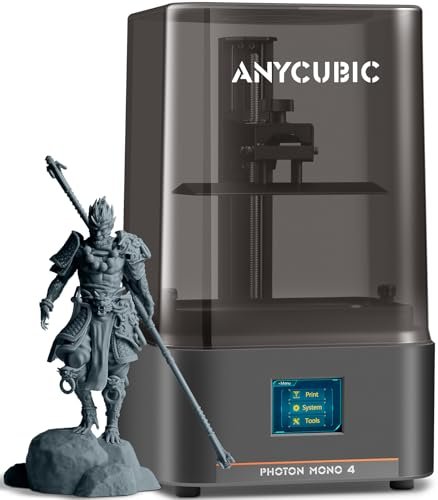
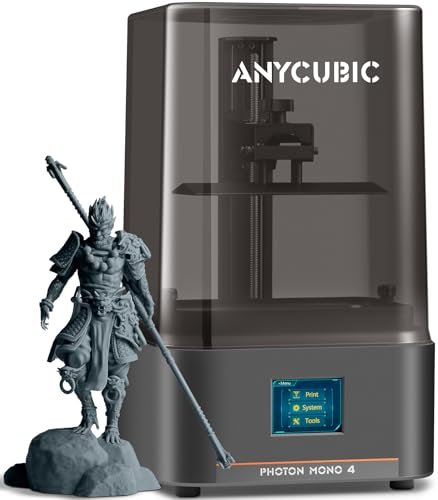
The ANYCUBIC Photon Mono 4 brings a 7-inch 10K monochrome display to an entry-level price point, delivering an impressive 17×17μm XY resolution. Its upgraded LighTurbo matrix light source casts uniform UV coverage across the build area, smoothing out stair-stepping on miniature armor and fine fabric textures. The redesigned laser-engraved platform 2.0 provides a firm grip on raft layers without forcing you to chisel prints free. Thanks to its straightforward 4-point leveling system and power-loss recovery, you spend less time troubleshooting and more time washing and curing your finished models.
Key features that stand out:
– 7-inch 10K monochrome screen with 9024×5120 resolution
– Ultra-fine 17×17μm pixel size on X and Y axes
– Anycubic LighTurbo matrix optical engine for balanced exposure
– Usable 153.4 x 87 x 165 mm build envelope
– Laser-etched aluminum build plate for balanced model adhesion
– Resume print feature to safeguard jobs against unexpected power cuts
Pros:
– Crisp detail reproduction with virtually invisible layer lines
– Great build plate adhesion out of the box
– Compact footprint fits easily on smaller workbenches
Cons:
– It lacks Anycubic mobile app integration for wireless print management.
Best for: Tabletop miniature painters seeking ultra-sharp details on a tighter budget.
Expert Opinion: The Mono 4 packs exceptional pixel density into a compact chassis, making layer lines virtually undetectable on small tabletop sculpts even if you have to transfer files the traditional way via USB.
ELEGOO Mars 5 Ultra Resin 3D Printer
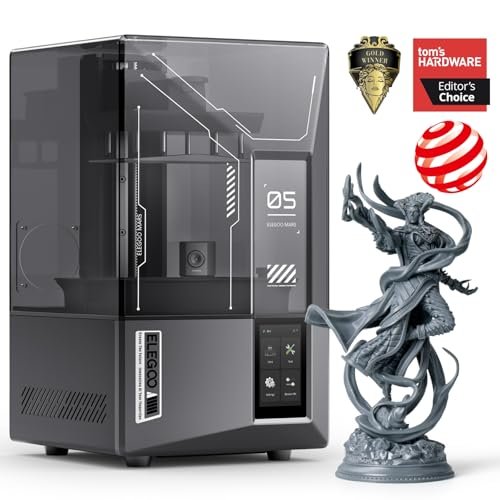
The ELEGOO Mars 5 Ultra changes the pace of desktop printing with an innovative tilt-release peeling mechanism that hits speeds up to 150 mm/h. Pairing that raw speed with a 7-inch 9K monochrome screen, it creates detailed pieces in a fraction of standard exposure cycles. An integrated AI camera system monitors your build plate in real time, alerting you to detached supports or warping before you waste a whole vat of resin. Factor in smart mechanical sensors that check for cured debris and liquid shortages, and this printer takes most of the guesswork out of daily resin crafting.
Key features that stand out:
– 7-inch 9K mono LCD delivering 18 μm XY accuracy
– Tilt-release mechanism printing at speeds up to 150 mm/h
– Built-in AI camera for real-time error, empty plate, and warp detection
– Smart mechanical sensor for tank residue and resin shortage alerts
– Wi-Fi cluster functionality for centralized multi-device control
Pros:
– Rapid print cycles cut waiting times down significantly
– Intelligent sensors stop print jobs before foreign debris cracks your LCD
– Built-in Wi-Fi makes network slicing and file transfers effortless
Cons:
– AI visual detection accuracy can dip depending on room lighting and darker resin colors.
Best for: Power hobbyists and small print shops needing high-speed production and smart safety features.
Expert Opinion: The tilt-release system genuinely cuts print times in half without introducing layer shifts, making this one of the smartest and most reliable compact units you can grab during any equipment sale.
ELEGOO Saturn 4 Ultra 16K Resin 3D Printer
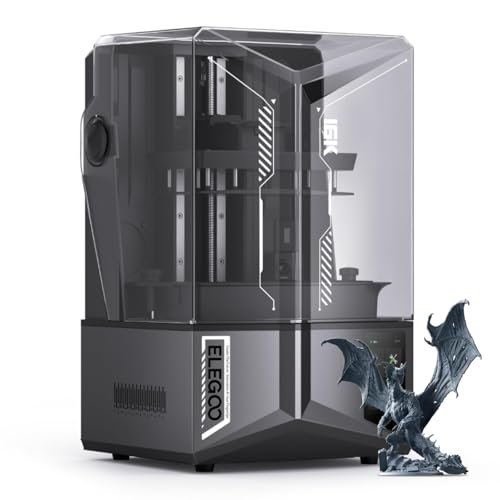
The ELEGOO Saturn 4 Ultra 16K provides a massive workspace combined with an industry-leading 16K ultra-high resolution display that captures skin textures and fine filigree flawlessly. Cold workshops are no longer an obstacle thanks to the smart vat heating system that maintains your resin at an optimal 30 °C for consistent layer flow. It features one-click automatic leveling, letting you plug the unit in and start working without touching manual bed screws. With tilt-release mechanics and an internal chamber light paired with its AI monitoring camera, you get clean, reliable large-scale prints around the clock.
Key features that stand out:
– Large 10-inch 16K mono LCD for extreme detail on big models
– Built-in vat heater maintaining resin temperature at a stable 30 °C
– True automated bed leveling with no manual adjustment needed
– AI camera with integrated chamber lighting and time-lapse video generation
– Fast tilt-release mechanism achieving layer speeds up to 150 mm/h
Pros:
– Heated resin vat eliminates winter print failures caused by cold, viscous resin
– Generous build volume easily accommodates multi-part statues and mass batches
– One-click auto leveling makes initial setup effortless
Cons:
– The heavier flip-top lid and larger overall footprint demand dedicated workspace clearance.
Best for: Serious sculptors, statue creators, and studio makers who want massive build capacity with peak fidelity.
Expert Opinion: Incorporating a built-in vat heater solves the single biggest issue resin hobbyists face during colder months, ensuring high success rates across the unit’s huge 10-inch build plate.
ELEGOO Mars 5 Resin 3D Printer
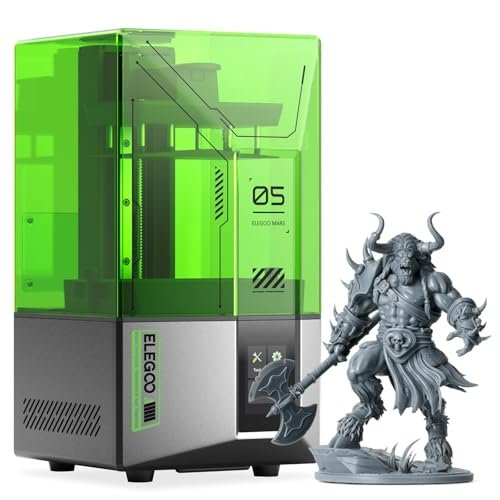
The standard ELEGOO Mars 5 focuses on hassle-free operation, featuring a one-click automatic leveling system that lets beginners skip complex paper-gap calibration entirely. Its 4K monochrome LCD works in tandem with a dependable COB light source, producing clean, sharp prints for gaming tokens, jewelry prototypes, and scale parts. A smart mechanical residue sensor continuously monitors the vat to prevent loose cured chunks from pressing into the screen. ELEGOO also packed in an advanced overheat protection cut-off, ensuring the internal electronics remain stable during extended overnight print jobs.
Key features that stand out:
– One-click automatic bed leveling system for simple operation
– 4K mono LCD paired with a uniform COB light matrix
– Built-in residue sensor to prevent screen punctures from cured bits
– Automated hardware self-check routine prior to print starts
– Overheat safety cut-off that triggers if the LED module exceeds 80 °C
Pros:
– True plug-and-play setup with zero manual leveling required
– Hardware self-checks protect beginners from ruining the LCD screen
– Highly accessible entry point for newcomers to UV resin crafting
Cons:
– It lacks the tilt-release speed and Wi-Fi features found on the Ultra variant.
Best for: Budget-conscious beginners seeking an easy-to-use printer equipped with screen protection sensors.
Expert Opinion: For anyone intimidated by manual bed leveling or accidental screen punctures, the Mars 5 brings high-end automated safety sensors down to an approachable, budget-friendly price point.
ANYCUBIC Photon Mono 4 10K HD Resin 3D Printer
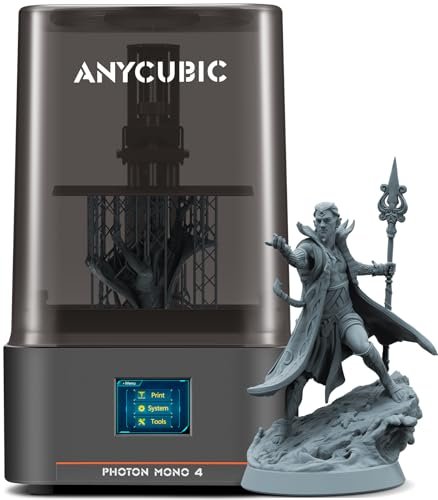
This variant of the ANYCUBIC Photon Mono 4 combines a 7-inch 10K HD monochrome screen with an optical system tuned for 1.5-second single layer exposures. That rapid cure time significantly shortens project durations while preserving sharp 9024×5120 clarity across tiny features. The re-engineered build plate uses custom laser-engraved crosshatching to ensure heavy models stay anchored during peel movements. Backed by solid factory calibration and a reliable one-year warranty that includes six months of screen protection, this machine offers dependable everyday productivity straight out of the box.
Key features that stand out:
– 7-inch 10K mono LCD screen offering 17×17μm XY pixel precision
– LighTurbo matrix light engine capable of 1.5-second layer exposure times
– Practical 153.4 x 87 x 165 mm build envelope for assorted hobby projects
– Redesigned laser-engraved build platform for balanced grip and easy model release
– Factory-assembled frame supporting instant resume printing after blackouts
– Generous warranty with dedicated 6-month LCD screen coverage
Pros:
– Fast single-layer curing speeds up your overall production runs
– Factory pre-tuning allows you to start printing right after unboxing
– High pixel density produces sharp edges without visible voxel stepping
Cons:
– Manual leveling screws still need an occasional check after you pry off broad prints.
Best for: Experienced hobbyists who want rapid turnarounds and high-definition details backed by strong warranty support.
Expert Opinion: Anycubic’s fast exposure tuning on this 10K platform strikes an exceptional balance between rapid throughput and crisp, clean surface finishes, making it a reliable workhorse for routine batch printing.
Quick Comparison Insights
- Screen Resolution: If microscopic surface clarity is your main goal, the ELEGOO Saturn 4 Ultra (16K) and both ANYCUBIC Photon Mono 4 models (10K) lead the pack, giving miniatures ultra-smooth curves without raster lines.
- Peel Speed: The ELEGOO Mars 5 Ultra and Saturn 4 Ultra utilize tilt-release technology to clock speeds up to 150 mm/h, leaving traditional vertical-lift printers far behind in turnaround time.
- Leveling Simplicity: If you hate manually leveling build plates with paper shims, the ELEGOO Mars 5 and Saturn 4 series feature hands-free automatic leveling, whereas the Anycubic Mono 4 uses a fast, but manual, 4-point screw system.
- Thermal Control: For makers working in unheated garages or basements, the ELEGOO Saturn 4 Ultra stands alone with its smart 30 °C vat heating system, preventing failed jobs caused by cold, sluggish photopolymer resins.
Final Verdict: Which Resin Printer Should You Choose?
The High-Detail Miniaturist: ANYCUBIC Photon Mono 4
Choose this model if your priority is painting 28mm to 75mm tabletop miniatures. Its 10K resolution and 17μm XY accuracy yield incredible edge definition on tiny armor seams, facial expressions, and weapon hilts without stretching your wallet.
The Fast-Paced Maker: ELEGOO Mars 5 Ultra
If you frequently print small prototypes or tabletop scatter terrain and hate waiting hours for results, this is your machine. The tilt-release feature and AI camera monitoring keep prints fast, clean, and well-supervised.
The Large-Scale Creator: ELEGOO Saturn 4 Ultra 16K
When you need to print large busts, statues, or full plates of functional parts in one pass, this printer is well worth the investment. The combination of a 10-inch 16K panel, auto-leveling, and active vat heating makes it a dependable studio centerpiece.
The First-Time Hobbyist: ELEGOO Mars 5
For newcomers who want a reliable introduction to photopolymer printing without calibration headaches, the standard Mars 5 is the sensible route. Its mechanical debris sensor and auto-leveling drastically lower the learning curve.
Frequently Asked Questions About 3D Resin Printer Sale Deals
How do I know if a 3d resin printer sale is offering a good value?
A good deal combines modern LCD resolution (at least 4K, though 9K to 16K is now standard) with reliable leveling mechanisms and readily available replacement parts like FEP or ACF release films. Check whether the discount includes extras, such as spare resin vats, wash containers, or bundled UV curing equipment, which are necessary accessories for any resin setup.
What is the difference between 4K, 10K, and 16K resin 3D printers?
These numbers indicate the pixel density of the monochrome LCD screen masking the UV light. A higher resolution spread across a similar screen size yields smaller XY pixels (measured in microns). For instance, a 10K 7-inch screen offers pixels around 17 to 18 microns, making layer lines nearly invisible compared to older 4K panels with 35-to-50-micron pixels.
Why is active vat heating important on resin printers?
Photopolymer resin flows best and cures reliably when kept between 25 °C and 30 °C (77 °F to 86 °F). In cooler rooms, resin becomes thick and viscous, leading to layer separation, poor bed adhesion, and failed supports. Built-in tank heaters keep the resin at a steady temperature, ensuring dependable prints throughout winter months.
Do I need a wash and cure station when buying a resin printer?
Yes, liquid resin prints come off the build plate coated in sticky, uncured resin. You need to wash them thoroughly in isopropyl alcohol (IPA) or an alternative solvent and then give them a secondary post-cure under 405nm UV light to reach their full structural strength. Dedicated wash and cure stations simplify this messy process considerably.
What is the tilt-release mechanism found on newer resin printers?
Instead of moving the build plate straight up to peel the cured layer off the bottom release film (FEP/PFA), a tilt-release system tilts the resin vat gently to separate the print from one side to the other. This peeling action reduces mechanical pulling forces on delicate model supports, cuts cycle times, and boosts print speeds up to 150 mm/h.
Can I run a resin 3D printer safely inside my home?
Resin printers emit volatile organic compounds (VOCs) and distinct odors during printing and washing. You should always run your machine in a well-ventilated space, such as a garage, workshop, or dedicated room equipped with an extraction fan or air purifier with activated carbon filters. Wear nitrile gloves and safety glasses whenever handling liquid resin.
How often do I need to replace the LCD screen on a resin printer?
Modern monochrome LCD screens are durable and generally rated for around 2,000 hours of active printing. Because monochrome displays transmit UV light much more efficiently than older RGB panels, single-layer cure times drop to 1.5 to 2.5 seconds, reducing heat wear and significantly extending screen life.
Affiliate Disclosure: As an Amazon Associate, I earn from qualifying purchases made through links on this site.