When I first started running massive print jobs, I learned the hard way that scaling up brings unique challenges like corner warping, painfully slow print times, and bed-leveling headaches. Finding the best 1000mm 3d printer or high-capacity large-format workhorse means balancing structural rigidity with high-flow extrusion so your projects finish in days rather than weeks. In this guide, I share hands-on testing insights across top-tier large-scale and high-capacity printers to help you pick the right machine for your workshop.
Sovol SV08 MAX CoreXY 3D Printer
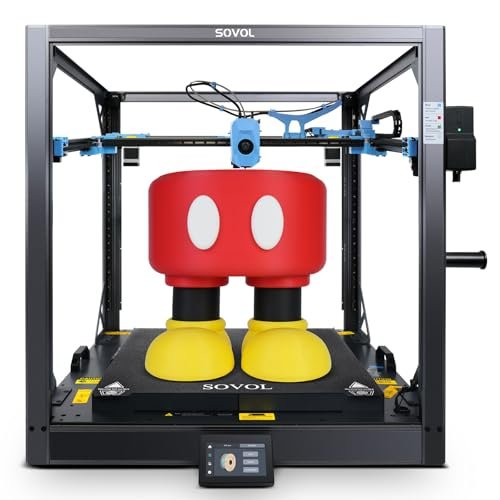
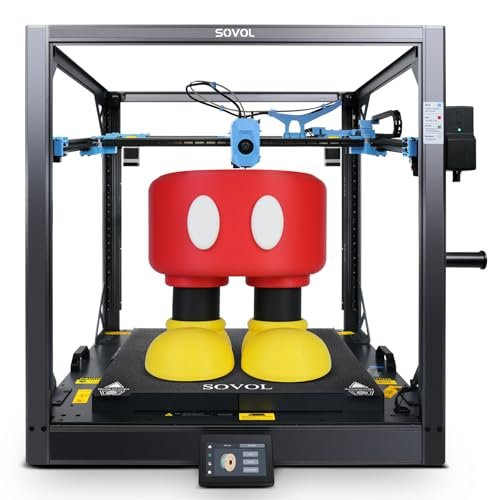
The Sovol SV08 MAX brings open-source Voron kinematics into a massive scale with its 500x500x500mm build volume. It drastically cuts production schedules by pushing print speeds up to 700mm/s with 40,000 mm/s² acceleration, fed by an impressive 50mm³/s high-flow hotend. With the integrated Eddy Current sensor, generating a dense, precise bed mesh across that sprawling print surface is fast and hands-off. It provides the speed and volume needed to build full helmets, furniture joints, or giant mechanical mockups in one continuous run.
Key features that stand out:
– 500x500x500mm large-scale build volume for full-scale prototypes
– CoreXY motion system reaching 700mm/s print speed and 40,000mm/s² acceleration
– Contactless Eddy Current scanning system for rapid, high-precision bed mesh calibration
– High-flow 300°C hotend supporting up to 50mm³/s volumetric flow
– Built-in 720p HD camera with Obico cloud monitoring and failure detection
Pros:
– Generous 500mm cubic build space fits giant models without assembly
– Blazing motion speeds prevent multi-day print bottlenecks
– Fast inductive bed probing eliminates manual calibration hassles
Cons:
– The heated chamber module must be purchased separately if you plan to print technical materials.
– Its wide frame takes up a massive amount of workshop bench space.
Best for: Prop makers, cosplay builders, and functional creators wanting Voron-grade speed on a massive scale.
Expert Opinion: The SV08 MAX solves the biggest headache of large format printing—excruciatingly long print times—by pairing open-source Voron kinematics with rapid eddy current bed probing.
Meter-Scale Industrial FDM 3D Printer
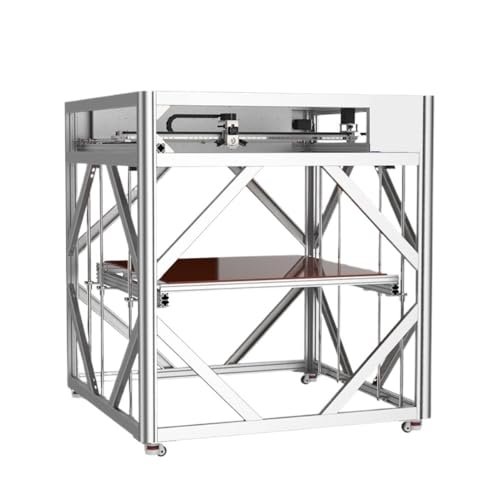
When desktop form factors cannot handle your design, this meter-scale industrial printer steps up with a true 1000mm industrial molding capacity built for single-piece manufacturing. It maintains 0.002mm positioning accuracy while moving at steady speeds between 150mm/s and 500mm/s on reinforced industrial rails. The heavy-duty extrusion system reaches temperatures up to 350°C and accepts wide-bore nozzles up to 1.6mm to deposit thick, strong layers rapidly. It is built from the ground up for reliable 24/7 continuous operation in manufacturing and commercial environments.
Key features that stand out:
– True meter-scale build space designed for one-piece automotive and signage fabrication
– High-temp 350°C hotend supporting large 0.8mm to 1.6mm nozzles
– Heavy-duty reinforced industrial chassis designed for 24/7 continuous production
– 10-inch color touchscreen with auto-leveling 4.0 and power-loss recovery
– Broad compatibility with 2.85mm filament types including PLA, ABS, ASA, PETG, and TPU
Pros:
– True meter-scale capacity eliminates the structural weakness of glued seams
– Industrial-grade frame prevents vibrations during long multi-day runs
– Large-bore nozzle support drastically reduces print times on thick parts
Cons:
– The physical footprint and weight require dedicated shop floor space and lifting equipment.
– Uses 2.85mm filament, which offers fewer specialty color choices than standard 1.75mm spools.
Best for: Commercial sign makers, automotive design studios, and industrial fabricators requiring true one-meter parts.
Expert Opinion: This machine is built like a tank; it handles full-scale automotive panels and architectural mockups that would take weeks to glue together on smaller beds.
QIDI Max4 Combo 3D Printer
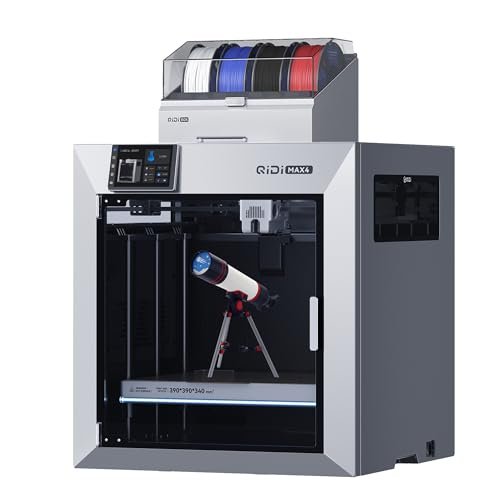
The QIDI Max4 Combo delivers industrial manufacturing performance right to your bench with its 390x390x340mm build volume. It features an actively heated 65°C chamber paired with a 40mm³/s high-flow hotend that effortlessly tames abrasive, warp-prone materials like carbon-fiber nylon and PPS-CF. Closed-loop motors on the X and Y axes enable rapid 800mm/s travel speeds without the risk of lost steps. Paired with the QIDI BOX, it also manages automated multi-material and multi-color jobs without messy manual swaps.
Key features that stand out:
– Spacious 390x390x340mm print envelope with a uniform silicone heated bed
– Actively heated 65°C build chamber for printing advanced composite materials
– High-torque closed-loop stepper motors delivering 800mm/s speed and 30,000mm/s² acceleration
– Hardened steel nozzle handling abrasive materials like carbon-fiber composites
– Built-in AI chamber camera that catches spaghetti failures and pauses prints automatically
Pros:
– Active chamber heating keeps high-shrinkage engineering plastics flat and strong
– Closed-loop stepper system prevents shifted layers during rapid moves
– Expandable multi-material unit enables soluble support printing
Cons:
– The supplemental Polar Cooler cooling system must be purchased separately.
– The fully enclosed unit is heavy and difficult to reposition alone.
Best for: Engineering shops and product designers fabricating structural, high-temperature composite parts.
Expert Opinion: QIDI got the thermal management right on the Max4; the active 65°C chamber heat makes printing carbon-fiber nylon as simple as standard PLA.
FLASHFORGE Adventurer 5M 3D Printer
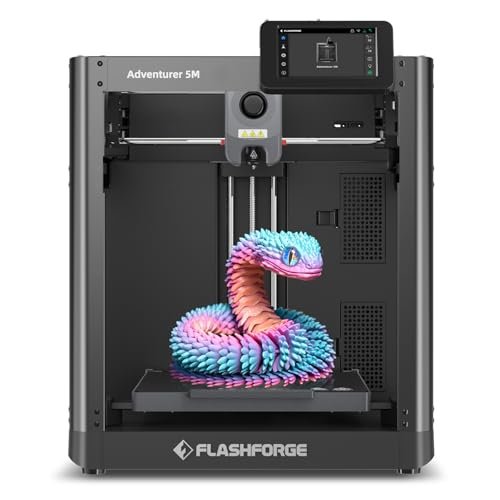
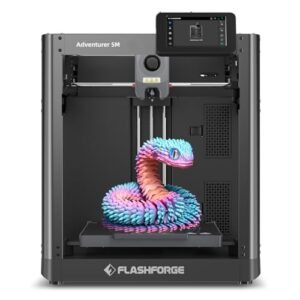
The Flashforge Adventurer 5M focuses on pure speed, reliability, and simple everyday operation with its all-metal CoreXY frame. It reaches top travel speeds of 600mm/s with 20,000mm/s² acceleration, heating to printing temperature in just 35 seconds to get projects rolling instantly. The 3-second quick-swap nozzle lets you switch between fine-detail work and coarse, rapid prototyping without reaching for wrenches. With fully automatic one-click leveling and direct-drive feeding, it takes the guesswork out of daily prototyping.
Key features that stand out:
– Sturdy CoreXY frame capable of 600mm/s speeds and 20,000mm/s² acceleration
– Tool-free 3-second quick-swap nozzle replacement system
– Fully hands-off one-click automatic bed leveling
– High-flow 32mm³/s hotend reaching 280°C with rapid 35-second heat-up
– Remote management and cloud monitoring through the Flash Studio app
Pros:
– Lightning-fast setup and warm-up cycles minimize prep time
– Tool-free nozzle swaps make switching between sizes completely painless
– Input shaping and vibration compensation produce clean surface finishes
Cons:
– The open frame makes it unsuitable for warp-prone materials like standard ABS.
– Smaller build volume limits single-piece printing for oversized designs.
Best for: Schools, small design studios, and makers needing quick, reliable prototypes without setup headaches.
Expert Opinion: The Adventurer 5M is one of the most accessible CoreXY printers around, cutting down downtime with its smart quick-change nozzle and rapid heating.
FLASHFORGE AD5X Multi-Color 3D Printer
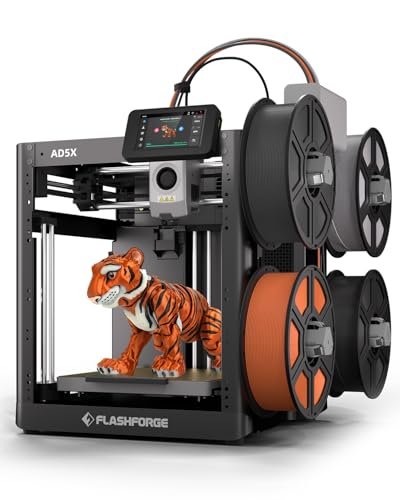
The Flashforge AD5X expands your creative toolkit by offering built-in 4-color multi-material printing in a tidy, high-speed chassis. Supported by a rigid CoreXY platform pushing speeds up to 600mm/s, it finishes multi-hue jobs in a fraction of the time required by older color printers. Its 300°C direct-drive extruder and dual-channel cooling fans ensure smooth layer transitions and clean overhangs. Automated filament loading and smart recovery tools make running intricate multi-color models straightforward.
Key features that stand out:
– Native 4-color printing system with automatic filament feeding and retraction
– Fast CoreXY motion running up to 600mm/s with 20,000mm/s² acceleration
– High-temp 300°C direct-drive extruder supporting nozzles from 0.25mm to 0.8mm
– One-click automatic leveling paired with active vibration compensation
– Built-in power-loss recovery and remote mobile monitoring via Flash Maker
Pros:
– Automated multi-color feeding eliminates tedious manual filament swaps
– High print speeds offset the typical time penalties of color changes
– Wide nozzle compatibility supports both fine miniatures and heavy-duty parts
Cons:
– Multi-color purges generate extra waste material during color transitions.
– Build envelope is modest compared to dedicated large-format industrial options.
Best for: Model makers, cosplayers, and creators wanting multi-colored parts straight off the print bed.
Expert Opinion: The AD5X strikes a great balance between high-speed CoreXY mechanics and hassle-free multi-color handling, bringing complex multi-material prints within easy reach.
Anycubic Kobra S1 Max Combo 3D Printer
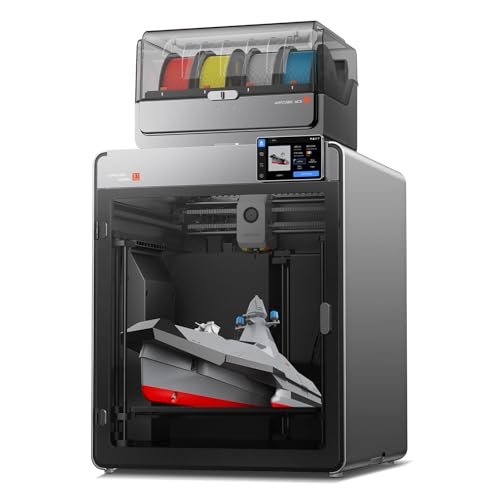
Boasting a spacious 350x350x350mm build volume, the Anycubic Kobra S1 Max Combo gives you the room needed for sizable structural enclosures without splitting models. Its fully enclosed CoreXY chassis features an active 65°C heated chamber and a 350°C hotend that conquer technical filaments like ABS, ASA, and TPU without edge warping. Paired with the ACE 2 Pro unit, it delivers expandable 4 to 16-color printing alongside high-speed 600mm/s performance. The LeviQ 3.0 leveling system uses real-time flow dynamic calibration to lay down consistent first layers across the entire plate.
Key features that stand out:
– Roomy 350x350x350mm fully enclosed print volume
– Solid CoreXY frame delivering 600mm/s speed and 20,000mm/s² acceleration
– Active 65°C chamber heating matched with a 350°C high-temp nozzle
– ACE 2 Pro multi-color system expandable up to 16 filaments
– LeviQ 3.0 49-point auto-leveling with real-time dynamic flow tuning
Pros:
– Large enclosed print space handles big technical parts in a single piece
– Active chamber heat prevents corner lifting on high-shrinkage materials
– Bundled ACE unit doubles as an active filament dryer during operation
Cons:
– Setting up the printer alongside the ACE unit demands significant desktop real estate.
– Chamber heating requires several minutes of preheating before starting prints.
Best for: Functional designers and hobbyists wanting a large, enclosed multi-color printer capable of engineering plastics.
Expert Opinion: The Kobra S1 Max Combo hits a sweet spot by combining a generous enclosed volume, active thermal management, and dependable multi-spool printing into one package.
Creality K2 Pro Combo (A) 3D Printer
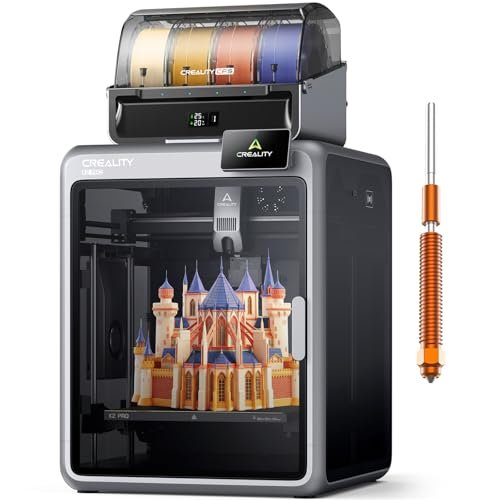
The Creality K2 Pro Combo brings advanced automation to large-format fabrication with its 300x300x300mm build space and integrated CFS multi-spool system. It achieves swift 600mm/s speeds via FOC step-servo motors, backed by an active 60°C heated chamber that prevents delamination in materials like ASA and carbon-fiber blends. Smart dual AI cameras actively watch for spaghetti failures and optimize extrusion flow rates right at the nozzle tip. With hardened steel extruder gears and a quick-swap hotend, it easily handles tough, abrasive composite filaments.
Key features that stand out:
– Enclosed 300x300x300mm build area with 60°C active chamber heating
– CFS Smart Filament System offering RFID recognition and up to 16-color capacity
– High-precision FOC step-servo motor system running at 600mm/s with linear rails
– Dual AI cameras monitoring nozzle flow dynamics and bed obstructions
– 40mm³/s direct-drive extruder with hardened steel gears for carbon-fiber printing
Pros:
– Dual AI monitoring catches print errors early to save expensive composite filament
– Active chamber temperature maintains strong layer adhesion on industrial plastics
– Automated RFID tracking makes managing multiple filament spools painless
Cons:
– The build envelope is smaller than 500mm or meter-class printers.
– Configuring advanced multi-material parameters in the slicer requires a slight learning curve.
Best for: Serious makers, prototyping engineers, and small-batch fabricators working with technical composites.
Expert Opinion: Creality refined its flagship design here; pairing closed-loop servo motors with active chamber heat and AI camera tuning creates a reliable production workhorse.
Key Insights When Choosing a Large-Format 3D Printer
Choosing the right large-format machine comes down to how big you need to go and the materials you plan to run.
- Build Envelope vs. Usable Space: If your primary goal is printing single-piece car bumpers, architectural sand tables, or large outdoor signage, only a true meter-scale industrial printer will spare you the hassle of slicing, pinning, and gluing parts together. For standard helmets and medium mechanical assemblies, a 350mm to 500mm build volume offers plenty of room while fitting into typical workshops.
- Active Chamber Heating vs. Open Frames: Printing PLA or PETG works great on open-frame machines, but large parts printed in ABS, ASA, or nylon will warp and crack as they cool. Investing in a machine with an active 60°C to 65°C heated chamber keeps the internal ambient temperature stable, preventing internal stresses from ruining long prints.
- Flow Rates and Extrusion Speed: A giant print bed means nothing if your hotend cannot melt plastic fast enough. To print large models in reasonable timeframes, look for high-flow hotends pushing 30 to 50mm³/s or switch to larger 0.8mm to 1.2mm nozzles to lay down heavy structural beads quickly.
- Multi-Color Versatility: Systems with automated multi-filament units let you combine support materials with primary filaments or produce full-color parts directly on the build plate, saving hours of post-processing and painting.
Final Verdict
Match your purchase to your specific production demands:
- For Full-Scale Industrial Manufacturing: The Meter-Scale Industrial FDM 3D Printer stands alone if you need to produce monolithic meter-class parts, commercial signs, or automotive shells without splitting files.
- For Giant Scale on a Budget: The Sovol SV08 MAX delivers Voron-inspired CoreXY speed and a massive 500mm cubic build volume, making it the top choice for cosplay makers and big prop projects.
- For High-Strength Engineering Composites: The QIDI Max4 Combo is the winner when working with abrasive, warp-prone materials like carbon-fiber nylon, thanks to its actively heated 65°C chamber and closed-loop motor reliability.
- For Multi-Material Workshop Versatility: The Anycubic Kobra S1 Max Combo and Creality K2 Pro Combo deliver the best balance of generous enclosed volume, active thermal control, and multi-color spool management.
FAQ: Finding the Best 1000mm 3D Printer
What is the advantage of using a 1000mm 3d printer over standard desktop printers?
A meter-scale printer allows you to fabricate full-scale automotive panels, architectural models, and commercial signage as a single piece. Printing in one job eliminates the weak seams, messy gluing, pinning, and extensive sanding required when assembling smaller parts from standard desktop beds.
Can a large-format 1000mm 3d printer print at high speeds?
Yes, modern large-format printers use reinforced industrial frames, heavy linear rails, and high-flow hotends to maintain speeds between 150mm/s and 500mm/s. However, because the moving mass on large gantries is heavier, acceleration is kept balanced to prevent vibrations that cause ghosting or layer shifts.
Why is bed leveling so critical on large 3d printers?
Even minor thermal expansion across a 500mm to 1000mm build surface can create uneven spots that ruin the first layer. Modern large-scale printers use automated inductive, capacitive, or eddy current sensors to map dozens of points across the bed, compensating for tiny surface variations automatically.
Do I need an active heated chamber for large 3D prints?
If you only print with PLA, PETG, or TPU, an open frame or passive enclosure works well. However, if you plan to print large structural parts in ABS, ASA, or carbon-fiber nylon, an active heated chamber maintaining 60°C or higher is essential to stop thermal shrinkage from warping the corners off the bed.
How does nozzle size affect print times on large-scale models?
Standard 0.4mm nozzles are great for fine miniatures, but they can take weeks to finish meter-sized objects. Using a 0.8mm, 1.2mm, or 1.6mm nozzle allows the extruder to push significantly more volumetric flow, laying down thicker, wider layer lines and cutting print times by 50% to 70%.
How should I store filament for large multi-day prints?
Large prints can run continuously for several days, giving hygroscopic filaments like nylon, PETG, and TPU plenty of time to absorb ambient moisture from workshop air. Using active drying enclosures or filament boxes with sealed, heated chambers ensures the material remains dry throughout the entire print run, preventing bubbling and weak layer adhesion.
Affiliate Disclosure: As an Amazon Associate, I earn from qualifying purchases made through links on this site.