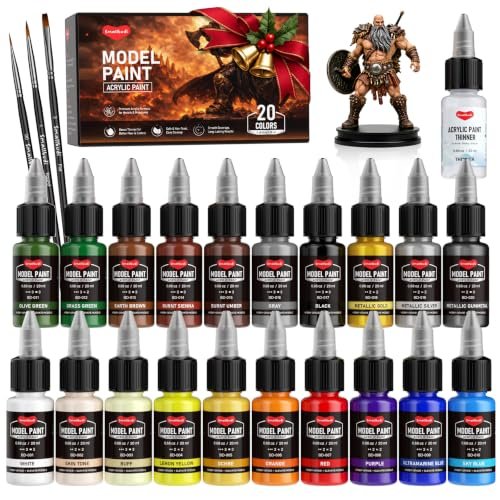
I’ve spent years sanding, priming, and detailing raw FDM figures on my workbench, and having the right tools makes all the difference. When discovering the best way to paint PLA 3D prints, using high-pigment acrylic model paints and proper preparation gear saves you from flaking paint and visible layer lines. In this guide, I share tested kits and tools that help you turn rough plastic prints into smooth, display-worthy models.
Smallbudi 20 Colors Model Paint Set
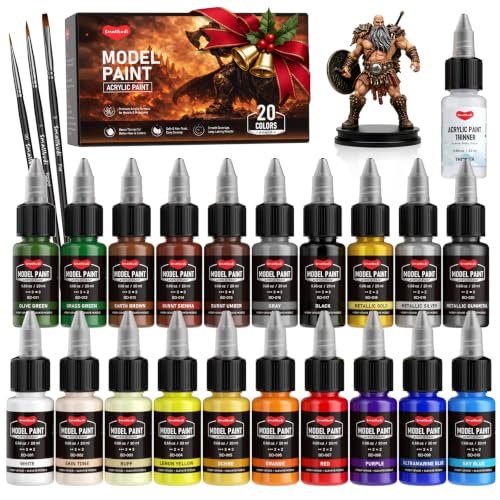
This starter kit offers an approachable entry point for anyone learning how to detail miniature figures and custom prints. The set features 20 rich pigment colors including base tones, skin shades, and metallics that provide solid opacity without hiding delicate surface geometry. Because the paints arrive pre-thinned for smooth brushwork, you can apply coats straight from the bottle or mix in the included acrylic thinner for glazing techniques. It’s a reliable, mess-free kit that eliminates guesswork thanks to its included reference color wheel and precision brushes.
Key features that stand out:
– Complete kit with 20 acrylic colors (20ml bottles), 3 fine detail brushes, and 1 acrylic thinner
– Professional high-adhesion formula designed specifically for plastic, PLA, resin, metal, and wood
– Dries to a refined, non-reflective matte finish while metallics maintain realistic sheen
– Includes an instructional guide and color wheel for easy shade mixing and color theory practice
Pros:
– Strong pigment opacity covers dark PLA filament in just a couple of thin coats
– Included thinner lets you adapt the paint for fine layering or airbrushing
– Handy color wheel helps beginners learn blending techniques quickly
Cons:
– Twenty colors can feel limiting if you work on large, multi-tone tabletop dioramas.
Best for: Beginners who want an affordable, ready-to-use acrylic kit for small PLA miniatures and gaming terrain.
Expert Opinion: This set is ideal if you are tackling your first batch of printed miniatures. The paint flows smoothly over primed PLA without pooling into crevices, and having thinner included right in the box saves you from buying separate blending mediums.
ELEGOO 3D Paint Kit
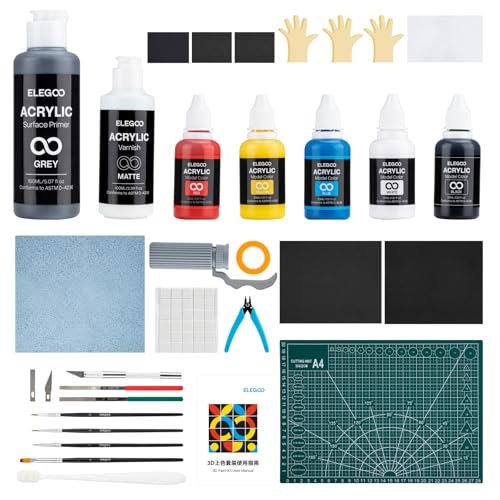
Designed directly with 3D printer enthusiasts in mind, this comprehensive package covers your workflow from surface prep to sealing. It includes five primary base colors paired with an intuitive blending guide that lets you mix virtually any shade you need for your model. The kit shines with its practical accessories, featuring a dedicated wet palette to keep paints workable for days and an ergonomic painting handle that holds small prints securely. Its low-odor, water-based formula makes it a safe, clean option for indoor hobby desks.
Key features that stand out:
– All-in-one bundle containing paints, finishing varnish, soft nylon brushes, and protective gear
– Included wet palette system prevents paint from drying out during extended painting sessions
– Ergonomic model-holding handle provides stable control on tiny parts and fingers
– Water-based, eco-friendly formula ensures minimal odor during indoor desk use
Pros:
– Complete toolset means you do not need to buy separate holders, palettes, or varnishes
– The wet palette keeps acrylics fresh across multiple days of painting
– Model handle prevents oily fingers from rubbing fresh paint off delicate prints
Cons:
– You must mix your own secondary and tertiary shades since it only supplies five base colors.
Best for: Makers seeking an all-in-one starter bundle that provides all the essential accessories for miniature painting.
Expert Opinion: ELEGOO understands the pain points of painting 3D prints. The included painting handle and wet palette are items hobbyists usually have to buy separately, making this an incredibly practical choice for anyone setting up a clean painting station at home.
Smallbudi 32 Colors Model Paint Set

Stepping up your color options makes detailing complex prints much faster, and this 32-bottle set strikes a sweet spot between variety and bench space. You get 28 standard matte shades and 4 metallics, giving you immediate access to natural wood tones, deep shadows, and armor finishes without constant mixing. The acrylic emulsion provides strong surface adhesion on plastic, allowing colors to grip primed PLA without scratching off during handling. With three bottles of thinner and three detail brushes included, it readily supports advanced blending and wash techniques.
Key features that stand out:
– 32 targeted colors (20ml bottles) featuring 28 standard hues and 4 specialized metallics
– High pigment load provides solid coverage over layer lines without muddying fine details
– Comes equipped with 3 precision detail brushes and 3 bottles of acrylic thinner
– Pre-thinned consistency works right out of the bottle for dry-brushing, base coating, or glazing
Pros:
– Generous color range minimizes mixing time during complex figure projects
– Multiple bottles of thinner ensure you have enough medium for wet blending and airbrush thinning
– Matte finish minimizes surface glare so layer lines stay disguised
Cons:
– The supplied detail brushes wear down quickly if you paint rough, unprimed layer lines.
Best for: Intermediate hobbyists painting fantasy figures, cosplay props, and scale models that require diverse natural tones.
Expert Opinion: Having 32 distinct tones ready to go keeps your creative momentum moving. The high pigment concentration lets you lay down smooth, opaque coats over primed PLA prints without building up bulky layers that swallow surface textures.
Smallbudi 44 Colors Model Paint Set
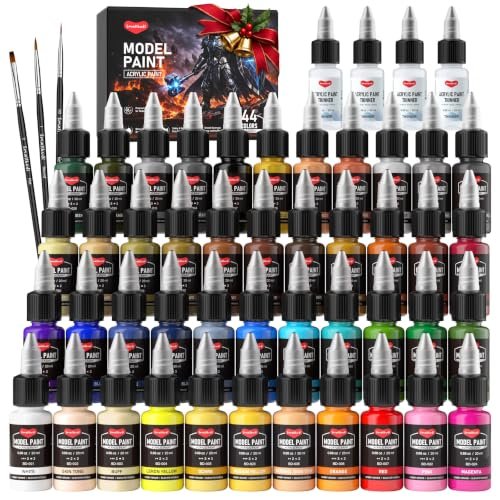
If you want an expansive palette that covers every conceivable shade from weathered stone to mechanical joints, this 44-piece set delivers. It packs 38 realistic standard shades and 6 reflective metallics, making it easy to detail complex mechanical prints, board game bosses, and large display pieces. The paint formula features excellent leveling properties, drying down to a smooth matte coat that visually softens micro-layer lines. Backed by four bottles of thinner and fine-tip brushes, it supports everything from heavy base coats to micro-edge highlighting.
Key features that stand out:
– Comprehensive palette of 44 colors (20ml bottles) with dedicated greyscale, earth, and metallic tones
– 6 formulated metallic shades engineered specifically for mechanical parts, armor, and weapon details
– Bundled with 4 bottles of acrylic thinner and 3 detail paint brushes
– High opacity formula designed to lay flat on plastic, resin, and FDM surfaces
Pros:
– Massive color selection eliminates downtime spent trying to color-match intermediate tones
– Four bottles of thinner give you ample supply for airbrush conversion
– High opacity covers grey, black, or white PLA primer evenly
Cons:
– Organizing and storing 44 individual paint bottles takes up significant workspace.
Best for: Dedicated modelers and commission painters who need an extensive palette for diverse, multi-part 3D prints.
Expert Opinion: For extensive hobby projects, this 44-color set is a massive time-saver. The specialty metallic shades and varied earth tones adhere firmly to primed PLA, delivering professional coverage that prevents underlying print artifacts from showing through.
MYNT3D Professional Printing 3D Pen with OLED Display
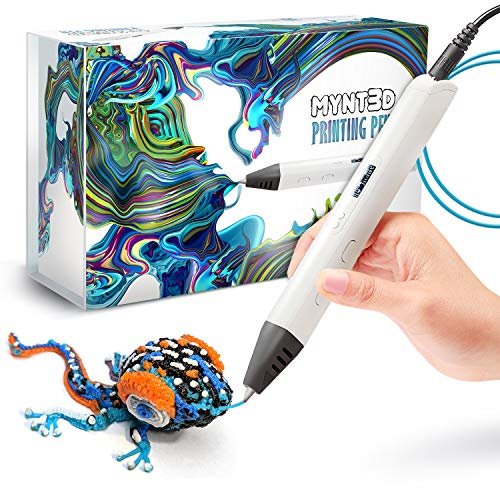
While paints add color, surface preparation dictates your final paint quality, and this professional 3D pen serves as an exceptional post-processing tool. It features precise single-degree temperature control ranging from 140 to 230 °C, letting you weld multi-part PLA prints, fill stubborn seam gaps, and repair print flaws using matching filament. The adjustable speed slider gives you exact control over material flow, allowing you to deposit tiny beads of molten plastic into layer gaps before sanding and painting. It is an indispensable workshop companion for smoothing rough joints before your brushes ever touch the model.
Key features that stand out:
– Stepless speed adjustment lets you dial in the exact extrusion rate for delicate gap filling
– Micro-adjustable temperature control (140–230 °C) displayed on a crisp OLED screen
– Ergonomic, lightweight body designed for comfortable, fatigue-free detailing work
– Compatible with standard 1.75mm PLA and ABS filaments for easy material matching
Pros:
– Fills deep seams and print holes using actual PLA plastic instead of shrinking putties
– Precise temperature control prevents scorching or overheating delicate thin-walled prints
– Lets you fuse multi-part prints into a single, structurally sound object prior to priming
Cons:
– Requires careful hands-on practice to avoid extruding excess plastic onto fine surface details.
Best for: Makers who want to fix seams, weld multi-piece prints, and fill surface gaps before applying primer and paint.
Expert Opinion: Do not underestimate the value of a quality 3D pen in your finishing workflow. Using the MYNT3D pen to fuse seams and fill deep layer gaps with native PLA plastic creates a durable bond that sands flush, giving you a cleaner surface for your base coats.
Helpful Comparison Insights
Choosing between these options depends on where you are in your painting journey and what tools currently sit on your workbench:
- For painters wanting curated accessories over raw color count: The ELEGOO 3D Paint Kit is the most complete workflow package. While it provides fewer stock paints, the inclusion of a wet palette, painting handle, and clear varnish saves you money on auxiliary gear that every miniature painter eventually needs.
- For hobbyists who hate color mixing: The Smallbudi 32 and 44 Color Sets offer immediate convenience. Having access to dedicated flesh tones, armor metallics, and weathering shades lets you paint straight from the bottle with consistent shade repeatability across multiple print batches.
- For compact workspaces and tight budgets: The Smallbudi 20 Color Set gives you all the core pigments required to learn basic model painting techniques without cluttering your desk.
- For seamless surface prep: The MYNT3D Professional Pen solves structural print problems. Paint highlights surface defects rather than hiding them, and using a 3D pen to plastic-weld seams and fill voids ensures a smooth canvas for your brushes.
Final Verdict
- Top All-Around Painting Setup: ELEGOO 3D Paint Kit takes the lead for beginners and intermediate makers alike because of its practical tools. The wet palette and model grip handle directly improve your control, leading to cleaner brush strokes and smoother results.
- Best Paint Variety for Serious Miniatures: Smallbudi 32 Colors Model Paint Set hits the ideal balance between color diversity and practicality. You get plenty of pre-mixed shades and metallics along with ample thinner for glazing.
- Best Preparation and Repair Tool: MYNT3D Professional 3D Pen stands out as a unique, powerful addition to any print finishing kit, giving you the ability to weld joints and fix print blemishes before you prime.
FAQs About the Best Way to Paint PLA 3D Prints
Do I need to sand PLA prints before painting?
Yes, light sanding is one of the best ways to prepare PLA prints for paint. Start with 200-grit sandpaper to knock down obvious layer lines, then move to 400-grit and 600-grit wet sandpaper for a smooth finish. Wet sanding keeps friction heat down, which prevents the PLA plastic from softening or gumming up your abrasive paper.
What is the best primer for PLA 3D prints?
An acrylic spray primer or automotive filler primer works best on PLA. Filler primer fills microscopic stair-stepping lines between print layers, while standard hobby acrylic primer creates a micro-textured surface that helps water-based paints adhere securely without beading up or chipping.
Can you paint directly onto PLA without primer?
You shouldn’t paint raw PLA directly with water-based acrylics. PLA has a smooth, non-porous surface that causes unprimed paint to pool, peel, or scratch off with minimal handling. Applying a light, even coat of primer gives the paint pigments something to grip onto.
How do you prevent brush marks when painting PLA?
The secret to avoiding visible brush marks is thinning your paints and applying multiple thin coats rather than one thick layer. Acrylic thinner or a drop of clean water reduces paint viscosity, allowing surface tension to self-level the paint across the print before it dries.
What paint is best for PLA models?
High-pigment miniature acrylic paint is the standard choice for PLA models. Acrylics dry quickly, clean up with water, emit virtually no toxic fumes, and dry to a matte finish that conceals layer lines. Enamels and oil washes can be used for weathering, but only after an acrylic base coat seals the print.
How do I seal and protect painted 3D prints?
Apply a clear acrylic varnish once your final paint layer has cured for 24 hours. Matte varnish protects tabletop gaming miniatures from sweat and skin oils while knocking down plastic shine. If you want metallic armor or glass visors to pop, paint localized gloss varnish over those specific areas.
How can I fill deep layer lines and seams before painting?
For deep gaps or multi-part joins, use a 3D pen loaded with matching PLA filament to weld the seams together, or apply model putty/gap filler. Once cured, sand the repair flush with the surrounding print, wipe away dust, and apply your primer coat.
Affiliate Disclosure: As an Amazon Associate, I earn from qualifying purchases made through links on this site.